



 Chat with AI
Exam 12: Muscles

Exam 1: Introduction to Physiology69 Questions
Exam 2: Molecular Interactions149 Questions
Exam 3: Compartmentation: Cells and Tissues160 Questions
Exam 4: Energy and Cellular Metabolism147 Questions
Exam 5: Membrane Dynamics144 Questions
Exam 6: Communication, Integration, and Homeostasis82 Questions
Exam 7: Introduction to the Endocrine System76 Questions
Exam 8: Neurons: Cellular and Network Properties229 Questions
Exam 9: The Central Nervous System107 Questions
Exam 10: Sensory Physiology175 Questions
Exam 11: Efferent Division: Autonomic and Somatic Motor Control78 Questions
Exam 12: Muscles106 Questions
Exam 13: Integrative Physiology I: Control of Body Movement76 Questions
Exam 14: Cardiovascular Physiology191 Questions
Exam 15: Blood Flow and the Control of Blood Pressure125 Questions
Exam 16: Blood114 Questions
Exam 17: Mechanics of Breathing118 Questions
Exam 18: Gas Exchange and Transport87 Questions
Exam 19: The Kidneys76 Questions
Exam 20: Integrative Physiology II: Fluid and Electrolyte Balance83 Questions
Exam 21: The Digestive System140 Questions
Exam 22: Metabolism and Energy Balance133 Questions
Exam 23: Endocrine Control of Growth and Metabolism100 Questions
Exam 24: The Immune System120 Questions
Exam 25: Integrative Physiology III: Exercise62 Questions
Exam 26: Reproduction and Development124 Questions
Select questions type


In smooth muscle cells, Ca²⁺ binds to ________ which activates the enzyme ________ to phosphorylate myosin and increase force.
(Short Answer)
4.9/5  (83)
(83) Sketch and label a relaxed sarcomere, then draw the same sarcomere in a contracted state.The myofilaments may be represented as simple lines.
(Short Answer)
4.7/5 (83)
(83) Define and explain the difference between isotonic, isometric and eccentric contractions and give an example of a specific movement for each.What is the role of series elastic elements in muscle contraction?
(Essay)
4.9/5 (90)
(90) A change in smooth muscle cell tension in the absence of a change in electrical potential of the cells is described as a(n)
(Multiple Choice)
5.0/5 (74)
(74) Which of the following is NOT a property of single-unit smooth muscles?
(Multiple Choice)
4.8/5 (72)
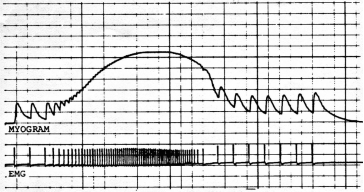
(72) The graph below was generated by students in a physiology lab.The top trace (myogram)shows contraction force, the bottom (EMG)shows the electrical stimulus.On the graph, label a muscle twitch.What property of muscle is being tested here? What caused the increase in force (and subsequent decrease)?
(Essay)
4.8/5 (81)
(81) As a muscle cell undergoes an eccentric contraction, sarcomere length will ________ as the length of the A band ________.
(Short Answer)
4.9/5 (68)
(68) When a skeletal muscle cell contracts and the muscle shortens,
(Multiple Choice)
4.9/5 (87)
(87) The heavy chain of myosin contains two important regions: the first acts as ________ to convert energy into movement whereas the second binds to ________.
(Short Answer)
5.0/5 (72)
(72) The binding of acetylcholine to its receptor at the neuromuscular junction causes the opening of a
(Multiple Choice)
4.9/5 (84)
(84) After death, when metabolism stops, in which step of the contractile cycle must skeletal muscles remain?
(Multiple Choice)
4.9/5 (91)
(91) Sketch a graph of the length-tension relationship in a contracting skeletal muscle, and explain its shape in terms of events in the sarcomere.
(Essay)
4.7/5 (80)
(80) Define and explain the differences between slow wave potentials and pacemaker potentials in smooth muscle cells.
(Essay)
4.8/5 (89)
(89) In comparison to skeletal muscle, smooth muscle cells function over a ________ range of muscle lengths and exhibit a speed of contraction that is ________ than skeletal muscle.
(Short Answer)
4.8/5 (85)
(85) Match the structures with the accurate description.
-a bundle of adjacent muscle cells
(Multiple Choice)
4.9/5 (82)
(82) Outline and explain the cellular event that affects the force generated by smooth muscle cells.What are the initiating events, and how do these events affect force production by the smooth muscle cell? How can this process be activated without changes in membrane potential?
(Essay)
4.8/5 (90)
(90) Asynchronous activation of motor units is important because it functions to ________.
(Short Answer)
4.8/5 (77)
(77) Which of the following is a characteristic of slow-twitch oxidative skeletal muscle fibers?
(Multiple Choice)
4.8/5 (77)
(77) 
Filters
- Essay(0)
- Multiple Choice(0)
- Short Answer(0)
- True False(0)
- Matching(0)