



 Chat with AI
Exam 2: Knowing the Heavens

Exam 1: Astronomy and the Universe78 Questions
Exam 2: Knowing the Heavens99 Questions
Exam 3: Eclipses and the Motion of the Moon67 Questions
Exam 4: Gravitation and the Waltz of the Planets105 Questions
Exam 5: The Nature of Light91 Questions
Exam 6: Optics and Telescopes97 Questions
Exam 7: Comparative Planetology I: Our Solar System63 Questions
Exam 8: Comparative Planetology II: the Origin of Our Solar System53 Questions
Exam 9: The Living Earth78 Questions
Exam 10: Our Barren Moon101 Questions
Exam 11: Mercury, Venus, and Mars: Terrestrial, yet Unique99 Questions
Exam 12: Jupiter and Saturn: Lords of the Planets97 Questions
Exam 13: Jupiter and Saturns Satellites of Fire and Ice110 Questions
Exam 14: Uranus, Neptune, Pluto, and the Kuiper Belt: Remote Worlds105 Questions
Exam 15: Asteroids, Comets, and Impacts80 Questions
Exam 16: Our Star, the Sun68 Questions
Exam 17: The Nature of the Stars113 Questions
Exam 18: The Birth of Stars97 Questions
Exam 19: Stellar Evolution: on and After the Main Sequence64 Questions
Exam 20: Stellar Evolution: The Death of Stars78 Questions
Exam 21: Stellar Remnants: Neutron Stars and Black Holes107 Questions
Exam 22: Our Galaxy48 Questions
Exam 23: Galaxies85 Questions
Exam 24: Quasars and Active Galaxies73 Questions
Exam 25: Cosmology: The Origin and Evolution of the Universe68 Questions
Exam 26: Exploring the Early Universe72 Questions
Exam 27: The Search for Extraterrestrial Life26 Questions
Select questions type


Where must you stand on Earth to have the celestial equator pass through your zenith?
(Multiple Choice)
4.8/5  (67)
(67) Suppose Earth's rotation axis were straight up and down with respect to the plane of the ecliptic and not tilted. Each of the following statements would be true except one. Which one would not be true?
(Multiple Choice)
4.7/5 (83)
(83) If you view the sky from 20° north of the equator, the north circumpolar stars (which do not rise and set) would be:
(Multiple Choice)
4.7/5 (70)
(70) If a person on the equator sees a particular star cross the horizon at 10 P.M. (2200 hours) on a particular night, what time would the same person (at the same location) see that star cross the horizon on the next night?
(Multiple Choice)
4.8/5 (78)
(78) Over what range of declination will stars be circumpolar (i.e., be visible at any time of the night on any night of the year) for an observer at the South Pole?
(Multiple Choice)
4.7/5 (66)
(66) If the daytime sky were not bright, in which direction would we see the Sun move along the ecliptic over the course of 1 year, relative to the background stars?
(Multiple Choice)
5.0/5 (92)
(92) At what approximate value of right ascension was the Sun this year on June 21?
(Multiple Choice)
4.9/5 (69)
(69) At what approximate value of right ascension was the Sun this year on March 21?
(Multiple Choice)
4.8/5 (74)
(74) Time, as indicated by an uncorrected sundial, can differ from true time by as much as 15 minutes at certain times of the year. This is because:
(Multiple Choice)
4.8/5 (60)
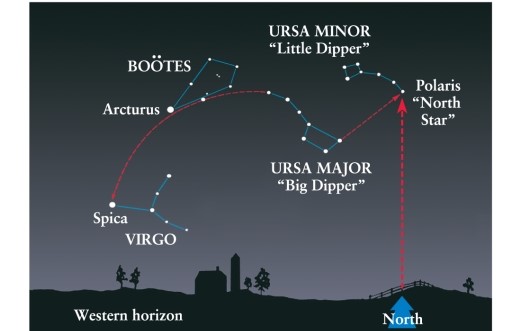
(60) If the stars Polaris and Arcturus (as shown in Figure 2-6 of Universe, 11th ed.), are known to be 71° apart, how far away from Polaris is the closest star in Ursa Major?
(Multiple Choice)
4.9/5 (83)
(83) At which time of the year will your shadow in sunlight at midday be shortest?
(Multiple Choice)
5.0/5 (75)
(75) You view the night sky for a period of 1 hour. What changes during this hour?
(Multiple Choice)
4.8/5 (81)
(81) A given star in the sky will reach its highest point for a particular observer when it passes through the:
(Multiple Choice)
4.8/5 (81)
(81) Do the astronomical coordinates of right ascension and declination of a star change systematically night by night?
(Multiple Choice)
4.8/5 (84)
(84) People in which one of the following cities experience sunrise first?
(Multiple Choice)
5.0/5 (86)
(86) 
Filters
- Essay(0)
- Multiple Choice(0)
- Short Answer(0)
- True False(0)
- Matching(0)