



 Chat with AI
Exam 4: Gravitation and the Waltz of the Planets

Exam 1: Astronomy and the Universe78 Questions
Exam 2: Knowing the Heavens99 Questions
Exam 3: Eclipses and the Motion of the Moon67 Questions
Exam 4: Gravitation and the Waltz of the Planets105 Questions
Exam 5: The Nature of Light91 Questions
Exam 6: Optics and Telescopes97 Questions
Exam 7: Comparative Planetology I: Our Solar System63 Questions
Exam 8: Comparative Planetology II: the Origin of Our Solar System53 Questions
Exam 9: The Living Earth78 Questions
Exam 10: Our Barren Moon101 Questions
Exam 11: Mercury, Venus, and Mars: Terrestrial, yet Unique99 Questions
Exam 12: Jupiter and Saturn: Lords of the Planets97 Questions
Exam 13: Jupiter and Saturns Satellites of Fire and Ice110 Questions
Exam 14: Uranus, Neptune, Pluto, and the Kuiper Belt: Remote Worlds105 Questions
Exam 15: Asteroids, Comets, and Impacts80 Questions
Exam 16: Our Star, the Sun68 Questions
Exam 17: The Nature of the Stars113 Questions
Exam 18: The Birth of Stars97 Questions
Exam 19: Stellar Evolution: on and After the Main Sequence64 Questions
Exam 20: Stellar Evolution: The Death of Stars78 Questions
Exam 21: Stellar Remnants: Neutron Stars and Black Holes107 Questions
Exam 22: Our Galaxy48 Questions
Exam 23: Galaxies85 Questions
Exam 24: Quasars and Active Galaxies73 Questions
Exam 25: Cosmology: The Origin and Evolution of the Universe68 Questions
Exam 26: Exploring the Early Universe72 Questions
Exam 27: The Search for Extraterrestrial Life26 Questions
Select questions type


The period in Kepler's third law, P2 = a3, is measured in:

Free
(Multiple Choice)
4.7/5  (102)
(102) Correct Answer: Verified
B
Tycho Brahe's most important contribution to the development of modern astronomy was the:
Free
(Multiple Choice)
4.7/5 (83)
(83) Correct Answer:Verified
VerifiedD
Acceleration of a body is the rate of change with time of its:
Free
(Multiple Choice)
4.8/5 (76)
(76) Correct Answer:Verified
VerifiedD
Imagine a cannonball shot straight upward. At its highest point it stops, momentarily, before falling back to earth. At this highest point, what forms of energy does it possess?
(Multiple Choice)
4.9/5 (66)
(66) Which one of the following statements about the observation of retrograde motion is correct? Retrograde motion can be observed on:
(Multiple Choice)
4.9/5 (62)
(62) If an object is launched radially away from a planet, it will continue to follow a straight path. If it is not launched radially, however, its path will be a curve. If the launch speed is less than the escape speed, (assuming it reaches an orbit) this curve will be (an):
(Multiple Choice)
4.9/5 (76)
(76) Consider a satellite in a circular orbit. Suppose it loses some energy to friction in the thin upper atmosphere. What will be its subsequent orbit? (See Figure 4-22, Universe, 11th ed.)
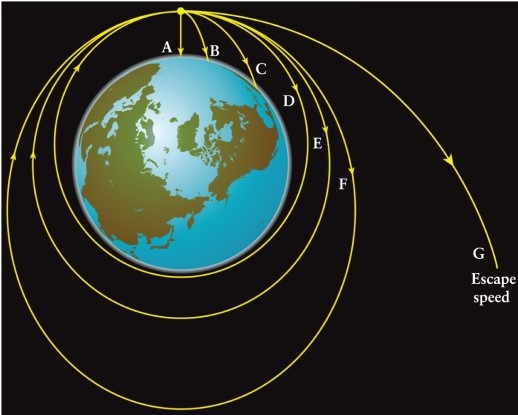
(Multiple Choice)
4.8/5 (75)
(75) Newton, in his second law of motion, stated that any body of mass m acted on by a force F:
(Multiple Choice)
5.0/5 (71)
(71) An asteroid in the asteroid belt orbits the Sun at a distance of 2.8 au. Using Kepler's laws and the relation between an object's sidereal period and synodic period, determine the synodic period of this asteroid when observed from Earth.
(Multiple Choice)
4.9/5 (87)
(87) Earth moves eastward in its orbit around the Sun, and so does Mars. Suppose Mars moved westward rather than eastward. What result would this have on the retrograde motion of Mars as observed from Earth? (You might need to make a drawing similar to Figure 4-5 of Universe, 11th ed. to answer this question.)

(Multiple Choice)
4.9/5 (81)
(81) What is the synodic period of Neptune? (See Table of Orbital Data in Appendix 1, Universe, 11th ed.)

(Multiple Choice)
4.7/5 (87)
(87) One of the important innovations in the work of Tycho Brahe was:
(Multiple Choice)
4.8/5 (88)
(88) Greek philosophy after about 600 B.C.E., beginning with the Pythagoreans and others, was quite different from the philosophies (Babylonian, Egyptian, etc.) that preceded it. What was this important difference?
(Multiple Choice)
4.8/5 (77)
(77) Two asteroids are separated by a distance R and feel a force F due to their mutual gravitational attraction. They now drift until their separation is R/3. What is their mutual gravitational attraction at this separation?
(Multiple Choice)
4.8/5 (86)
(86) Galileo Galilei died in the same year that saw the birth of:
(Multiple Choice)
4.8/5 (82)
(82) If a particular asteroid with a circular orbit is seen at opposition every 1.44 years, then its sidereal period is:
(Multiple Choice)
4.9/5 (82)
(82) If we could observe a planet in orbit around the Sun but very far away, as its distance approached infinity, its sidereal period would approach:
(Multiple Choice)
4.8/5 (82)
(82) Which of the following planets shows the smallest maximum western elongation when viewed from Earth?
(Multiple Choice)
5.0/5 (90)
(90) 
Filters
- Essay(0)
- Multiple Choice(0)
- Short Answer(0)
- True False(0)
- Matching(0)