



 Chat with AI
Exam 4: Gravitation and the Waltz of the Planets

Exam 1: Astronomy and the Universe78 Questions
Exam 2: Knowing the Heavens99 Questions
Exam 3: Eclipses and the Motion of the Moon67 Questions
Exam 4: Gravitation and the Waltz of the Planets105 Questions
Exam 5: The Nature of Light91 Questions
Exam 6: Optics and Telescopes97 Questions
Exam 7: Comparative Planetology I: Our Solar System63 Questions
Exam 8: Comparative Planetology II: the Origin of Our Solar System53 Questions
Exam 9: The Living Earth78 Questions
Exam 10: Our Barren Moon101 Questions
Exam 11: Mercury, Venus, and Mars: Terrestrial, yet Unique99 Questions
Exam 12: Jupiter and Saturn: Lords of the Planets97 Questions
Exam 13: Jupiter and Saturns Satellites of Fire and Ice110 Questions
Exam 14: Uranus, Neptune, Pluto, and the Kuiper Belt: Remote Worlds105 Questions
Exam 15: Asteroids, Comets, and Impacts80 Questions
Exam 16: Our Star, the Sun68 Questions
Exam 17: The Nature of the Stars113 Questions
Exam 18: The Birth of Stars97 Questions
Exam 19: Stellar Evolution: on and After the Main Sequence64 Questions
Exam 20: Stellar Evolution: The Death of Stars78 Questions
Exam 21: Stellar Remnants: Neutron Stars and Black Holes107 Questions
Exam 22: Our Galaxy48 Questions
Exam 23: Galaxies85 Questions
Exam 24: Quasars and Active Galaxies73 Questions
Exam 25: Cosmology: The Origin and Evolution of the Universe68 Questions
Exam 26: Exploring the Early Universe72 Questions
Exam 27: The Search for Extraterrestrial Life26 Questions
Select questions type


Newton's law of universal gravitation is so named because it:
(Multiple Choice)
4.8/5  (72)
(72) Imagine a 10-kg rock speeding through empty space at 200 m/s, so far away from other objects that there is no gravitational force (or any other outside forces) exerted on the rock. What is the rock's subsequent motion?
(Multiple Choice)
4.9/5 (89)
(89) At which configuration is a planet whose angle of elongation is 0°?
(Multiple Choice)
4.8/5 (76)
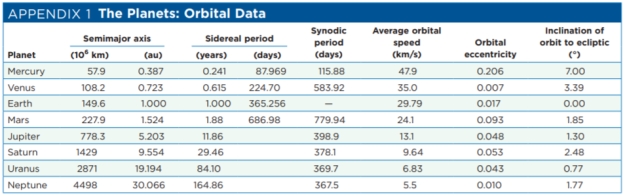
(76) Approximately how many of its sidereal periods has Neptune completed since its discovery in 1846? (See Table of Orbital Data in Appendix 1, Universe, 11th ed.)
(Multiple Choice)
4.9/5 (73)
(73) A certain object at rest on the surface of Earth has a weight of 49 newtons. Its mass is, therefore:
(Multiple Choice)
4.8/5 (78)
(78) The planet whose discovery was initially made by using measured deviations of other planets from regular orbits and the application of Newton's laws of mechanics to predict its existence was:
(Multiple Choice)
4.8/5 (84)
(84) What will be the synodic period of a (hypothetical) planet that orbits the Sun at exactly the same distance as does Earth?
(Multiple Choice)
4.9/5 (88)
(88) The eccentricity of Venus's orbit is e = 0.007, while the eccentricity of Mars's orbit is e = 0.093. Thus, the:
(Multiple Choice)
4.9/5 (73)
(73) Which of the following planets passes between Earth and the Sun?
(Multiple Choice)
4.8/5 (84)
(84) How many times is Mars at inferior conjunction during one orbit around the Sun?
(Multiple Choice)
4.8/5 (81)
(81) The geocentric model for the solar system became unsatisfactory to astronomers compared with the heliocentric model early in the sixteenth century. Each of the following is part of the explanation for this except one. Which is the exception?
(Multiple Choice)
4.8/5 (78)
(78) The astronomer who used parallax to show that the supernova of 1572 occurred at a large distance from Earth was:
(Multiple Choice)
4.9/5 (78)
(78) Why do you think the planets were chosen as key indicators of a person's destiny by early astrologers?
(Multiple Choice)
4.8/5 (85)
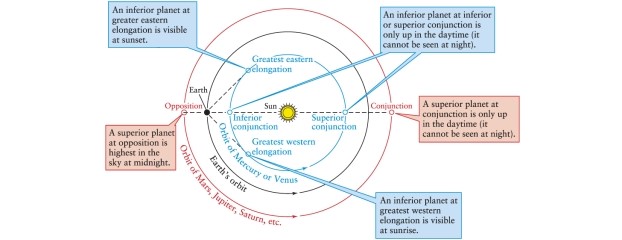
(85) When observed at greatest eastern elongation (see Figure 4-6 of Universe, 11th ed.), Venus is about 45° from the Sun. How long after sunset does Venus set on the western horizon?
(Multiple Choice)
4.8/5 (78)
(78) 
Filters
- Essay(0)
- Multiple Choice(0)
- Short Answer(0)
- True False(0)
- Matching(0)