



 Chat with AI
Exam 25: Cosmology: The Origin and Evolution of the Universe

Exam 1: Astronomy and the Universe78 Questions
Exam 2: Knowing the Heavens99 Questions
Exam 3: Eclipses and the Motion of the Moon67 Questions
Exam 4: Gravitation and the Waltz of the Planets105 Questions
Exam 5: The Nature of Light91 Questions
Exam 6: Optics and Telescopes97 Questions
Exam 7: Comparative Planetology I: Our Solar System63 Questions
Exam 8: Comparative Planetology II: the Origin of Our Solar System53 Questions
Exam 9: The Living Earth78 Questions
Exam 10: Our Barren Moon101 Questions
Exam 11: Mercury, Venus, and Mars: Terrestrial, yet Unique99 Questions
Exam 12: Jupiter and Saturn: Lords of the Planets97 Questions
Exam 13: Jupiter and Saturns Satellites of Fire and Ice110 Questions
Exam 14: Uranus, Neptune, Pluto, and the Kuiper Belt: Remote Worlds105 Questions
Exam 15: Asteroids, Comets, and Impacts80 Questions
Exam 16: Our Star, the Sun68 Questions
Exam 17: The Nature of the Stars113 Questions
Exam 18: The Birth of Stars97 Questions
Exam 19: Stellar Evolution: on and After the Main Sequence64 Questions
Exam 20: Stellar Evolution: The Death of Stars78 Questions
Exam 21: Stellar Remnants: Neutron Stars and Black Holes107 Questions
Exam 22: Our Galaxy48 Questions
Exam 23: Galaxies85 Questions
Exam 24: Quasars and Active Galaxies73 Questions
Exam 25: Cosmology: The Origin and Evolution of the Universe68 Questions
Exam 26: Exploring the Early Universe72 Questions
Exam 27: The Search for Extraterrestrial Life26 Questions
Select questions type


Measurement of structure in the cosmic microwave background radiation has recently indicated that we live in a flat universe between a closed and an open universe, and yet the measured density of detected matter and radiation is only 20% to 40% of the critical density required for a flat universe. In what form is the other 60% to 80% of the "matter" likely to be?

Free
(Multiple Choice)
4.8/5  (86)
(86) Correct Answer: Verified
D
What value for the Hubble constant is obtained from the observations of the ESA Planck satellite?
Free
(Multiple Choice)
4.8/5 (90)
(90) Correct Answer:Verified
VerifiedB
If the Hubble constant is found to be 25 km/s/Mly, what would then be an upper estimate for the age of the universe?
Free
(Multiple Choice)
4.8/5 (70)
(70) Correct Answer:Verified
VerifiedB
When the universe was about 24,000 years old, the radiation density had decreased to the point where it was equal to the matter density, yet it was only many years later that atoms formed. What happened to make possible the formation of atoms?
(Multiple Choice)
4.7/5 (94)
(94) Within which time frame from the initial Big Bang is it felt that the present laws of physics completely fail us, because time and space as we know them did not exist?
(Multiple Choice)
4.8/5 (60)
(60) The future of our universe-continuous expansion or eventual contraction-can be determined by observing the rate at which cosmological expansion is changing because of gravitational attraction between masses in the universe. How would this effect of deceleration be measured in terms of the Hubble relationship between speed of recession (graphed vertically) and distance (graphed horizontally)?
(Multiple Choice)
5.0/5 (88)
(88) When we view a quasar with a redshift z, this means the wavelengths of light emitted from the quasar have been shifted by z = Δλ \ λ0. This wavelength shift is:
(Multiple Choice)
5.0/5 (76)
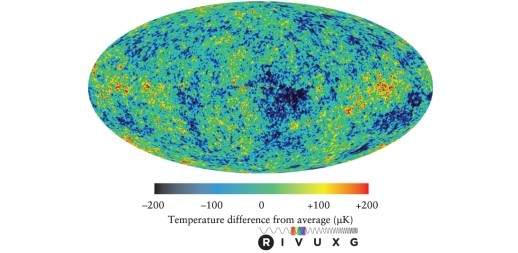
(76) Figure 25-13 of Universe, 11th ed., shows temperature variations in the cosmic microwave background. Dark areas in the image correspond to regions where the photons were gravitationally redshifted when they left the early universe. Suppose we point a telescope at one of these regions now. What would we expect to see?
(Multiple Choice)
4.9/5 (73)
(73) The first 10-43 seconds of the age of the universe, during which time matter was so compressed that all known science fails us, is called the:
(Multiple Choice)
4.8/5 (71)
(71) What was Einstein's cosmological constant, denoted by the Greek letter lambda, intended to represent?
(Multiple Choice)
4.9/5 (89)
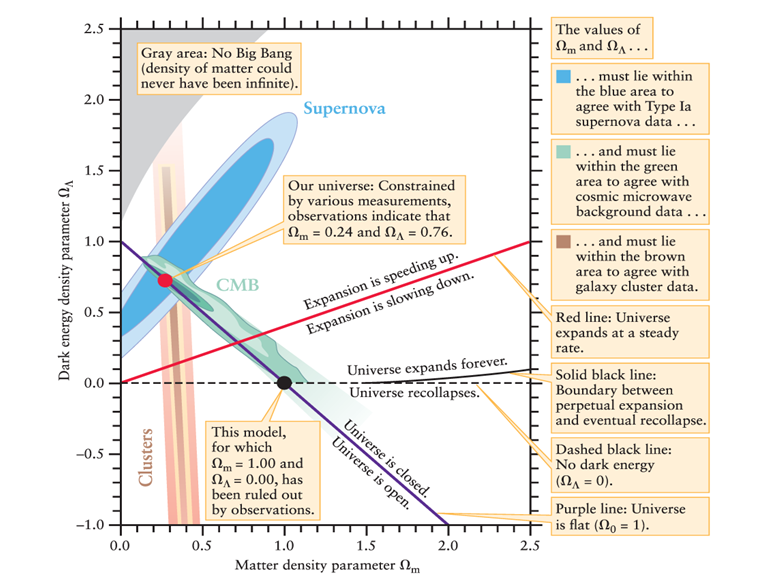
(89) If there is no dark energy, what is the future of the universe? (See Figure 25-18 of Universe, 11th ed.)
(Multiple Choice)
4.9/5 (77)
(77) In which of the following areas of scientific study will we never be able to follow the scientific method in repeating the observations of several different "samples" in order to verify the generality of the conclusions?
(Multiple Choice)
4.7/5 (80)
(80) If the uncertainty in the Hubble constant H0 = 73 km/s/Mpc is 10%, leading to values of between 65.7 km/s/Mpc and 80.3 km/s/Mpc, what is the corresponding range in the estimated age of the universe?
(Multiple Choice)
4.9/5 (70)
(70) As we look at more distant regions of space, we see those regions as they existed at earlier times, but our farthest views are blocked by a "wall"-beyond which the universe is opaque. What event occurred at the time marked by this wall?
(Multiple Choice)
4.8/5 (73)
(73) Studying the pattern of temperature variations in the early universe (see Figure 25-13 of Universe, 11th ed.) tells us something about the sound waves existing at that time. This, in turn, has given us information about all of the following EXCEPT the:
(Multiple Choice)
4.9/5 (80)
(80) The 2.7-K cosmic microwave background radiation comes from:
(Multiple Choice)
4.9/5 (74)
(74) By what factor has the universe expanded since the time of recombination?
(Multiple Choice)
4.8/5 (78)
(78) Is there an advantage in using redshift z to describe the distances to faraway galaxies?
(Multiple Choice)
4.8/5 (81)
(81) 
Filters
- Essay(0)
- Multiple Choice(0)
- Short Answer(0)
- True False(0)
- Matching(0)