



 Chat with AI
Exam 9: The Living Earth

Exam 1: Astronomy and the Universe78 Questions
Exam 2: Knowing the Heavens99 Questions
Exam 3: Eclipses and the Motion of the Moon67 Questions
Exam 4: Gravitation and the Waltz of the Planets105 Questions
Exam 5: The Nature of Light91 Questions
Exam 6: Optics and Telescopes97 Questions
Exam 7: Comparative Planetology I: Our Solar System63 Questions
Exam 8: Comparative Planetology II: the Origin of Our Solar System53 Questions
Exam 9: The Living Earth78 Questions
Exam 10: Our Barren Moon101 Questions
Exam 11: Mercury, Venus, and Mars: Terrestrial, yet Unique99 Questions
Exam 12: Jupiter and Saturn: Lords of the Planets97 Questions
Exam 13: Jupiter and Saturns Satellites of Fire and Ice110 Questions
Exam 14: Uranus, Neptune, Pluto, and the Kuiper Belt: Remote Worlds105 Questions
Exam 15: Asteroids, Comets, and Impacts80 Questions
Exam 16: Our Star, the Sun68 Questions
Exam 17: The Nature of the Stars113 Questions
Exam 18: The Birth of Stars97 Questions
Exam 19: Stellar Evolution: on and After the Main Sequence64 Questions
Exam 20: Stellar Evolution: The Death of Stars78 Questions
Exam 21: Stellar Remnants: Neutron Stars and Black Holes107 Questions
Exam 22: Our Galaxy48 Questions
Exam 23: Galaxies85 Questions
Exam 24: Quasars and Active Galaxies73 Questions
Exam 25: Cosmology: The Origin and Evolution of the Universe68 Questions
Exam 26: Exploring the Early Universe72 Questions
Exam 27: The Search for Extraterrestrial Life26 Questions
Select questions type


The circulation in Earth's atmosphere is dominated by:

Free
(Multiple Choice)
4.9/5  (84)
(84) Correct Answer: Verified
C
What is the direct source of the energy that warms the lowest layers of our atmosphere?
Free
(Multiple Choice)
4.9/5 (85)
(85) Correct Answer:Verified
VerifiedB
The gases trapped in Earth's interior at its formation probably had the same abundances as the solar nebula. What happened to the light elements hydrogen and helium?
Free
(Multiple Choice)
4.8/5 (69)
(69) Correct Answer:Verified
VerifiedC
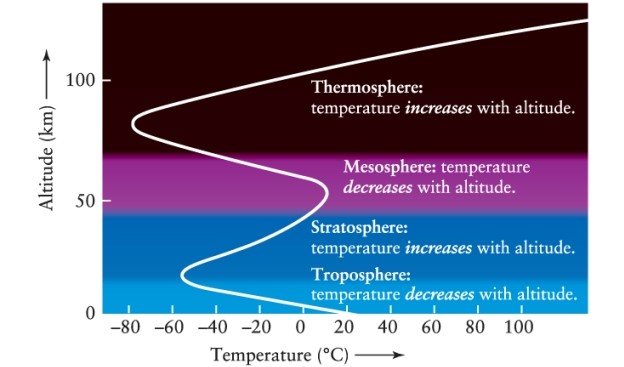
At the altitude of the boundary between the troposphere and the stratosphere in Earth's atmosphere, the temperature is approximately (See Figure 9-25 of Universe, 11th ed.):
(Multiple Choice)
4.9/5 (83)
(83) Suppose it is proposed that some of Earth's crust might be leftover solid material from the planetesimals that collided to form the planet. What do you think of this idea? Three of the following are reasonable responses to this idea. Which one is not?
(Multiple Choice)
4.9/5 (89)
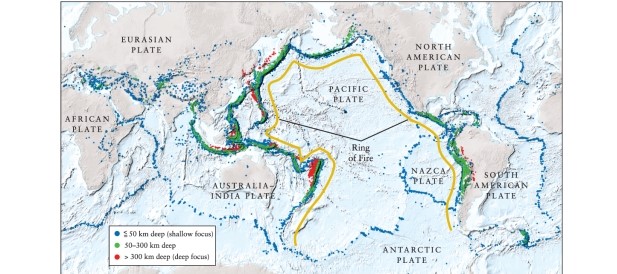
(89) Which of the following places on Earth experiences frequent earthquakes and volcanic activity because of its location? (See Figure 9-15, Universe, 11th ed.)
(Multiple Choice)
4.9/5 (62)
(62) If the CO2 content of our atmosphere was 280 ppm in 1850, how has this value changed in the century and a half through 2000?
(Multiple Choice)
4.9/5 (87)
(87) The motions of large portions of Earth's surface, or "plates," are caused by:
(Multiple Choice)
4.8/5 (78)
(78) The mean density of Earth in terms of that of water (1000 kg/m3 or 1 gm/cm3) is:
(Multiple Choice)
4.8/5 (81)
(81) Suppose that an astronaut trained in geology lands on the surface of a distant planet and finds that most of the rock at the landing site is composed of limestone. The astronaut can immediately surmise that the location of the landing site:
(Multiple Choice)
4.9/5 (87)
(87) The Himalayas were formed by the subduction of the Indian plate and the uplifting of the southern edge of the Eurasian plate. The Indian plate is unusual in that it:
(Multiple Choice)
4.9/5 (86)
(86) We have evidence that Earth's magnetic field has reversed its direction several times over geologic time scales. The average time between reversals is about:
(Multiple Choice)
4.8/5 (82)
(82) S waves are more restricted in their possible paths through Earth compared to P waves. This is because S waves:
(Multiple Choice)
4.9/5 (72)
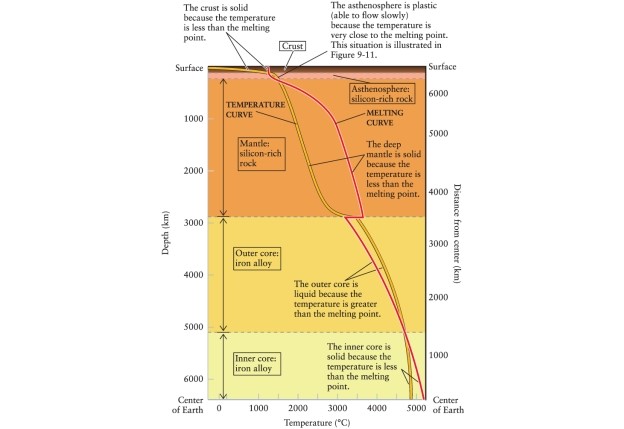
(72) The material of Earth's interior (See Figure 9-10 of Universe, 11th ed.) becomes molten at a certain depth below the surface. This depth is:
(Multiple Choice)
4.8/5 (83)
(83) Which of the planets fits the following description: "cool, solid surface with an atmosphere of N2 and O2 and H2O clouds"?
(Multiple Choice)
4.8/5 (83)
(83) Earth was formed about 4.6 billion years ago, but most of Earth's surface is:
(Multiple Choice)
4.8/5 (79)
(79) 
Filters
- Essay(0)
- Multiple Choice(0)
- Short Answer(0)
- True False(0)
- Matching(0)