



 Chat with AI
Exam 9: The Living Earth

Exam 1: Astronomy and the Universe78 Questions
Exam 2: Knowing the Heavens99 Questions
Exam 3: Eclipses and the Motion of the Moon67 Questions
Exam 4: Gravitation and the Waltz of the Planets105 Questions
Exam 5: The Nature of Light91 Questions
Exam 6: Optics and Telescopes97 Questions
Exam 7: Comparative Planetology I: Our Solar System63 Questions
Exam 8: Comparative Planetology II: the Origin of Our Solar System53 Questions
Exam 9: The Living Earth78 Questions
Exam 10: Our Barren Moon101 Questions
Exam 11: Mercury, Venus, and Mars: Terrestrial, yet Unique99 Questions
Exam 12: Jupiter and Saturn: Lords of the Planets97 Questions
Exam 13: Jupiter and Saturns Satellites of Fire and Ice110 Questions
Exam 14: Uranus, Neptune, Pluto, and the Kuiper Belt: Remote Worlds105 Questions
Exam 15: Asteroids, Comets, and Impacts80 Questions
Exam 16: Our Star, the Sun68 Questions
Exam 17: The Nature of the Stars113 Questions
Exam 18: The Birth of Stars97 Questions
Exam 19: Stellar Evolution: on and After the Main Sequence64 Questions
Exam 20: Stellar Evolution: The Death of Stars78 Questions
Exam 21: Stellar Remnants: Neutron Stars and Black Holes107 Questions
Exam 22: Our Galaxy48 Questions
Exam 23: Galaxies85 Questions
Exam 24: Quasars and Active Galaxies73 Questions
Exam 25: Cosmology: The Origin and Evolution of the Universe68 Questions
Exam 26: Exploring the Early Universe72 Questions
Exam 27: The Search for Extraterrestrial Life26 Questions
Select questions type


Earth's interior received its heat energy from the impacts of planetesimals and from radioactivity. This heat energy is gradually radiating into space. As Earth's interior continues to cool, we can expect that, in the distant future, the:
(Multiple Choice)
5.0/5  (85)
(85) In most cases the greatest force that moves seafloor plates is:
(Multiple Choice)
4.9/5 (81)
(81) Earth has a temperature and thus emits radiation somewhat like a blackbody. What is the source of the energy for this radiation?
(Multiple Choice)
5.0/5 (75)
(75) Geologists land on a new planet and begin a series of seismic measurements. A quake occurs, and they detect both S and P waves on the opposite side of the planet from the quake. What does this say about the planet's geology?
(Multiple Choice)
4.8/5 (83)
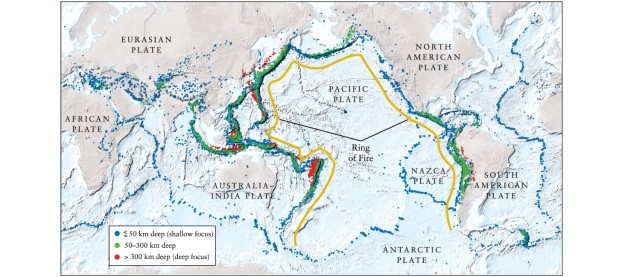
(83) Which two tectonic plates are slowly separating from each other along the Mid-Atlantic Ridge in the south Atlantic? (See Figure 9-15 of Universe, 11th ed.)
(Multiple Choice)
4.7/5 (81)
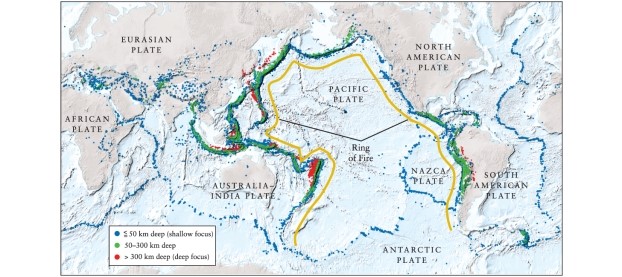
(81) The Australia-India tectonic plate (See Figure 9-15 of Universe, 11th ed.) is pushing against which plate to form the Himalayan Mountains?
(Multiple Choice)
4.9/5 (94)
(94) On Venus, large amounts of carbon dioxide (CO2) have come from the planet's interior to form a thick CO2 atmosphere. What is the carbon dioxide situation on Earth?
(Multiple Choice)
4.8/5 (84)
(84) Earth is the only planet whose atmosphere contains a significant amount of:
(Multiple Choice)
5.0/5 (78)
(78) Long-period variations in surface temperature on Earth are caused by a variety of factors. Which one of the following is not one of these factors?
(Multiple Choice)
5.0/5 (86)
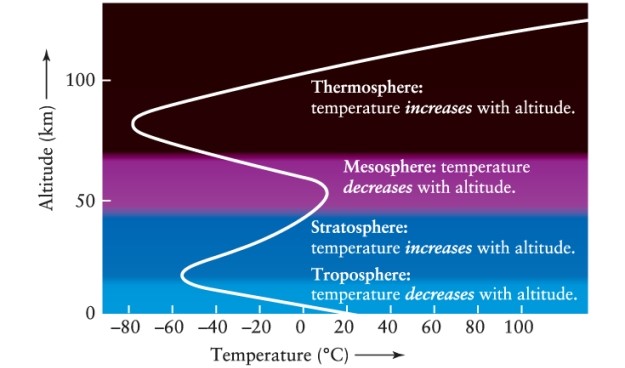
(86) You begin at the base of Earth's atmosphere where the temperature is 0°C. From here you send a weather balloon straight up in order to measure temperature. What will you find? (See Figure 9-25 of Universe, 10th ed.)
(Multiple Choice)
4.9/5 (88)
(88) During the El Niño phenomenon, many animals in the equatorial Pacific die. The ultimate cause of this is the:
(Multiple Choice)
4.7/5 (71)
(71) Which one of the following techniques can be used to determine the mass of a planet most easily?
(Multiple Choice)
5.0/5 (79)
(79) Earth's atmosphere contains about 20% oxygen. What is believed to be the source of this molecular oxygen?
(Multiple Choice)
4.8/5 (78)
(78) Earth's albedo is 0.39. The total amount of radiant energy emitted (rather than reflected) by Earth is thus:
(Multiple Choice)
4.9/5 (86)
(86) 
Filters
- Essay(0)
- Multiple Choice(0)
- Short Answer(0)
- True False(0)
- Matching(0)