



 Chat with AI
Exam 9: The Living Earth

Exam 1: Astronomy and the Universe78 Questions
Exam 2: Knowing the Heavens99 Questions
Exam 3: Eclipses and the Motion of the Moon67 Questions
Exam 4: Gravitation and the Waltz of the Planets105 Questions
Exam 5: The Nature of Light91 Questions
Exam 6: Optics and Telescopes97 Questions
Exam 7: Comparative Planetology I: Our Solar System63 Questions
Exam 8: Comparative Planetology II: the Origin of Our Solar System53 Questions
Exam 9: The Living Earth78 Questions
Exam 10: Our Barren Moon101 Questions
Exam 11: Mercury, Venus, and Mars: Terrestrial, yet Unique99 Questions
Exam 12: Jupiter and Saturn: Lords of the Planets97 Questions
Exam 13: Jupiter and Saturns Satellites of Fire and Ice110 Questions
Exam 14: Uranus, Neptune, Pluto, and the Kuiper Belt: Remote Worlds105 Questions
Exam 15: Asteroids, Comets, and Impacts80 Questions
Exam 16: Our Star, the Sun68 Questions
Exam 17: The Nature of the Stars113 Questions
Exam 18: The Birth of Stars97 Questions
Exam 19: Stellar Evolution: on and After the Main Sequence64 Questions
Exam 20: Stellar Evolution: The Death of Stars78 Questions
Exam 21: Stellar Remnants: Neutron Stars and Black Holes107 Questions
Exam 22: Our Galaxy48 Questions
Exam 23: Galaxies85 Questions
Exam 24: Quasars and Active Galaxies73 Questions
Exam 25: Cosmology: The Origin and Evolution of the Universe68 Questions
Exam 26: Exploring the Early Universe72 Questions
Exam 27: The Search for Extraterrestrial Life26 Questions
Select questions type


Suppose Earth's albedo were greater than 0.39. This would mean that:
(Multiple Choice)
4.9/5  (86)
(86) Once the light gases escaped, the dominant gas in Earth's first atmosphere was probably:
(Multiple Choice)
4.8/5 (75)
(75) One might expect the dominant circulation in Earth's atmosphere to be one large convection cell in each hemisphere, with air rising at the equator due to solar heating, moving toward the poles at high altitude, cooling and sinking, then returning toward the equator along the surface. The actual circulation is more complicated than this primarily because of the:
(Multiple Choice)
4.9/5 (78)
(78) One distinct difference between Earth and its neighboring planets, Venus and Mars, is the presence of:
(Multiple Choice)
5.0/5 (93)
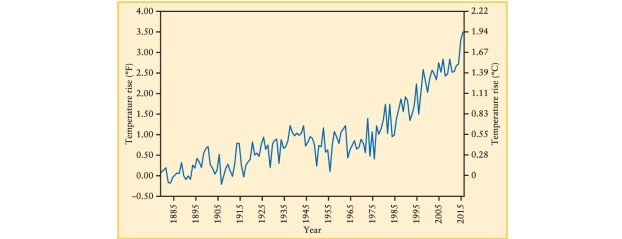
(93) Since 1900, approximately how much has the global temperature risen? (See Figure 9-32 of Universe, 11th ed.) [Instructor note: Students might argue in favor of a different answer from Figure 9-33. This figure specifically gives temperature increase in Fahrenheit on land in the northern hemisphere, where most of Earth's population resides.]
(Multiple Choice)
4.7/5 (81)
(81) When seen by astronauts traveling to the Moon, the noticeable color(s) of Earth was (were):
(Multiple Choice)
4.8/5 (74)
(74) Why did Earth's original atmosphere, composed primarily of hydrogen, not last long?
(Multiple Choice)
4.7/5 (69)
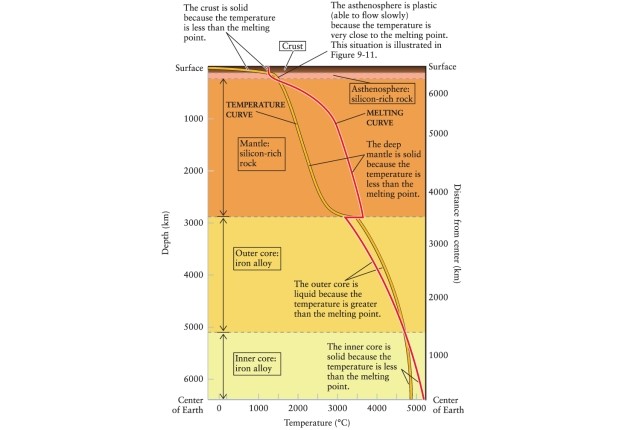
(69) The depth from the surface of Earth to the top of its liquid core is about (See Figure 9-10 of Universe, 11th ed.):
(Multiple Choice)
4.7/5 (76)
(76) Why do transverse seismic S waves not traverse Earth's deep interior?
(Multiple Choice)
4.8/5 (87)
(87) Which one of the following statements about the solar wind is true?
(Multiple Choice)
4.8/5 (70)
(70) 
Filters
- Essay(0)
- Multiple Choice(0)
- Short Answer(0)
- True False(0)
- Matching(0)