



 Chat with AI
Exam 8: Comparative Planetology II: the Origin of Our Solar System

Exam 1: Astronomy and the Universe78 Questions
Exam 2: Knowing the Heavens99 Questions
Exam 3: Eclipses and the Motion of the Moon67 Questions
Exam 4: Gravitation and the Waltz of the Planets105 Questions
Exam 5: The Nature of Light91 Questions
Exam 6: Optics and Telescopes97 Questions
Exam 7: Comparative Planetology I: Our Solar System63 Questions
Exam 8: Comparative Planetology II: the Origin of Our Solar System53 Questions
Exam 9: The Living Earth78 Questions
Exam 10: Our Barren Moon101 Questions
Exam 11: Mercury, Venus, and Mars: Terrestrial, yet Unique99 Questions
Exam 12: Jupiter and Saturn: Lords of the Planets97 Questions
Exam 13: Jupiter and Saturns Satellites of Fire and Ice110 Questions
Exam 14: Uranus, Neptune, Pluto, and the Kuiper Belt: Remote Worlds105 Questions
Exam 15: Asteroids, Comets, and Impacts80 Questions
Exam 16: Our Star, the Sun68 Questions
Exam 17: The Nature of the Stars113 Questions
Exam 18: The Birth of Stars97 Questions
Exam 19: Stellar Evolution: on and After the Main Sequence64 Questions
Exam 20: Stellar Evolution: The Death of Stars78 Questions
Exam 21: Stellar Remnants: Neutron Stars and Black Holes107 Questions
Exam 22: Our Galaxy48 Questions
Exam 23: Galaxies85 Questions
Exam 24: Quasars and Active Galaxies73 Questions
Exam 25: Cosmology: The Origin and Evolution of the Universe68 Questions
Exam 26: Exploring the Early Universe72 Questions
Exam 27: The Search for Extraterrestrial Life26 Questions
Select questions type


Suppose the ratio of radiogenic 40K to nonradiogenic 39K was 1:10 at the time a rock was formed, and that at that time also the ratio between radiogenic 40Ar to 39K was 1:20. Now, when the rock is analyzed, it is found that the ratios are 40K/39K = 1:20 and 40Ar/39K = 1:10. How old is the rock (in billions of years)?

Free
(Multiple Choice)
4.8/5  (78)
(78) Correct Answer: Verified
B
In a rotating physical system (e.g., a star formation region or a skater), what happens to the rotation rate (or angular speed) when the mass of the system condenses toward the center of rotation?
Free
(Multiple Choice)
4.9/5 (90)
(90) Correct Answer:Verified
VerifiedD
As the early Sun got smaller in a Kelvin-Helmholtz contraction, its interior became hotter and gained thermal energy. What was the source of this energy?
Free
(Multiple Choice)
4.9/5 (79)
(79) Correct Answer:Verified
VerifiedB
An early theory of solar system formation was the tidal hypothesis-the idea that a star passed close enough to the Sun to draw out a long filament of material that then condensed to form the planets and other solar system bodies. Why was this theory discredited?
(Multiple Choice)
4.8/5 (84)
(84) How has the present mix of chemical elements in the universe been produced?
(Multiple Choice)
4.9/5 (82)
(82) Of all the stars with metal abundances like the Sun surveyed so far by the radial velocity method, about how many have planets in orbit around them?
(Multiple Choice)
4.9/5 (75)
(75) How do we explain the relatively low mass of Mars, which is much smaller than Earth or Venus?
(Multiple Choice)
4.7/5 (75)
(75) Which of these chemical elements is relatively rare in the universe?
(Multiple Choice)
4.9/5 (75)
(75) The ages of meteorites have been found through radioactive dating. One major difficulty with this technique is that:
(Multiple Choice)
4.8/5 (71)
(71) In order to employ the radioactive age-dating technique on a sample of rock, it is necessary to know all of these except one. Which is the exception?
(Multiple Choice)
4.8/5 (76)
(76) Which of the these types of material has the highest condensation temperature in the planetary system?
(Multiple Choice)
4.9/5 (68)
(68) Each of these is a technique used to discover exoplanets except one. What is the exception?
(Multiple Choice)
4.7/5 (71)
(71) It is found by the radioactive age-dating technique that only one-quarter of the original sample of a radiogenic element remains, so the time is calculated to be two half-lives. What does this time represent?
(Multiple Choice)
4.9/5 (86)
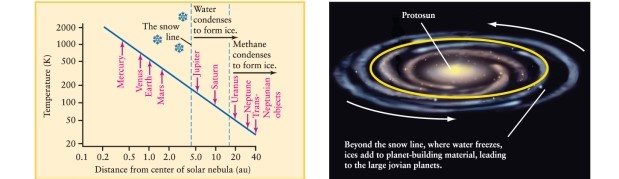
(86) In the early solar nebula, iron sulfide condensed into solid form at a temperature of about 750 K. What is the smallest distance from the Sun at which this would have happened? (See Figure 8-10 of Universe, 11th ed.)
(Multiple Choice)
4.8/5 (77)
(77) When dealing with radioactive decay of materials, we often read about the age of a particular rock. What is meant by the age of a rock?
(Multiple Choice)
5.0/5 (74)
(74) Table 8-1 of Universe, 11th ed (in the text). lists three general properties of the solar system. These deal with the size and composition of terrestrial planets versus jovian planets, directions and orientations of planetary orbits, and sizes of terrestrial planetary orbits versus jovian planetary orbits. Which planets do not fit into this general scheme?
(Multiple Choice)
4.8/5 (68)
(68) Suppose the ratio of radiogenic 238U to nonradiogenic 204Pb was 4:100 at the time a rock was formed, and also that at that time, the ratio of radiogenic 206Pb to 204Pb was 1:100. Now, when the rock is analyzed, it is found that the ratios are 238U/204Pb = 1:100 and 206Pb/204Pb = 4:100. How old is the rock (in billions of years)?
(Multiple Choice)
4.9/5 (60)
(60) 
Filters
- Essay(0)
- Multiple Choice(0)
- Short Answer(0)
- True False(0)
- Matching(0)