



 Chat with AI
Exam 2: Knowing the Heavens

Exam 1: Astronomy and the Universe78 Questions
Exam 2: Knowing the Heavens99 Questions
Exam 3: Eclipses and the Motion of the Moon67 Questions
Exam 4: Gravitation and the Waltz of the Planets105 Questions
Exam 5: The Nature of Light91 Questions
Exam 6: Optics and Telescopes97 Questions
Exam 7: Comparative Planetology I: Our Solar System63 Questions
Exam 8: Comparative Planetology II: the Origin of Our Solar System53 Questions
Exam 9: The Living Earth78 Questions
Exam 10: Our Barren Moon101 Questions
Exam 11: Mercury, Venus, and Mars: Terrestrial, yet Unique99 Questions
Exam 12: Jupiter and Saturn: Lords of the Planets97 Questions
Exam 13: Jupiter and Saturns Satellites of Fire and Ice110 Questions
Exam 14: Uranus, Neptune, Pluto, and the Kuiper Belt: Remote Worlds105 Questions
Exam 15: Asteroids, Comets, and Impacts80 Questions
Exam 16: Our Star, the Sun68 Questions
Exam 17: The Nature of the Stars113 Questions
Exam 18: The Birth of Stars97 Questions
Exam 19: Stellar Evolution: on and After the Main Sequence64 Questions
Exam 20: Stellar Evolution: The Death of Stars78 Questions
Exam 21: Stellar Remnants: Neutron Stars and Black Holes107 Questions
Exam 22: Our Galaxy48 Questions
Exam 23: Galaxies85 Questions
Exam 24: Quasars and Active Galaxies73 Questions
Exam 25: Cosmology: The Origin and Evolution of the Universe68 Questions
Exam 26: Exploring the Early Universe72 Questions
Exam 27: The Search for Extraterrestrial Life26 Questions
Select questions type


In 1 year the apparent path of the Sun through the background of the stars passes through:

Free
(Multiple Choice)
4.9/5  (82)
(82) Correct Answer: Verified
B
The total width of the zodiac surrounding the ecliptic plane in the sky is approximately:
Free
(Multiple Choice)
4.9/5 (69)
(69) Correct Answer:Verified
VerifiedB
The line on the sky joining the north and south celestial poles through a person's zenith is known as the
Free
(Multiple Choice)
4.9/5 (81)
(81) Correct Answer:Verified
VerifiedA
The two bright stars in the constellation Gemini, the Twins are Castor (right ascension 7h 33m, declination +31° 56N) and Pollux (right ascension 7h 44m, declination +28° 5N). From these coordinates you can see that:
(Multiple Choice)
4.8/5 (74)
(74) As Earth rotates, the apparent motion of the pole star, Polaris, in a period of a day is:
(Multiple Choice)
4.9/5 (88)
(88) Where would you have to be in order to see the north celestial pole in your zenith?
(Multiple Choice)
4.9/5 (80)
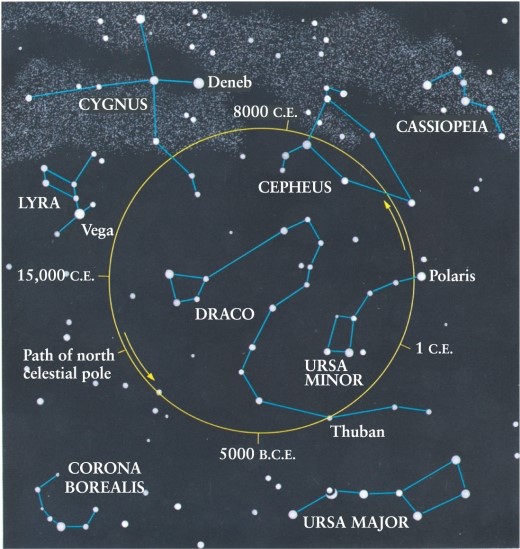
(80) If the polar axis of Earth precesses through a full circle (See Figure 2-20 of Universe, 11th ed.) in 26,000 years, how many years will it take for the line between the axis and the center of the circle to move through 1°?
(Multiple Choice)
4.9/5 (75)
(75) Which of the following was not obtained by people of ancient civilizations from observations of the night sky?
(Multiple Choice)
4.9/5 (67)
(67) You are looking at the star Aldebaran (right ascension 4h 34m, declination +16° 28N) from a location in the northern hemisphere. Where is the star Betelgeuse (right ascension 5h 54m, declination +7° 24N)?
(Multiple Choice)
4.7/5 (71)
(71) What does it mean to be "in the tropics," that is, between the Tropic of Cancer and the Tropic of Capricorn?
(Multiple Choice)
4.9/5 (78)
(78) Earlier in this chapter we discussed some ancient buildings that were constructed so that they were aligned to the rising of the Sun at vernal equinox or some other important astronomical date. How does the precession of the equinoxes affect these alignments in a building, say, 2000 years old?
(Multiple Choice)
4.7/5 (84)
(84) In late September, Andromeda appears high in the sky at midnight. Six months later Virgo appears high in the sky at midnight. Where is Andromeda at this time?
(Multiple Choice)
4.7/5 (99)
(99) By observing the sky closely night by night, you would note that a particular star rises:
(Multiple Choice)
4.9/5 (77)
(77) At what approximate value of declination was the Sun on December 21 this year?
(Multiple Choice)
4.8/5 (72)
(72) If you are standing on Earth's equator, your zenith (the vertical direction above your head) over a period of 1 year will maintain which of the following alignments?
(Multiple Choice)
4.8/5 (75)
(75) A calendar year, from vernal equinox to vernal equinox, is called a:
(Multiple Choice)
4.8/5 (86)
(86) Where must you stand on Earth to have the celestial equator along your horizon?
(Multiple Choice)
4.8/5 (88)
(88) 
Filters
- Essay(0)
- Multiple Choice(0)
- Short Answer(0)
- True False(0)
- Matching(0)