



 Chat with AI
Exam 2: Knowing the Heavens

Exam 1: Astronomy and the Universe78 Questions
Exam 2: Knowing the Heavens99 Questions
Exam 3: Eclipses and the Motion of the Moon67 Questions
Exam 4: Gravitation and the Waltz of the Planets105 Questions
Exam 5: The Nature of Light91 Questions
Exam 6: Optics and Telescopes97 Questions
Exam 7: Comparative Planetology I: Our Solar System63 Questions
Exam 8: Comparative Planetology II: the Origin of Our Solar System53 Questions
Exam 9: The Living Earth78 Questions
Exam 10: Our Barren Moon101 Questions
Exam 11: Mercury, Venus, and Mars: Terrestrial, yet Unique99 Questions
Exam 12: Jupiter and Saturn: Lords of the Planets97 Questions
Exam 13: Jupiter and Saturns Satellites of Fire and Ice110 Questions
Exam 14: Uranus, Neptune, Pluto, and the Kuiper Belt: Remote Worlds105 Questions
Exam 15: Asteroids, Comets, and Impacts80 Questions
Exam 16: Our Star, the Sun68 Questions
Exam 17: The Nature of the Stars113 Questions
Exam 18: The Birth of Stars97 Questions
Exam 19: Stellar Evolution: on and After the Main Sequence64 Questions
Exam 20: Stellar Evolution: The Death of Stars78 Questions
Exam 21: Stellar Remnants: Neutron Stars and Black Holes107 Questions
Exam 22: Our Galaxy48 Questions
Exam 23: Galaxies85 Questions
Exam 24: Quasars and Active Galaxies73 Questions
Exam 25: Cosmology: The Origin and Evolution of the Universe68 Questions
Exam 26: Exploring the Early Universe72 Questions
Exam 27: The Search for Extraterrestrial Life26 Questions
Select questions type


If a star is described as being in the constellation Leo, a modern astronomer knows that it is:
(Multiple Choice)
4.7/5  (100)
(100) In the right ascension coordinate direction, 1 hour corresponds to what equivalent angle?
(Multiple Choice)
4.9/5 (71)
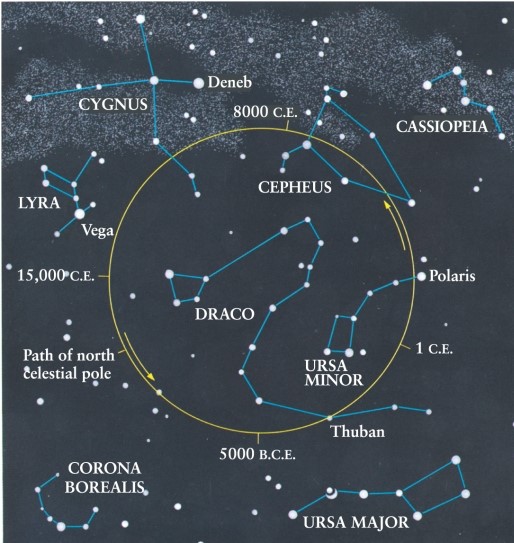
(71) Polaris is our "pole star" at the present time. At approximately what time in history or in the future would the star Thuban be our "pole star?" (See Figure 2-20 of Universe, 11th ed.)
(Multiple Choice)
4.9/5 (75)
(75) The declination angle between the north celestial pole and the celestial equator is:
(Multiple Choice)
4.9/5 (93)
(93) What is the angle, measured in degrees between two stars of RA = 4h, declination = 0°, and RA = 8h, declination = 0°?
(Multiple Choice)
4.9/5 (68)
(68) At a particular time, the vernal equinox passes through the celestial meridian of an observer. What is the sidereal time at that site?
(Multiple Choice)
4.9/5 (74)
(74) If Earth's spin axis were perpendicular to Earth's orbital plane (the ecliptic plane), then the seasons and seasonal variation would be:
(Multiple Choice)
4.8/5 (79)
(79) The two angles used by astronomers to define the position of a star in the sky and define a coordinate system applicable anywhere on Earth are:
(Multiple Choice)
4.9/5 (71)
(71) Sidereal time is the more fundamental time, since it is a measure of the true rotation rate of Earth. Why then do we govern our lives by solar time rather than sidereal time?
(Multiple Choice)
4.7/5 (70)
(70) Which ancient culture discovered a 584-day pattern in the motions of Venus?
(Multiple Choice)
4.8/5 (83)
(83) At what approximate value of declination was the Sun on September 21 this year?
(Multiple Choice)
4.7/5 (82)
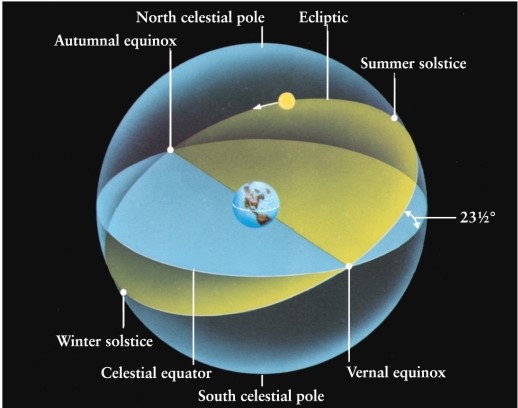
(82) If you were standing on the equator, which of the following positions in the sky would pass directly over your head (i.e., through your zenith) at some time in one 24-hour period? (See Figure 2-15 of Universe, 11th ed.)
(Multiple Choice)
4.8/5 (97)
(97) The beginning of a sidereal day (at midnight, sidereal time) at any location on Earth is defined by the passage of the:
(Multiple Choice)
4.9/5 (80)
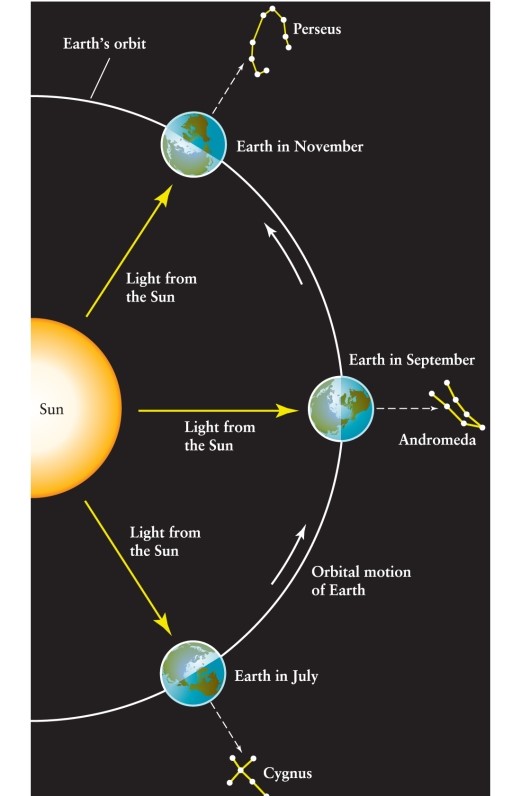
(80) Perseus appears high in the sky at midnight in November. Andromeda appears high in the sky at midnight in September. (See Figure 2-5 of Universe, 11th ed.) Where is Andromeda at midnight in November?
(Multiple Choice)
4.8/5 (74)
(74) To what constellation will the north celestial pole be closest in the year 14,000 C.E.? (See Figure 2-20 of Universe, 11th ed.) 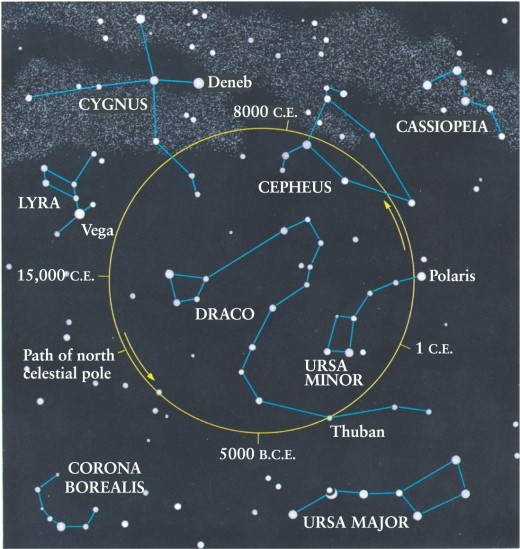
(Multiple Choice)
4.8/5 (74)
(74) 
Filters
- Essay(0)
- Multiple Choice(0)
- Short Answer(0)
- True False(0)
- Matching(0)