



 Chat with AI
Exam 8: Comparative Planetology II: the Origin of Our Solar System

Exam 1: Astronomy and the Universe78 Questions
Exam 2: Knowing the Heavens99 Questions
Exam 3: Eclipses and the Motion of the Moon67 Questions
Exam 4: Gravitation and the Waltz of the Planets105 Questions
Exam 5: The Nature of Light91 Questions
Exam 6: Optics and Telescopes97 Questions
Exam 7: Comparative Planetology I: Our Solar System63 Questions
Exam 8: Comparative Planetology II: the Origin of Our Solar System53 Questions
Exam 9: The Living Earth78 Questions
Exam 10: Our Barren Moon101 Questions
Exam 11: Mercury, Venus, and Mars: Terrestrial, yet Unique99 Questions
Exam 12: Jupiter and Saturn: Lords of the Planets97 Questions
Exam 13: Jupiter and Saturns Satellites of Fire and Ice110 Questions
Exam 14: Uranus, Neptune, Pluto, and the Kuiper Belt: Remote Worlds105 Questions
Exam 15: Asteroids, Comets, and Impacts80 Questions
Exam 16: Our Star, the Sun68 Questions
Exam 17: The Nature of the Stars113 Questions
Exam 18: The Birth of Stars97 Questions
Exam 19: Stellar Evolution: on and After the Main Sequence64 Questions
Exam 20: Stellar Evolution: The Death of Stars78 Questions
Exam 21: Stellar Remnants: Neutron Stars and Black Holes107 Questions
Exam 22: Our Galaxy48 Questions
Exam 23: Galaxies85 Questions
Exam 24: Quasars and Active Galaxies73 Questions
Exam 25: Cosmology: The Origin and Evolution of the Universe68 Questions
Exam 26: Exploring the Early Universe72 Questions
Exam 27: The Search for Extraterrestrial Life26 Questions
Select questions type


The oldest rocks yet found by radioactive age dating, in order of decreasing age, are:
(Multiple Choice)
4.8/5  (95)
(95) The oldest rocks, as measured by radioactive age dating, have been found:
(Multiple Choice)
4.7/5 (74)
(74) Which of these statements is an example of Kelvin-Helmholtz contraction?
(Multiple Choice)
4.8/5 (73)
(73) What is surprising about the planet orbiting the star 51 Pegasi?
(Multiple Choice)
4.8/5 (74)
(74) The planetary system was probably formed from three different categories of material with different condensation temperatures (the temperature at which the material melts): gases, ices, and rocks. Which is the correct order of these materials, in increasing condensation temperature?
(Multiple Choice)
4.9/5 (79)
(79) The fractional abundance of hydrogen by mass in the solar system is about:
(Multiple Choice)
4.8/5 (74)
(74) Astrometry is the branch of astronomy dealing with the measurement of the:
(Multiple Choice)
4.9/5 (82)
(82) The most likely mechanism for the solar system's formation appears to be:
(Multiple Choice)
4.8/5 (77)
(77) Suppose an exoplanet is in an orbital plane perpendicular to our line of sight. Which one of the following methods might be used to detect this planet?
(Multiple Choice)
4.9/5 (84)
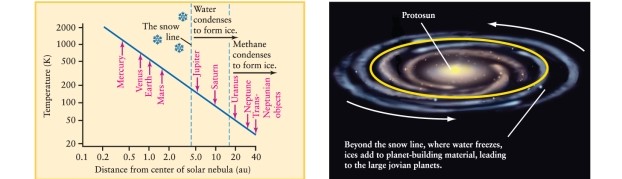
(84) Various ices condense at temperatures less than 300 K. What is the smallest distance from the Sun in the early solar nebula at which these ices would have condensed to form solid particles? (See Figure 8-10 of Universe, 11th ed.)
(Multiple Choice)
4.9/5 (96)
(96) 
Filters
- Essay(0)
- Multiple Choice(0)
- Short Answer(0)
- True False(0)
- Matching(0)