



 Chat with AI
Exam 25: Cosmology: The Origin and Evolution of the Universe

Exam 1: Astronomy and the Universe78 Questions
Exam 2: Knowing the Heavens99 Questions
Exam 3: Eclipses and the Motion of the Moon67 Questions
Exam 4: Gravitation and the Waltz of the Planets105 Questions
Exam 5: The Nature of Light91 Questions
Exam 6: Optics and Telescopes97 Questions
Exam 7: Comparative Planetology I: Our Solar System63 Questions
Exam 8: Comparative Planetology II: the Origin of Our Solar System53 Questions
Exam 9: The Living Earth78 Questions
Exam 10: Our Barren Moon101 Questions
Exam 11: Mercury, Venus, and Mars: Terrestrial, yet Unique99 Questions
Exam 12: Jupiter and Saturn: Lords of the Planets97 Questions
Exam 13: Jupiter and Saturns Satellites of Fire and Ice110 Questions
Exam 14: Uranus, Neptune, Pluto, and the Kuiper Belt: Remote Worlds105 Questions
Exam 15: Asteroids, Comets, and Impacts80 Questions
Exam 16: Our Star, the Sun68 Questions
Exam 17: The Nature of the Stars113 Questions
Exam 18: The Birth of Stars97 Questions
Exam 19: Stellar Evolution: on and After the Main Sequence64 Questions
Exam 20: Stellar Evolution: The Death of Stars78 Questions
Exam 21: Stellar Remnants: Neutron Stars and Black Holes107 Questions
Exam 22: Our Galaxy48 Questions
Exam 23: Galaxies85 Questions
Exam 24: Quasars and Active Galaxies73 Questions
Exam 25: Cosmology: The Origin and Evolution of the Universe68 Questions
Exam 26: Exploring the Early Universe72 Questions
Exam 27: The Search for Extraterrestrial Life26 Questions
Select questions type


Suppose the ionization energy of hydrogen were larger than 13.6 eV and the decoupling of radiation and matter had occurred earlier, say at z = 2000. What would the temperature have been at that time?
(Multiple Choice)
4.7/5  (89)
(89) In Newton's model of an infinite universe with stars distributed smoothly throughout, an individual star would feel:
(Multiple Choice)
4.9/5 (65)
(65) If the Hubble constant is 73 km/s/Mpc then the age of the universe is 13.4 billion years, assuming a uniform expansion. Suppose it were discovered that the Hubble constant is actually larger than 73 km/s/Mpc. What effect would this have on the calculated age of the universe?
(Multiple Choice)
4.9/5 (74)
(74) Which one of the following statements represents a correct description of the expansion of the universe?
(Multiple Choice)
4.7/5 (87)
(87) What is the lookback time (i.e., how long ago did the light leave its source) for an object with a redshift z = 0.05, assuming that the Hubble constant is 22.4 km/s/Mly? (Assume nonrelativistic speed for this object.)
(Multiple Choice)
4.9/5 (83)
(83) At present, the energy density of matter greatly exceeds that of radiation. But in the early universe, radiation energy was dominant. Why was this?
(Multiple Choice)
4.8/5 (77)
(77) In cosmology, to what does the phrase "critical density" refer?
(Multiple Choice)
4.9/5 (68)
(68) The Sun presently consists of about 25% helium. Where did this helium come from?
(Multiple Choice)
4.7/5 (71)
(71) The discovery that the Sun and similar stars consist of about 25% helium posed a dilemma: There was too much helium in the universe to be accounted for by nucleosynthesis in stars in the contemporary cosmological models. How was this dilemma resolved?
(Multiple Choice)
4.8/5 (92)
(92) A few decades ago many astronomers used a value 42 km/s/Mpc for the Hubble constant. What was the age of the universe based on this value?
(Multiple Choice)
4.9/5 (72)
(72) If, as we now believe, the rate of expansion of the universe was slower in the past than at present, then in the past the value of the Hubble ratio, H = v/d, was: (See Figure 25-16 of Universe, 11th ed.)
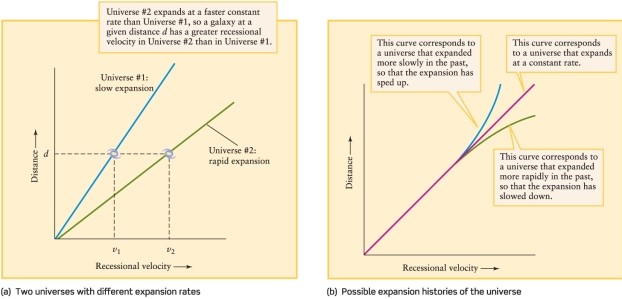
(Multiple Choice)
5.0/5 (57)
(57) In our description of the universe, what does the word "homogeneous" mean?
(Multiple Choice)
4.9/5 (75)
(75) In which of the following universe scenarios will the present universe recollapse at some time in the future?
(Multiple Choice)
4.7/5 (83)
(83) If space has a hyperbolic geometry (unbounded universe), what will happen to two initially parallel flashlight beams as they traverse billions of light years of space?
(Multiple Choice)
4.8/5 (71)
(71) If there is dark energy in the universe with a positive energy density, what is the future of the universe? (See Figure 25-18 of Universe, 11th ed.(in the text))
(Multiple Choice)
4.8/5 (76)
(76) An object has a lookback time of 1 billion years. Assuming it is nonrelativistic, and that the Hubble constant is 22.4 km/s/Mly, what is its velocity?
(Multiple Choice)
4.9/5 (70)
(70) How is it that we can detect evidence of sound waves in the early universe?
(Multiple Choice)
4.9/5 (70)
(70) 
Filters
- Essay(0)
- Multiple Choice(0)
- Short Answer(0)
- True False(0)
- Matching(0)