



 Chat with AI
Exam 4: Gravitation and the Waltz of the Planets

Exam 1: Astronomy and the Universe78 Questions
Exam 2: Knowing the Heavens99 Questions
Exam 3: Eclipses and the Motion of the Moon67 Questions
Exam 4: Gravitation and the Waltz of the Planets105 Questions
Exam 5: The Nature of Light91 Questions
Exam 6: Optics and Telescopes97 Questions
Exam 7: Comparative Planetology I: Our Solar System63 Questions
Exam 8: Comparative Planetology II: the Origin of Our Solar System53 Questions
Exam 9: The Living Earth78 Questions
Exam 10: Our Barren Moon101 Questions
Exam 11: Mercury, Venus, and Mars: Terrestrial, yet Unique99 Questions
Exam 12: Jupiter and Saturn: Lords of the Planets97 Questions
Exam 13: Jupiter and Saturns Satellites of Fire and Ice110 Questions
Exam 14: Uranus, Neptune, Pluto, and the Kuiper Belt: Remote Worlds105 Questions
Exam 15: Asteroids, Comets, and Impacts80 Questions
Exam 16: Our Star, the Sun68 Questions
Exam 17: The Nature of the Stars113 Questions
Exam 18: The Birth of Stars97 Questions
Exam 19: Stellar Evolution: on and After the Main Sequence64 Questions
Exam 20: Stellar Evolution: The Death of Stars78 Questions
Exam 21: Stellar Remnants: Neutron Stars and Black Holes107 Questions
Exam 22: Our Galaxy48 Questions
Exam 23: Galaxies85 Questions
Exam 24: Quasars and Active Galaxies73 Questions
Exam 25: Cosmology: The Origin and Evolution of the Universe68 Questions
Exam 26: Exploring the Early Universe72 Questions
Exam 27: The Search for Extraterrestrial Life26 Questions
Select questions type


A spacecraft that has been put into a circular orbit around the Sun (in the same plane as Earth's orbit) with a sidereal period of 2.25 years is unobservable behind the Sun once every:
(Multiple Choice)
4.9/5  (88)
(88) The synodic period of a superior planet in motion around the Sun, as viewed from Earth, is defined as the time between:
(Multiple Choice)
4.8/5 (81)
(81) In the geocentric Ptolemaic model that described the apparent motions of planets against the background sky as viewed from a stationary Earth, at what distance with respect to its deferent is a particular planet on its epicycle when it appears to stop moving for a short period in its motion against the background?
(Multiple Choice)
4.9/5 (65)
(65) Consider a spacecraft in a circular orbit. Suppose a rocket thruster is fired, increasing the speed of the spacecraft. What will be its subsequent orbit? (See Figure 4-22, Universe, 11th ed.)
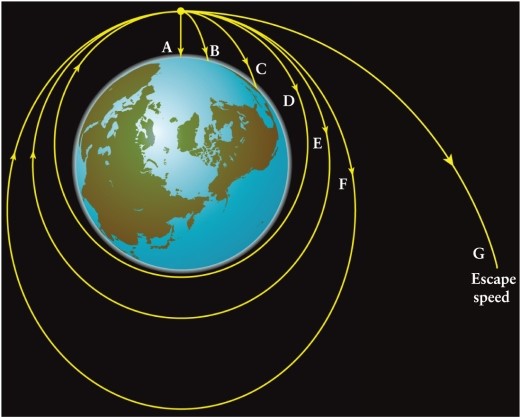
(Multiple Choice)
4.9/5 (86)
(86) According to Kepler's law, the approximate sidereal period of an asteroid moving around the Sun at a distance of about 2.8 au in the asteroid belt is:
(Multiple Choice)
4.7/5 (79)
(79) At what distance would a planet have to orbit the Sun to have its synodic period equal to its sidereal period, assuming circular orbits for Earth and the planet?
(Multiple Choice)
4.9/5 (72)
(72) The eccentricity of Venus's orbit is e = 0.007. Suppose a Planet X is discovered with an orbital eccentricity of e = 0.014. This tells us that:
(Multiple Choice)
4.9/5 (84)
(84) As Venus orbits the Sun, by what factor, as viewed from Earth, does its angular size change from smallest to largest? (See Figures 4-13 and 4-14, Universe, 11th ed.(in the text))
(Multiple Choice)
4.8/5 (83)
(83) The original form of Kepler's third law is P2 = a3, where P is the period of the orbital motion and a is the semimajor axis of the elliptical orbit. Newton's form of the third law, however, is , where m1 and m2 are the masses involved. Three of the motions listed below can be analyzed with the original form of the law, and one requires Newton's form. Which one requires Newton's form?
(Multiple Choice)
4.8/5 (74)
(74) A body moves through space with a certain speed. How many forces are needed to make this object move in a circle?
(Multiple Choice)
4.8/5 (63)
(63) An inner planet is observed (through a telescope) to have a gibbous shape whenever it is close to:
(Multiple Choice)
4.7/5 (89)
(89) If we could observe a planet in orbit around the Sun but very far away, as its distance approached infinity, its synodic period would approach:
(Multiple Choice)
4.8/5 (80)
(80) The sidereal period of Jupiter is almost 12 years. Its synodic period is:
(Multiple Choice)
4.8/5 (88)
(88) Newton's second law states that acceleration produced by a force is:
(Multiple Choice)
4.8/5 (74)
(74) Galileo's early observations of the sky with his newly made telescope included the:
(Multiple Choice)
4.9/5 (83)
(83) Greatest elongation in a planetary orbit occurs when the angle between:
(Multiple Choice)
4.7/5 (80)
(80) Which one of the following relationships represents Newton's most important contribution to physics?
(Multiple Choice)
4.7/5 (81)
(81) If you drop an object near Earth's surface it will have an acceleration of 9.8 m/s2. If, instead, you throw the object downward, its acceleration (after it leaves your hand) will be:
(Multiple Choice)
4.9/5 (87)
(87) If a planet moves around the Sun in a circular orbit, how many forces act on it?
(Multiple Choice)
4.9/5 (81)
(81) Titan, the largest satellite of Saturn, orbits Saturn with a semimajor axis of 1.22 × 10⁹ m and an orbital period of 1.38 × 10⁶ s (about 16 days). Use the formula in Box 4-4 to compute the combined mass of Saturn and Titan. What is the result, in kilograms?
(Multiple Choice)
4.8/5 (88)
(88) 
Filters
- Essay(0)
- Multiple Choice(0)
- Short Answer(0)
- True False(0)
- Matching(0)