



 Chat with AI
Exam 16: Our Star, the Sun

Exam 1: Astronomy and the Universe78 Questions
Exam 2: Knowing the Heavens99 Questions
Exam 3: Eclipses and the Motion of the Moon67 Questions
Exam 4: Gravitation and the Waltz of the Planets105 Questions
Exam 5: The Nature of Light91 Questions
Exam 6: Optics and Telescopes97 Questions
Exam 7: Comparative Planetology I: Our Solar System63 Questions
Exam 8: Comparative Planetology II: the Origin of Our Solar System53 Questions
Exam 9: The Living Earth78 Questions
Exam 10: Our Barren Moon101 Questions
Exam 11: Mercury, Venus, and Mars: Terrestrial, yet Unique99 Questions
Exam 12: Jupiter and Saturn: Lords of the Planets97 Questions
Exam 13: Jupiter and Saturns Satellites of Fire and Ice110 Questions
Exam 14: Uranus, Neptune, Pluto, and the Kuiper Belt: Remote Worlds105 Questions
Exam 15: Asteroids, Comets, and Impacts80 Questions
Exam 16: Our Star, the Sun68 Questions
Exam 17: The Nature of the Stars113 Questions
Exam 18: The Birth of Stars97 Questions
Exam 19: Stellar Evolution: on and After the Main Sequence64 Questions
Exam 20: Stellar Evolution: The Death of Stars78 Questions
Exam 21: Stellar Remnants: Neutron Stars and Black Holes107 Questions
Exam 22: Our Galaxy48 Questions
Exam 23: Galaxies85 Questions
Exam 24: Quasars and Active Galaxies73 Questions
Exam 25: Cosmology: The Origin and Evolution of the Universe68 Questions
Exam 26: Exploring the Early Universe72 Questions
Exam 27: The Search for Extraterrestrial Life26 Questions
Select questions type


The solar neutrino experiment designed by Raymond Davis has detected a rate of solar neutrinos arriving at Earth that is:
(Multiple Choice)
4.8/5  (97)
(97) Why was "heavy" water used in the Sudbury Neutrino Observatory instead of ordinary water?
(Multiple Choice)
4.7/5 (91)
(91) The study of solar oscillations has provided information about each of the following topics EXCEPT ONE. Which one is the EXCEPTION?
(Multiple Choice)
4.7/5 (74)
(74) Figure 16-15 of Universe, 11th ed., shows images of the Sun at different wavelengths that correspond to different temperatures. What relationship between wavelength and temperature is being used here?
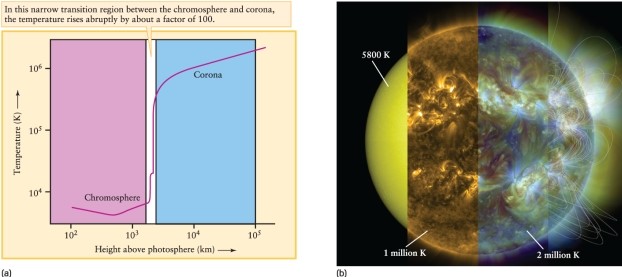
(Multiple Choice)
4.9/5 (73)
(73) Which technique has been used since the 1960s to attempt to measure solar neutrinos?
(Multiple Choice)
4.8/5 (68)
(68) If the Sun were the same temperature but twice its present diameter, the amount of energy we would receive would:
(Multiple Choice)
4.8/5 (78)
(78) Apart from the helium nuclei and energy that are produced in thermonuclear reactions between protons in the center of the Sun, what are the other byproducts?
(Multiple Choice)
4.9/5 (73)
(73) 
Filters
- Essay(0)
- Multiple Choice(0)
- Short Answer(0)
- True False(0)
- Matching(0)