



 Chat with AI
Exam 16: Our Star, the Sun

Exam 1: Astronomy and the Universe78 Questions
Exam 2: Knowing the Heavens99 Questions
Exam 3: Eclipses and the Motion of the Moon67 Questions
Exam 4: Gravitation and the Waltz of the Planets105 Questions
Exam 5: The Nature of Light91 Questions
Exam 6: Optics and Telescopes97 Questions
Exam 7: Comparative Planetology I: Our Solar System63 Questions
Exam 8: Comparative Planetology II: the Origin of Our Solar System53 Questions
Exam 9: The Living Earth78 Questions
Exam 10: Our Barren Moon101 Questions
Exam 11: Mercury, Venus, and Mars: Terrestrial, yet Unique99 Questions
Exam 12: Jupiter and Saturn: Lords of the Planets97 Questions
Exam 13: Jupiter and Saturns Satellites of Fire and Ice110 Questions
Exam 14: Uranus, Neptune, Pluto, and the Kuiper Belt: Remote Worlds105 Questions
Exam 15: Asteroids, Comets, and Impacts80 Questions
Exam 16: Our Star, the Sun68 Questions
Exam 17: The Nature of the Stars113 Questions
Exam 18: The Birth of Stars97 Questions
Exam 19: Stellar Evolution: on and After the Main Sequence64 Questions
Exam 20: Stellar Evolution: The Death of Stars78 Questions
Exam 21: Stellar Remnants: Neutron Stars and Black Holes107 Questions
Exam 22: Our Galaxy48 Questions
Exam 23: Galaxies85 Questions
Exam 24: Quasars and Active Galaxies73 Questions
Exam 25: Cosmology: The Origin and Evolution of the Universe68 Questions
Exam 26: Exploring the Early Universe72 Questions
Exam 27: The Search for Extraterrestrial Life26 Questions
Select questions type


Sunspots lie in the photosphere. What influence do they have on the corona above them?
(Multiple Choice)
4.9/5  (77)
(77) What is the nature and extent of the oscillations and waves in the Sun?
(Multiple Choice)
4.8/5 (55)
(55) What is the dominant mechanism by which energy is transported through the core of the Sun?
(Multiple Choice)
5.0/5 (79)
(79) The Davis neutrino detection experiment measured only about one-third of the expected solar neutrino flux. The Kamiokande experiment was a great improvement. Why?
(Multiple Choice)
4.8/5 (80)
(80) Compressed magnetic fields tend to push themselves apart. Yet sunspots can be stable for as long as 2 months. How do we explain this?
(Multiple Choice)
4.9/5 (72)
(72) Most solar variations associated with the so-called solar cycle show a repetitive pattern of magnetic behavior with an approximate period of:
(Multiple Choice)
4.9/5 (79)
(79) The temperature at the center of the Sun, where thermonuclear processes take place, is approximately:
(Multiple Choice)
4.8/5 (76)
(76) By how much does the mass of the Sun decrease each second because of the energy it radiates (its luminosity)?
(Multiple Choice)
4.9/5 (93)
(93) According to the theoretical model of the Sun tabulated in Table 16-2 and shown graphically in Figure 16-3 of Universe, 11th ed., within what radial distance of the solar center is the vast majority of solar energy generated?
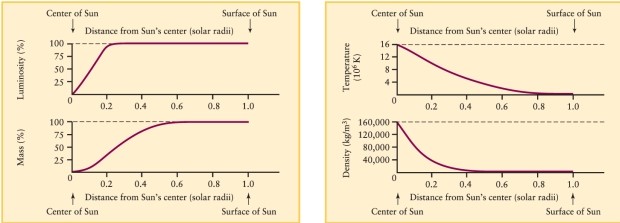
(Multiple Choice)
4.8/5 (80)
(80) The density of the Sun decreases as you move outward from the core. Approximately where is the Sun's density equal to the density of water?
(Multiple Choice)
4.8/5 (81)
(81) If sunspots are cooler than the photosphere (by at least 1000 K), what will be the peak wavelength in a sunspot spectrum compared with the peak wavelength of the photospheric spectrum?
(Multiple Choice)
4.9/5 (86)
(86) How is sunspot activity on the side of the Sun facing away from Earth monitored?
(Multiple Choice)
4.9/5 (85)
(85) In order from highest to lowest, what are the names of the three layers in the Sun's atmosphere?
(Multiple Choice)
4.9/5 (67)
(67) If the Sun were much less massive, how would the pressure at the center compare to its present value?
(Multiple Choice)
5.0/5 (79)
(79) The appearance of the visible spectrum of the Sun, when its light is separated in its component colors, is a:
(Multiple Choice)
4.9/5 (95)
(95) 
Filters
- Essay(0)
- Multiple Choice(0)
- Short Answer(0)
- True False(0)
- Matching(0)