



 Chat with AI
Exam 8: Behavioral Ecology

Exam 1: The Web of Life68 Questions
Exam 2: The Physical Environment76 Questions
Exam 3: The Biosphere73 Questions
Exam 4: Coping With Environmental Variation:74 Questions
Exam 5: Coping With Environmental Variation: Energy71 Questions
Exam 6: Evolution and Ecology68 Questions
Exam 7: Life History69 Questions
Exam 8: Behavioral Ecology71 Questions
Exam 9: Population Distribution and Abundance80 Questions
Exam 10: Population Dynamics68 Questions
Exam 11: Population Growth and Regulation69 Questions
Exam 12: Predation70 Questions
Exam 13: Parasitism72 Questions
Exam 14: Competition74 Questions
Exam 15: Mutualism and Commensalism71 Questions
Exam 16: The Nature of Communities71 Questions
Exam 17: Change in Communities73 Questions
Exam 18: Biogeography70 Questions
Exam 19: Species Diversity in Communities72 Questions
Exam 20: Production73 Questions
Exam 21: Energy Flow and Food Webs76 Questions
Exam 22: Nutrient Supply and Cycling76 Questions
Exam 23: Conservation Biology73 Questions
Exam 24: Landscape Ecology and Ecosystem Management71 Questions
Exam 25: Global Ecology74 Questions
Select questions type


Refer to the figure.
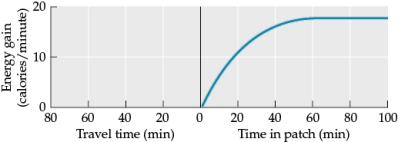 If travel time is 50 minutes, what is the optimal giving up time?
 (Multiple Choice)
4.8/5  (86)
(86) You are studying nest building in two bird species. Species A builds a long hanging nest while species B builds a short nest that sits on top of tree branches. You interbreed the birds in the lab and then examine the nests that the offspring produce. QTL analysis shows that whether a nest is built to hang or sit is affected by a single genetic locus. The length of the nest is also determined by the same genetic locus. What can you infer about the evolution of this behavior?
(Multiple Choice)
4.8/5 (91)
(91) Refer to the table.
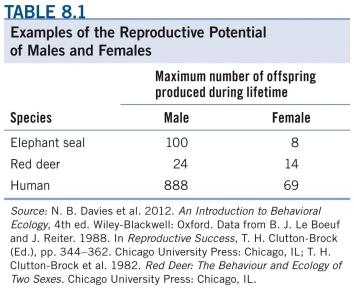 If one male elephant seal and one female elephant seal both produced the maximum number of possible offspring during their lifetime, the female would produce _______% as many offspring as the male. (Assume that these two individuals did not reproduce with each other.)
 (Multiple Choice)
4.8/5 (75)
(75) Refer to the table.
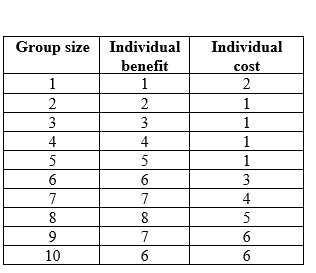 Suppose you are studying the optimal group size in a species. You collect the following data on the costs and benefits for each individual in groups of different sizes.
-Based on the data in the table, at what point do individuals pay more costs than they gain in benefits from group membership?
Suppose you are studying the optimal group size in a species. You collect the following data on the costs and benefits for each individual in groups of different sizes.
-Based on the data in the table, at what point do individuals pay more costs than they gain in benefits from group membership? (Multiple Choice)
4.7/5 (81)
(81) Refer to the figure.
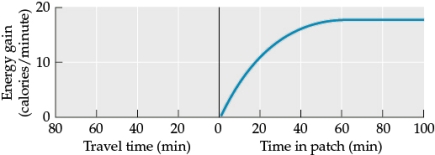 - If travel time is 20 minutes, what is the optimal giving up time?
 (Multiple Choice)
4.9/5 (71)
(71) According to research conducted by Zanette and colleagues, exposing song sparrow parents to the perception of increased predation risk caused
(Multiple Choice)
4.8/5 (86)
(86) Suppose a lion is hunting a herd of springbok. As the lion gets closer to the herd, the springbok would most likely
(Multiple Choice)
4.8/5 (74)
(74) Refer to the figure.
Figure 1
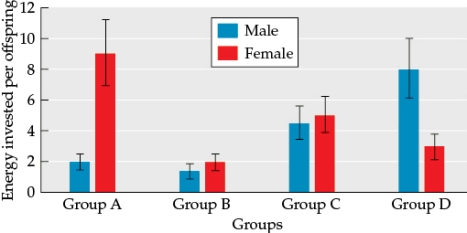 You are studying parental investment patterns in four groups (groups A, B, C, and D). Your data are shown in Figure 1. Answer the following questions:
a) In which group(s) do females clearly invest more energy in each offspring than males do?
b) In which group(s) do males clearly invest more energy in each offspring than females do?
c) In which group(s) is/are female and male energy investment per offspring similar?
d) Which group(s) is/are most likely to have solely female parental care?
e) Which group(s) is/are most likely to have solely male partental care?
f) Which group(s) is/are most likely to have biparental care?
g) Which group(s) is/are most likely to have no parental care?
Answer:
You are studying parental investment patterns in four groups (groups A, B, C, and D). Your data are shown in Figure 1. Answer the following questions:
a) In which group(s) do females clearly invest more energy in each offspring than males do?
b) In which group(s) do males clearly invest more energy in each offspring than females do?
c) In which group(s) is/are female and male energy investment per offspring similar?
d) Which group(s) is/are most likely to have solely female parental care?
e) Which group(s) is/are most likely to have solely male partental care?
f) Which group(s) is/are most likely to have biparental care?
g) Which group(s) is/are most likely to have no parental care?
Answer: (Essay)
4.8/5 (81)
(81) Which of the following statements about animal foraging behavior is false?
(Multiple Choice)
5.0/5 (82)
(82) Refer to the figure.
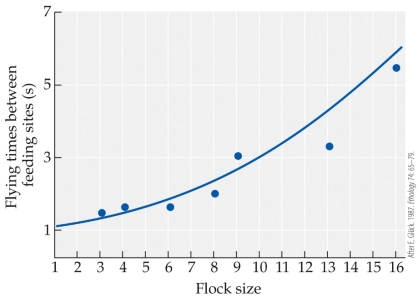 The figure shows data from a study on goldfinches that determined how foraging behavior changed with group size (referred to as "flock size").
- Suppose that each individual bird can eat 2 seeds every 5 seconds and that there are a maximum of 100 seeds in any one patch. For a flock of 16 individuals, how long would it take the flock to eat all of the seeds in the patch?
The figure shows data from a study on goldfinches that determined how foraging behavior changed with group size (referred to as "flock size").
- Suppose that each individual bird can eat 2 seeds every 5 seconds and that there are a maximum of 100 seeds in any one patch. For a flock of 16 individuals, how long would it take the flock to eat all of the seeds in the patch? (Multiple Choice)
4.8/5 (82)
(82) Refer to the figure.
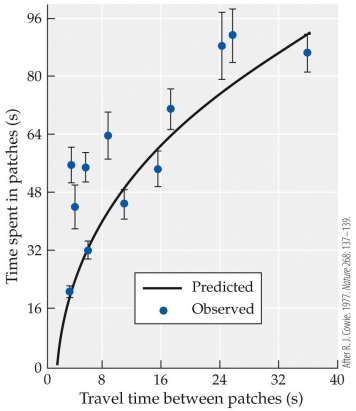 Based on the experimental data graphed in the figure, which of the following statements is true?
 (Multiple Choice)
4.8/5 (76)
(76) Refer to the figure.
Figure 3
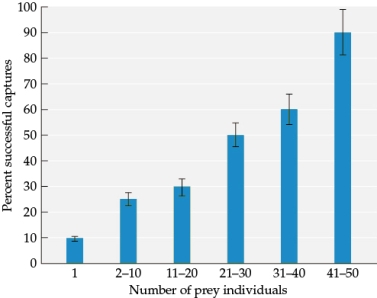 You are investigating the benefits that individuals gain from group living.
- You collect the data graphed in Figure 3. Suppose the prey species benefits from group living through decreased predation pressure. Explain the mechanism through which this could occur.
You are investigating the benefits that individuals gain from group living.
- You collect the data graphed in Figure 3. Suppose the prey species benefits from group living through decreased predation pressure. Explain the mechanism through which this could occur. (Essay)
4.7/5 (71)
(71) Refer to the table.
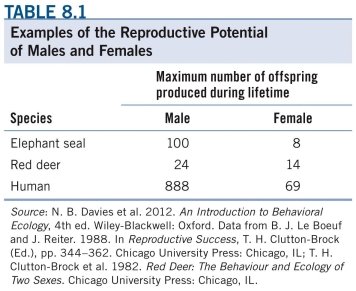 If one red deer male and one red deer female both produce the maximum number of possible offspring during their lifetime, the female would produce _______% as many offspring as the male. (Assume that these two individuals did not reproduce with each other.)
 (Multiple Choice)
4.9/5 (70)
(70) Suppose that two mosquito populations are being studied. The populations differ in their choice of aquatic environments in which they choose to lay their eggs. One population is urban and avoids laying eggs in water treated with insecticides, which are heavily used in urban areas. The other population does not discriminate between insecticide-treated and untreated water. Which of the following is a proximal explanation for the observed difference between these populations?
(Multiple Choice)
4.8/5 (89)
(89) Suppose the net energy value of a food item is 30 kcal. The time invested in obtaining each food item is 22 s, and the time invested in processing each food item is 3 s. What is the profitability of this food source?
(Multiple Choice)
4.7/5 (99)
(99) In species where males provide the bulk of the parental care, males are most likely to
(Multiple Choice)
4.8/5 (70)
(70) Refer to the figure.
Figure 2
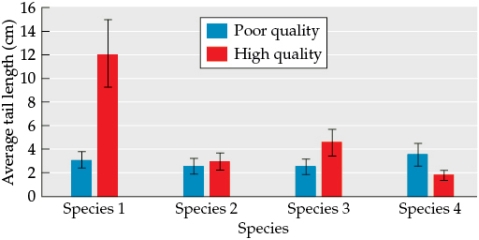 You are studying four bird species to determine the differences between poor-quality and high-quality males.
-You collect the data shown in Figure 2. Suppose that in species A, there are two high-quality males, 20 poor-quality males, and 50 females. A single male can mate with just one female each day, and females are all fertile for the same 10-day period. How would you expect these time constraints to affect female mate choice decisions?
You are studying four bird species to determine the differences between poor-quality and high-quality males.
-You collect the data shown in Figure 2. Suppose that in species A, there are two high-quality males, 20 poor-quality males, and 50 females. A single male can mate with just one female each day, and females are all fertile for the same 10-day period. How would you expect these time constraints to affect female mate choice decisions? (Essay)
4.7/5 (78)
(78) Which statement is not a conclusion of the Krebs et al. research on optimal foraging in great tits?
(Multiple Choice)
4.9/5 (79)
(79) Under sexual selection, individuals with certain characteristics gain advantages over others solely with respect to _______ success.
(Multiple Choice)
4.9/5 (80)
(80) 
Filters
- Essay(0)
- Multiple Choice(0)
- Short Answer(0)
- True False(0)
- Matching(0)