



 Chat with AI
Exam 8: Behavioral Ecology

Exam 1: The Web of Life68 Questions
Exam 2: The Physical Environment76 Questions
Exam 3: The Biosphere73 Questions
Exam 4: Coping With Environmental Variation:74 Questions
Exam 5: Coping With Environmental Variation: Energy71 Questions
Exam 6: Evolution and Ecology68 Questions
Exam 7: Life History69 Questions
Exam 8: Behavioral Ecology71 Questions
Exam 9: Population Distribution and Abundance80 Questions
Exam 10: Population Dynamics68 Questions
Exam 11: Population Growth and Regulation69 Questions
Exam 12: Predation70 Questions
Exam 13: Parasitism72 Questions
Exam 14: Competition74 Questions
Exam 15: Mutualism and Commensalism71 Questions
Exam 16: The Nature of Communities71 Questions
Exam 17: Change in Communities73 Questions
Exam 18: Biogeography70 Questions
Exam 19: Species Diversity in Communities72 Questions
Exam 20: Production73 Questions
Exam 21: Energy Flow and Food Webs76 Questions
Exam 22: Nutrient Supply and Cycling76 Questions
Exam 23: Conservation Biology73 Questions
Exam 24: Landscape Ecology and Ecosystem Management71 Questions
Exam 25: Global Ecology74 Questions
Select questions type


You are studying foraging behaviors in a small seed-eating bird species. It takes each individual bird 3 seconds to find, handle, and consume one individual seed. Assume that each food patch has 100 seeds. If it takes 30 seconds to travel between patches, how big does a flock have to be before the individual is spending more time traveling than foraging?
(Essay)
4.8/5  (90)
(90) Refer to the figure.
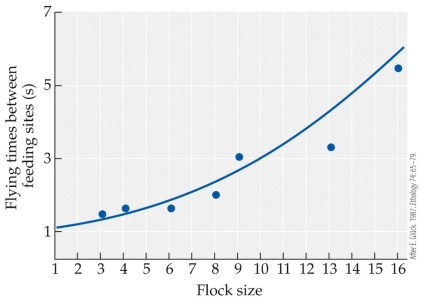 The figure shows data from a study on goldfinches that determined how foraging behavior changed with group size (referred to as "flock size").
- If flying flocks are more easily detected by predators, which flocks would you expect to be attacked most frequently?
The figure shows data from a study on goldfinches that determined how foraging behavior changed with group size (referred to as "flock size").
- If flying flocks are more easily detected by predators, which flocks would you expect to be attacked most frequently? (Multiple Choice)
4.9/5 (100)
(100) In a case where critical resources are clumped in space and males provide most of the parental care, the mating system is most likely to be
(Multiple Choice)
4.9/5 (73)
(73) Changes in behavior or diet triggered by stress about potential predation
(Multiple Choice)
4.8/5 (87)
(87) Which scenario would likely result in the highest transmission rates of pathogens among individuals in a group?
(Multiple Choice)
4.8/5 (86)
(86) You are studying foraging behaviors in a small seed-eating bird species. It takes each individual bird 3 seconds to find, handle, and consume one individual seed. Assume that each food patch has 100 seeds. Create a table (this will be referred to as Table 1) showing how long flocks of each size are expected to forage in a patch before completely depleting the resource. Then create a graph (this will be referred to as Figure 4) using the data in the table, with flock size (number of individuals) on the x-axis, and foraging time in a patch (in seconds) on the y-axis.
(Essay)
4.8/5 (84)
(84) In a case where critical resources are distributed evenly in space and males provide about half of the total parental care, the mating system is most likely to be
(Multiple Choice)
4.7/5 (82)
(82) Refer to the figures.
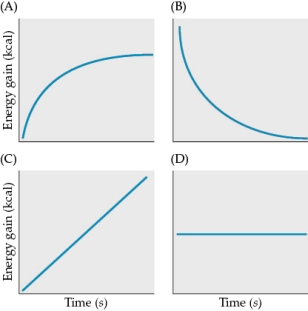 Suppose an animal is foraging in an area with an infinite amount of food. Which figure best depicts the animal's rate of energy gain?
 (Multiple Choice)
4.8/5 (86)
(86) Refer to the table.
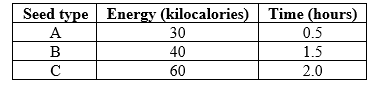 -The table lists the net energy values of various seed types, along with the time associated with a bird's finding and obtaining the food. Rank the seed types in terms of the bird's likelihood (from highest to lowest) of choosing this seed if it is trying to maximize its energy intake.
 (Multiple Choice)
4.9/5 (83)
(83) In which mating system do males mate with multiple females during a breeding season but females are monogamous?
(Multiple Choice)
4.8/5 (77)
(77) Refer to the figure.
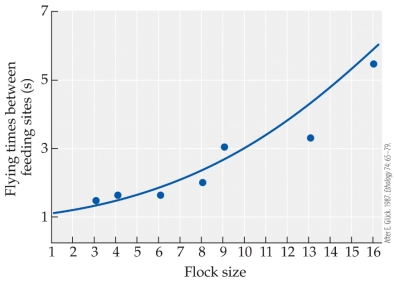 The figure shows data from a study on goldfinches to determine how foraging behavior changes with group size (referred to in the figure as flock size).
-If predator detection rates are positively associated with flock size, which flock(s) would you expect to be attacked least frequently?
The figure shows data from a study on goldfinches to determine how foraging behavior changes with group size (referred to in the figure as flock size).
-If predator detection rates are positively associated with flock size, which flock(s) would you expect to be attacked least frequently? (Multiple Choice)
4.9/5 (77)
(77) A lizard is blown out to sea during a hurricane. This type of storm occurs very infrequently-on average once every 100 years. The lizard washes up on the beach of a small island and finds some beetles on the beach. Which of the following is not a possible scenario that could help this lizard survive on the island?
(Multiple Choice)
4.9/5 (68)
(68) Refer to the figure.
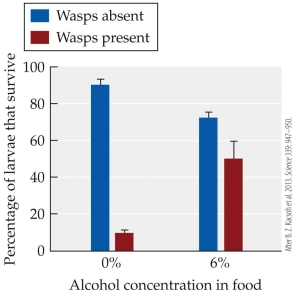 Females of certain parasitoid wasps lay their eggs on the larvae of female Drosophila melanogaster fruit flies and the hatched wasp larvae burrow through the fly larva, consuming and killing it. Fruit fly larvae sometimes feed on high alcohol food sources, such as rotting fruit, and are harmed by the alcohol-but any wasp larvae inside them are harmed even more. Kacsoh et al. (2013) found that when wasps were present, adult female fruit flies laid more than 90% of their eggs in high-alcohol foods, whereas when wasps were absent, they laid around 40% of their eggs in high-alcohol foods. Given this background and the experimental data in the figure, which of the following statements is true?
 (Multiple Choice)
4.9/5 (73)
(73) Which of the following statements about the effect of genes on behavior is false?
(Multiple Choice)
4.8/5 (71)
(71) Suppose a kestrel (a small predatory bird) is hunting a lizard. The kestrel catches the lizard by the end of its tail. The lizard would most likely
(Multiple Choice)
4.8/5 (100)
(100) Refer to the table.
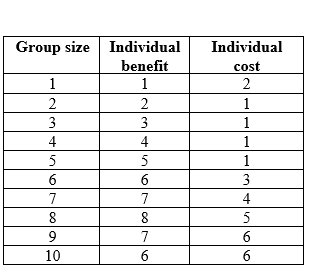 Suppose you are studying the optimal group size in a species. You collect the following data on the costs and benefits for each individual in groups of different sizes.
-Based on the data in the table, what is the optimal group size?
Suppose you are studying the optimal group size in a species. You collect the following data on the costs and benefits for each individual in groups of different sizes.
-Based on the data in the table, what is the optimal group size? (Multiple Choice)
4.7/5 (86)
(86) Based on the results of studies of male widowbird tail length and mating success, what would you predict would happen to male widowbirds over many generations in the absence of constraints on tail length?
(Multiple Choice)
4.8/5 (82)
(82) Refer to the figure.
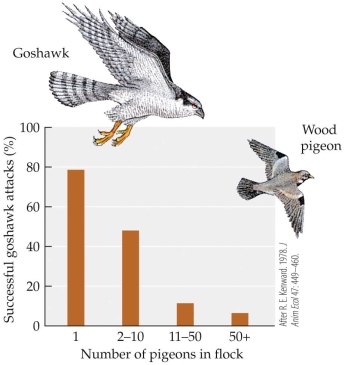 According to the figure, the success rate of attacks by goshawks hunting wood pigeons varies depending of the number of pigeons in the targeted flock (because the hawk is more likely to be detected if more pigeons are present). Relative to its success rate when attacking a flock of 2-??10 or 50 wood pigeons, how much greater is the success rate of a goshawk attacking a lone wood pigeon?
 (Multiple Choice)
4.8/5 (91)
(91) Females that are choosy about which males they mate with gain
(Multiple Choice)
4.7/5 (79)
(79) 
Filters
- Essay(0)
- Multiple Choice(0)
- Short Answer(0)
- True False(0)
- Matching(0)