



 Chat with AI
Exam 13: Parasitism

Exam 1: The Web of Life68 Questions
Exam 2: The Physical Environment76 Questions
Exam 3: The Biosphere73 Questions
Exam 4: Coping With Environmental Variation:74 Questions
Exam 5: Coping With Environmental Variation: Energy71 Questions
Exam 6: Evolution and Ecology68 Questions
Exam 7: Life History69 Questions
Exam 8: Behavioral Ecology71 Questions
Exam 9: Population Distribution and Abundance80 Questions
Exam 10: Population Dynamics68 Questions
Exam 11: Population Growth and Regulation69 Questions
Exam 12: Predation70 Questions
Exam 13: Parasitism72 Questions
Exam 14: Competition74 Questions
Exam 15: Mutualism and Commensalism71 Questions
Exam 16: The Nature of Communities71 Questions
Exam 17: Change in Communities73 Questions
Exam 18: Biogeography70 Questions
Exam 19: Species Diversity in Communities72 Questions
Exam 20: Production73 Questions
Exam 21: Energy Flow and Food Webs76 Questions
Exam 22: Nutrient Supply and Cycling76 Questions
Exam 23: Conservation Biology73 Questions
Exam 24: Landscape Ecology and Ecosystem Management71 Questions
Exam 25: Global Ecology74 Questions
Select questions type


Refer to the figure.
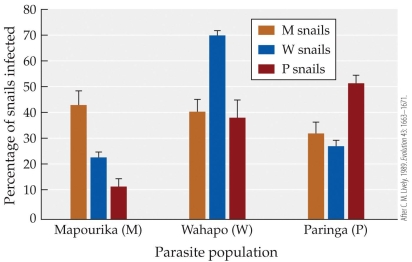 While sampling lakes in New Zealand for the number of snails infected with the Microphallus parasite, you get lost and aren't sure which lake you're sampling from. After returning to the lab, you identify the snails as Lake Paringa snails and determine the percentage of snails infected to be ~10%. Which lake did you most likely collect the snails from?
 (Multiple Choice)
4.9/5  (80)
(80) Humans have a long history of association with canines, which has led to the emergence of domestic dogs. Humans currently associate with dogs in different ways than they did historically. What type of relationship would a lap dog such as a Shih Tzu or a Chihuahua have with its owner? Could this relationship be considered parasitic?
(Essay)
4.9/5 (82)
(82) The most likely change caused by Vibrio cholerae in its hosts, which aids its dispersal to new hosts, is
(Multiple Choice)
4.9/5 (73)
(73) Which parasite would most likely be found in the human small intestine?
(Multiple Choice)
4.8/5 (88)
(88) In which way can a parasite change an ecological community?
(Multiple Choice)
4.9/5 (83)
(83) What is the advantage for a male cricket parasitized by hairworms to seek out water?
(Multiple Choice)
4.8/5 (84)
(84) Which statement about parasitic fungi, such as mildews, rusts, and smuts, is false?
(Multiple Choice)
4.9/5 (80)
(80) Which characteristic is an advantage that ectoparasites have over endoparasites?
(Multiple Choice)
4.9/5 (76)
(76) According to the basic host-pathogen model, if the combined death and recovery rate from a disease doubles, and the effectiveness of the disease to spread from infected to uninfected individuals also doubles, the threshold density should
(Multiple Choice)
4.9/5 (83)
(83) Climate change is predicted to have wide-ranging effects on species interactions and ultimately ecological communities. Which statement if true?
(Multiple Choice)
4.8/5 (82)
(82) The transmission coefficient of the hypothetical disease Dirks fever is 0.8. If the combined death and recovery rate is 0.4, what is the threshold density for Dirks fever?
(Multiple Choice)
4.8/5 (69)
(69) Two populations (population 1 and population 2) are suffering from disease outbreaks that spread rapidly (disease 1 and disease 2). Population 1 is only affected by disease 1 and population 2 is only affected by disease 2. The two populations are the same size and the same density. In population 1, disease 1 is sexually transmitted, and in population 2, disease 2 is transmitted by an insect vector. What major difference would you expect to see in the pattern of disease transmission between the two populations? How would you expect seasonality or mating strategy to affect the spread of the diseases? What methods could you use to control the spread of disease in each case?
(Essay)
4.9/5 (85)
(85) As a budding scientist you discover a parasite associated with your favorite organism. To learn more about the parasite and the organism, you study them in depth, learning that the organism attacks the parasite using memory cells in an effort to prevent infection. Which type of mechanism is the organism utilizing as a defense against the parasite?
(Multiple Choice)
4.9/5 (87)
(87) Suppose that a vertebrate has a mutation in the transferrin gene that makes the protein function less efficiently. Most likely, compared to individuals without the mutation, this individual would have _______ iron in its blood serum and _______ iron in the intercellular components of cells.
(Multiple Choice)
4.8/5 (62)
(62) What do the fungus that causes athlete's foot, the tick that spreads Lyme disease, and body lice all have in common?
(Multiple Choice)
4.9/5 (91)
(91) In humans, red blood cells that have been infected with the parasite that causes malaria (Plasmodium) are destroyed mainly in the
(Multiple Choice)
4.9/5 (84)
(84) Based on the results of Dobson and Meagher's study of bison, which statement is false?
(Multiple Choice)
4.8/5 (83)
(83) Kraaijeveld and colleagues performed studies with Drosophila strains that can mount an encapsulation defense. In the absence of encapsulation, wasp eggs that have the ability to avoid encapsulation hatch _______ other eggs that cannot avoid encapsulation. These studies demonstrate _______.
(Multiple Choice)
4.8/5 (90)
(90) 
Filters
- Essay(0)
- Multiple Choice(0)
- Short Answer(0)
- True False(0)
- Matching(0)