



 Chat with AI
Exam 13: Parasitism

Exam 1: The Web of Life68 Questions
Exam 2: The Physical Environment76 Questions
Exam 3: The Biosphere73 Questions
Exam 4: Coping With Environmental Variation:74 Questions
Exam 5: Coping With Environmental Variation: Energy71 Questions
Exam 6: Evolution and Ecology68 Questions
Exam 7: Life History69 Questions
Exam 8: Behavioral Ecology71 Questions
Exam 9: Population Distribution and Abundance80 Questions
Exam 10: Population Dynamics68 Questions
Exam 11: Population Growth and Regulation69 Questions
Exam 12: Predation70 Questions
Exam 13: Parasitism72 Questions
Exam 14: Competition74 Questions
Exam 15: Mutualism and Commensalism71 Questions
Exam 16: The Nature of Communities71 Questions
Exam 17: Change in Communities73 Questions
Exam 18: Biogeography70 Questions
Exam 19: Species Diversity in Communities72 Questions
Exam 20: Production73 Questions
Exam 21: Energy Flow and Food Webs76 Questions
Exam 22: Nutrient Supply and Cycling76 Questions
Exam 23: Conservation Biology73 Questions
Exam 24: Landscape Ecology and Ecosystem Management71 Questions
Exam 25: Global Ecology74 Questions
Select questions type


Refer to the figure.
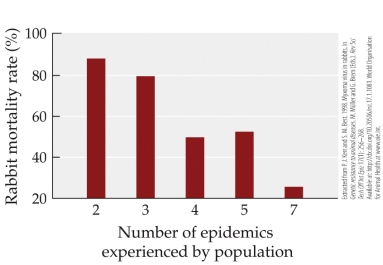 A population of rabbits has a mortality rate of 40%. The population would be hypothesized to have experienced _______ epidemics.
 (Multiple Choice)
4.8/5  (63)
(63) A bacterium that causes rash on the skin of mammals upon infection would be classified as a(n)
(Multiple Choice)
4.8/5 (87)
(87) Which statement about malaria and the life cycle of Plasmodium is false?
(Multiple Choice)
4.9/5 (74)
(74) Which of the following should reduce the critical threshold for the spread of disease?
(Multiple Choice)
5.0/5 (81)
(81) Which statement about the studies by Dybdahl and Lively on snails and their parasites is false?
(Multiple Choice)
4.9/5 (87)
(87) Refer to the figure.
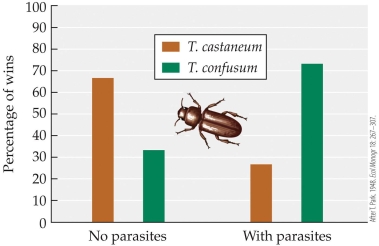 Thomas Park studied competition between two species of flour beetles, both with and without their protozoan parasite. The figure shows the results of his experiment. Based on these results, when the beetles were infected with the parasite, _______ was the dominant competitor. In cases without the parasite, _______ was the dominant competitor.
 (Multiple Choice)
4.9/5 (80)
(80) How does the protein transferrin assist in defenses against parasites?
(Multiple Choice)
4.8/5 (75)
(75) A flowering plant species and a honeycreeper (a type of bird) are both native to the Hawaiian Islands. The plant's flowers possess elongated curved structures with nectar at the base. The honeycreeper has a beak shape that matches the flower's size and shape and is traditionally the only pollinator of this species. A non-native bird species, however, (the Japanese white-eye) has recently been introduced to the Hawaiian Islands, and it is successful at extracting the nectar of the flowers despite having a short, straight bill. The white-eye creates a small hole near the base of the flowers thereby accessing nectar while bypassing the flower's reproductive structures. Would the white-eye be considered a parasite of the flower? Justify your answer.
(Essay)
5.0/5 (79)
(79) Which characteristic best distinguishes microparasites from macroparasites?
(Multiple Choice)
4.8/5 (91)
(91) In the context of host-parasite dynamics, a latent period is the time
(Multiple Choice)
4.8/5 (84)
(84) Eberhard's study of spiders and their parasitoid wasps showed that the
(Multiple Choice)
4.9/5 (76)
(76) Refer to the figure.
Figure 1
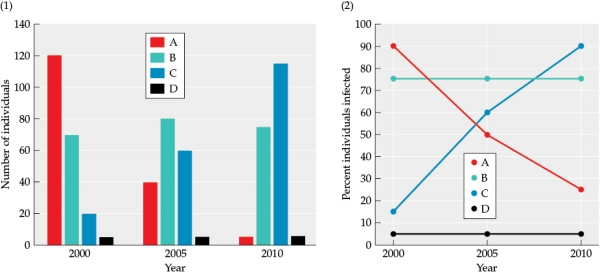 The figure shows data collected on a species of fish that lives on a coral reef. The fish were captured and studied three times-in 2000, 2005, and 2010. Four genotypes were found in an area of the coral reef (shown as A, B, C, and D). The figure shows: (1) the number of individuals of each genotype captured during each year, and (2) the percent of individuals infected with parasites captured during each year.
-Suppose this reef fish is found on several reefs. Each reef is largely isolated from the others. The parasite species is found on all of these reefs. The frequencies of fish genotypes vary across the different reefs and the parasites rapidly evolve to be able to circumvent the fish's parasite defense mechanisms. Under which conditions might the parasites be more effective at colonizing individuals from its home reef, and when would parasites be more successful at colonizing individuals from another reef?
The figure shows data collected on a species of fish that lives on a coral reef. The fish were captured and studied three times-in 2000, 2005, and 2010. Four genotypes were found in an area of the coral reef (shown as A, B, C, and D). The figure shows: (1) the number of individuals of each genotype captured during each year, and (2) the percent of individuals infected with parasites captured during each year.
-Suppose this reef fish is found on several reefs. Each reef is largely isolated from the others. The parasite species is found on all of these reefs. The frequencies of fish genotypes vary across the different reefs and the parasites rapidly evolve to be able to circumvent the fish's parasite defense mechanisms. Under which conditions might the parasites be more effective at colonizing individuals from its home reef, and when would parasites be more successful at colonizing individuals from another reef? (Essay)
4.8/5 (77)
(77) In the years since Myxoma was introduced to Australia, the virus has _______ and rabbits have _______ resistance to the virus.
(Multiple Choice)
4.8/5 (71)
(71) Some plants protect themselves against specific parasites by means of _______. This defense system works much like the memory cells of the vertebrate immune system.
(Multiple Choice)
4.9/5 (70)
(70) Refer to the figure.
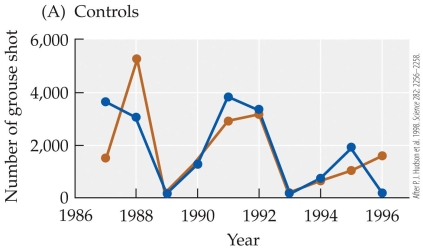
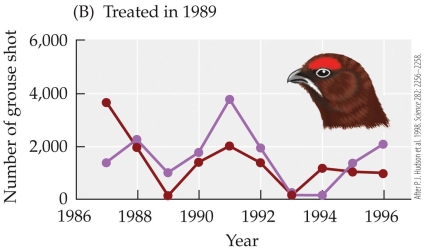
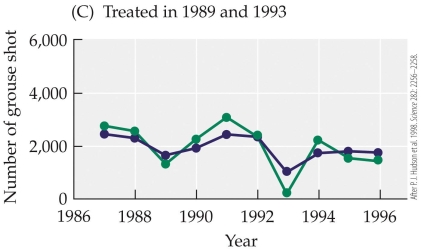 The figure shows results from a study by Hudson and colleagues on red grouse and their nematode parasite. The figures show the cycling of six red grouse populations subjected to three treatments: (A) two control populations, (B) two populations treated for nematode parasites in 1989, and (C) two populations treated for parasites in 1989 and 1993. Each of the six grouse populations is designated by a different color. These results show that removal of the parasite
 (Multiple Choice)
4.8/5 (94)
(94) Thomas Park's studies of flour beetles and their protozoan parasite best exemplified the principle that
(Multiple Choice)
4.9/5 (84)
(84) Which statement about the snail-trematode system studied by Dybdahl and Lively is false?
(Multiple Choice)
4.8/5 (76)
(76) The transmission coefficient of the hypothetical disease Dumas fever is 0.2. If the combined death and recovery rate is 0.4, what is the threshold density for Dumas fever?
(Multiple Choice)
4.9/5 (91)
(91) Two parasites are found in a population of primates. Parasite 1 is an ectoparasite that can survive for up to 2 weeks off of the host. Parasite 2 is an endoparasite that can survive for 1 day outside of the host, but only in ideal conditions. How would the patterns and mode of spread differ between the two parasite species? What kinds of social behaviors would make these parasites more or less successful?
(Essay)
4.9/5 (98)
(98) 
Filters
- Essay(0)
- Multiple Choice(0)
- Short Answer(0)
- True False(0)
- Matching(0)