



 Chat with AI
Exam 20: Production

Exam 1: The Web of Life68 Questions
Exam 2: The Physical Environment76 Questions
Exam 3: The Biosphere73 Questions
Exam 4: Coping With Environmental Variation:74 Questions
Exam 5: Coping With Environmental Variation: Energy71 Questions
Exam 6: Evolution and Ecology68 Questions
Exam 7: Life History69 Questions
Exam 8: Behavioral Ecology71 Questions
Exam 9: Population Distribution and Abundance80 Questions
Exam 10: Population Dynamics68 Questions
Exam 11: Population Growth and Regulation69 Questions
Exam 12: Predation70 Questions
Exam 13: Parasitism72 Questions
Exam 14: Competition74 Questions
Exam 15: Mutualism and Commensalism71 Questions
Exam 16: The Nature of Communities71 Questions
Exam 17: Change in Communities73 Questions
Exam 18: Biogeography70 Questions
Exam 19: Species Diversity in Communities72 Questions
Exam 20: Production73 Questions
Exam 21: Energy Flow and Food Webs76 Questions
Exam 22: Nutrient Supply and Cycling76 Questions
Exam 23: Conservation Biology73 Questions
Exam 24: Landscape Ecology and Ecosystem Management71 Questions
Exam 25: Global Ecology74 Questions
Select questions type


According to Schindler's studies of lakes in Ontario, Canada, NPP lake ecosystems are most limited by the supply of
(Multiple Choice)
4.7/5  (66)
(66) Plant species from resource-_______ environments often have low growth responses to fertilization because these plants typically have _______ intrinsic growth rates.
(Multiple Choice)
4.8/5 (87)
(87) Which value can be estimated most directly from the eddy covariance?
(Multiple Choice)
4.9/5 (68)
(68) Which statement accurately describes a way plants allocate carbon that is not used in respiration?
(Multiple Choice)
4.8/5 (100)
(100) In which biome would one most likely find the smallest percentage of NPP devoted to roots?
(Multiple Choice)
4.8/5 (70)
(70) Gross primary production is higher in tropical forests than boreal forests primarily as a consequence of what ecosystem characteristic?
(Multiple Choice)
4.8/5 (63)
(63) Refer to the table.
Table 1
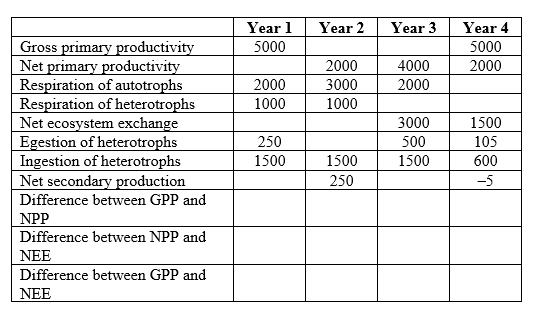 You are studying the movement of energy through an ecosystem. You collect data on energy use at the same site across four years, measured in g/m2/year. Assume that the site is sampled at the same location on the same date each year. Based on the data you collected (Table 1), create a completed table (this will be referred to as Table 2) with values in all of the cells.
 (Essay)
4.9/5 (80)
(80) Suppose that the net secondary production in a community is 1,600 kilograms. The respiration of heterotrophs is 3,000 kilograms, and the egestion is 800 kilograms. Plant respiration is 6,500 kilograms. How much plant material did the heterotrophs ingest?
(Multiple Choice)
4.8/5 (89)
(89) Suppose that net secondary production in an ecosystem is only 15% of the total amount of plant material ingested by heterotrophs. If herbivores egest 20% of what they ingest, what percentage of what they ingest goes to heterotroph respiration?
(Multiple Choice)
4.9/5 (84)
(84) Refer to the figure.
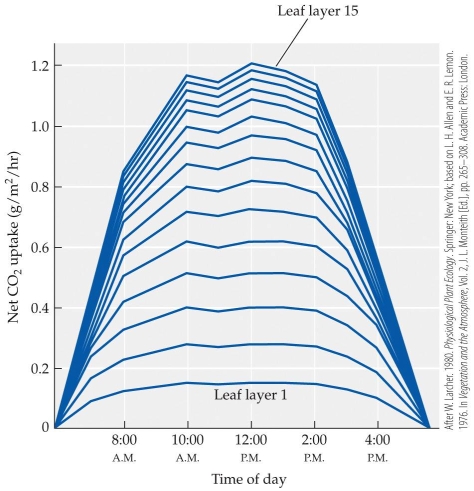 The figure shows the CO2 uptake by various leaf layers in a tropical forest. Leaf layer 1, at the top of the canopy, has the highest net rates of photosynthesis and layer 15 has the lowest net rates.
-What principles of production explain this pattern?
The figure shows the CO2 uptake by various leaf layers in a tropical forest. Leaf layer 1, at the top of the canopy, has the highest net rates of photosynthesis and layer 15 has the lowest net rates.
-What principles of production explain this pattern? (Multiple Choice)
4.8/5 (81)
(81) In his experiments in lakes in Ontario, Canada, Schindler found evidence for phosphorus limitation of NPP. A massive increase in _______ was responsible for the increase of NPP in response to phosphorus addition.
(Multiple Choice)
4.9/5 (79)
(79) The tropical rainforest in Costa Rica would most likely have a leaf area index of
(Multiple Choice)
4.7/5 (78)
(78) 
Filters
- Essay(0)
- Multiple Choice(0)
- Short Answer(0)
- True False(0)
- Matching(0)