



 Chat with AI
Exam 5: Epidemiology, Biostatistics, and Medical Informatics

Exam 1: Anatomy265 Questions
Exam 2: Behavioral Sciences178 Questions
Exam 3: Biochemistry102 Questions
Exam 4: Embryology59 Questions
Exam 5: Epidemiology, Biostatistics, and Medical Informatics94 Questions
Exam 6: Genetics88 Questions
Exam 7: Histology46 Questions
Exam 8: Immunology147 Questions
Exam 9: Microbiology and Virology330 Questions
Exam 10: Pathology817 Questions
Exam 11: Pharmacology and Toxicology509 Questions
Exam 12: Physiology339 Questions
Exam 13: Psychiatry and Psychotherapy23 Questions
Select questions type


Blood pressure readings are taken from a group of people who have no known medical issues. For men and women, the mean readings and related standard deviations (SDs) for systolic blood pressure (SBP) are shown by age group: 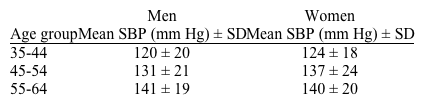 If hypertension is defined as SBP >140 mm Hg, approximately what percentage of men age 35-44 in this sample will be classified as having hypertension, assuming a normal (Gaussian) distribution?
 (Multiple Choice)
4.9/5  (73)
(73) A research is being carried out to assess the capabilities of a novel test for identifying ovarian cancer. The study included 200 women who had ovarian cancer and 300 people who did not. According to the findings of the study, the test is 80% sensitive and 70% specific. Which of the following is the approximate number of false negative test results found in this research based on this information?
(Multiple Choice)
4.9/5 (80)
(80) A research is being carried out to evaluate the efficacy of a novel medicine X added to conventional antihypertensive therapy vs standard antihypertensive therapy alone in avoiding the development of proteinuria in patients recently diagnosed with essential hypertension. Five years following diagnosis, 97 of 100 patients on drug X with conventional antihypertensive therapy did not develop proteinuria, but 90 of 100 patients on standard antihypertensive therapy did. Which of the following indicates the approximate number of patients with essential hypertension who need to be treated with medicine X to prevent 1 additional patient from getting proteinuria within 5 years, based on these findings?
(Multiple Choice)
4.8/5 (89)
(89) For the treatment of postmenopausal symptoms, a novel estrogen receptor agonist is being studied. A prospective research found that the medicine raises the incidence of DVT in treated women who smoke compared to untreated women who smoke, with a relative risk (RR) of 1.70 and a p-value of 0.01. In nonsmokers, there is no increased incidence of DVT with drug use (RR = 0.96; p-value = 0.68). Which of the following best characterizes this occurrence?
(Multiple Choice)
4.7/5 (76)
(76) A research team is looking into the relationship between BMI and blood pressure in a random sample of youngsters aged 12 to 16. Following data collection, they do a correlation analysis at a 1% significance level. The researchers discover that BMI has a r = 0.46 (p 0.001) correlation with systolic blood pressure and a r = 0.37 (p 0.001) correlation with diastolic blood pressure. Which of the following interpretations of these results is most accurate?
(Multiple Choice)
4.9/5 (82)
(82) A novel portable cholesterol-measuring gadget is being developed for use in underprivileged medical settings. A patient's cholesterol level is discovered to be 200 mg/dL, 201 mg/dL, and 200 mg/dL on three independent readings of the same blood sample during clinical trials of an early prototype. The identical sample had a cholesterol level of 260 mg/dL when measured using the gold standard technique. Which of the following best describes the new cholesterol-measuring device?
(Multiple Choice)
4.9/5 (87)
(87) A health care accrediting group is conducting an annual evaluation of a suburban hospital. Iatrogenic infection rates for all key hospital services are examined as part of the procedure. The data for inpatient surgical infections during the last year are provided below.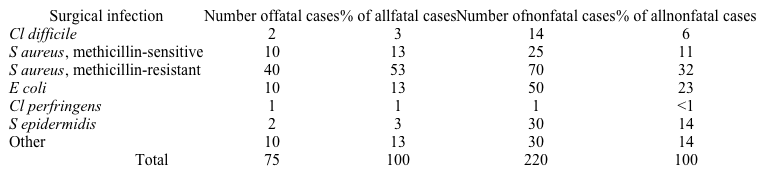 In this hospital, what is the case-fatality rate for methicillin-resistant S aureus surgical infections?
 (Multiple Choice)
4.9/5 (88)
(88) A 45-year-old woman arrives to the office complaining of a palpable thyroid node. According to her medical history, she was diagnosed with medulloblastoma as a youngster and treated with chemotherapy and external beam radiation. Thyroid fine-needle aspiration reveals no cancerous cells. "What are the possibilities that I don't have thyroid cancer?" the patient wonders as the test findings are revealed to her. Which of the diagnostic test parameters listed below would be most helpful in addressing this patient's question?
(Multiple Choice)
4.9/5 (79)
(79) A geneticist is curious about the possible causes of a congenital anomaly. She speculates that acetaminophen usage during the first trimester of pregnancy may be linked to the anomaly. In her study, a random sample of moms with and without the anomaly is drawn from official birth data. Personal interviews with the moms are then done to identify fetal exposure to acetaminophen. According to the findings, moms of children who did not have the anomaly used acetaminophen less often throughout the first trimester. Which of the following forms of bias is most likely to occur in this sort of study?
(Multiple Choice)
4.7/5 (78)
(78) A novel tumor marker is being researched for its potential application in the diagnosis of ovarian cancer. A 400-woman sample is divided into two groups depending on the presence or absence of BRCA mutations. Serum levels of the novel marker are measured in both groups, and both groups of women are subjected to standard screening to identify their illness status. The top curves depict the distribution of the new serum marker in women with BRCA mutations, whereas the bottom curves depict the distribution of the new serum marker in women without BRCA mutations. The recommended serum marker cutoff value for both groups is 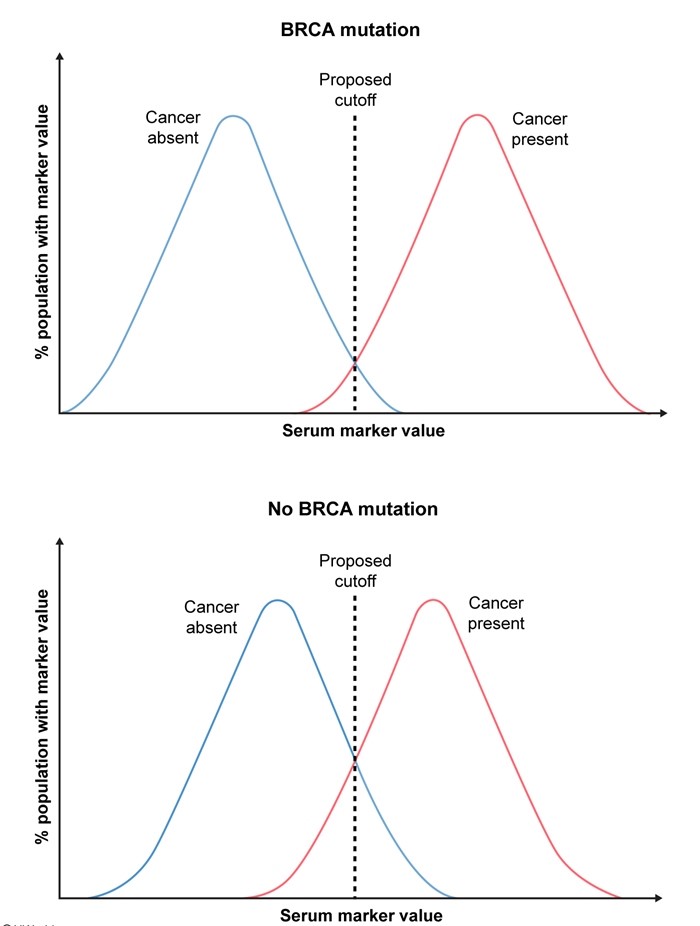 . Use of the new serum marker in women with BRCA mutations, compared with those without BRCA mutations, is associated with which of the following?
 (Multiple Choice)
4.9/5 (75)
(75) A prospective research with a relative risk (RR) of 1.81 and a p-value of 0.03 reveals a relationship between alcohol use and transitional bladder cancer. They next divide the research participants into two groups, smokers and nonsmokers, and evaluate the relationship between alcohol use and bladder cancer once more: 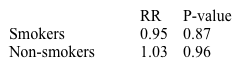 Which of the following best explains the difference between the overall and stratified results?
 (Multiple Choice)
4.8/5 (75)
(75) A study is being done to examine the link between smoking status and forced expiratory volume in one second (FEV1). Subjects are chosen at random and classified depending on their smoking status. Group A includes 200 nonsmokers, Group B includes 200 light smokers (1-7 cigarettes per day), Group C includes 200 intermediate smokers (8-22 cigarettes per day), and Group D includes 200 heavy smokers (23+ cigarettes per day). All individuals' FEV1 levels are quantified using appropriately calibrated office spirometers. Which of the following statistical methods is best for comparing the mean FEV1 findings across all four groups?
(Multiple Choice)
4.9/5 (82)
(82) A case-control research was carried out to determine the relationship between simvastatin medication and fibrinogen levels in patients undergoing percutaneous coronary intervention. Cases were defined as patients who had percutaneous coronary intervention and had high periprocedural fibrinogen levels (>400 mg/dL), whereas controls were defined as patients who had percutaneous coronary intervention but had normal fibrinogen levels (200-400 mg/dL). Every patient's history of simvastatin medication was reviewed in detail. The table below shows the number of patients who met each of the categorization criteria.  Which of the following is the best statistical method to estimate the association between simvastatin use and high serum fibrinogen levels in this study?
 (Multiple Choice)
4.8/5 (77)
(77) An intern in the endocrinology department is tasked with doing a chart review of all patients hospitalized with diabetes-related cardiovascular problems in the previous 6 months. According to the intern's early data analysis, there were 400 such patients, and their blood cholesterol levels were regularly distributed, with a mean of 220 mg/dL and a standard deviation of 10 mg/dL. Based on these findings, how many individuals in this research could be predicted to have blood cholesterol levels more than 240 mg/dL?
(Multiple Choice)
4.9/5 (70)
(70) A group of psychiatrists has detected an unusually high number of elderly people suffering from depression in the local neighborhood. It is decided to perform a cross-sectional research to evaluate the prevalence of depression in this particular group. The following are estimates of the community's depression prevalence (cases per 100 people): 11ec160b 3715 f593 9249 bb76ef083814 MD0001 00 Suppose a psychiatrist meets a 65-year-old lady, a 72-year-old man, and an 84-year-old woman from this neighborhood during an afternoon clinic. What is the likelihood that none of the three patients suffers depression if there is no relationship between them?
(Multiple Choice)
4.8/5 (76)
(76) UWRLD99, a new serum biomarker, is being studied for the early identification of pancreatic cancer. UWRLD99 concentrations (measured in international units [IU] per dL) have been reported to be increased in pancreatic cancer patients. The image below depicts test results from 200 volunteers ("healthy") and 190 patients with biopsy-proven pancreatic cancer ("diseased"). The researchers used a threshold of 200 IU/dL to establish the sensitivity and specificity of UWRLD99 for pancreatic cancer (indicated by the solid vertical line). 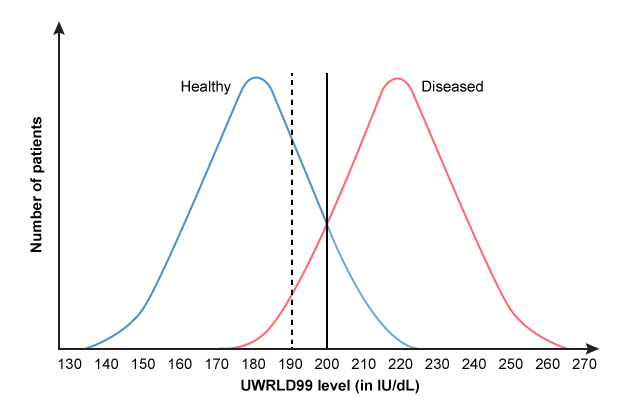 Which of the following would most likely be observed if they had selected a lower cutoff, as indicated by the dashed vertical line?
 (Multiple Choice)
4.8/5 (86)
(86) A 62-year-old man with diabetes, hypertension, and hyperlipidemia arrives at an academic medical center's emergency room complaining of chest discomfort, nausea, vomiting, and diaphoresis. An ECG reveals ST elevation in the anterior leads, as well as substantially increased cardiac enzymes. The center's researchers are planning a randomized controlled study to explore the hypothesis that medication B will reduce the mortality associated with acute ST-elevation myocardial infarction relative to standard of care. Which of the following would investigators want to optimize to guarantee that they do not miss a difference between medication B and standard of treatment (if one exists)?
(Multiple Choice)
4.8/5 (83)
(83) Researchers examining the impact of hormone replacement therapy (HRT) on the risk of myocardial infarction (MI) in postmenopausal women estimated the relative risk (RR) of MI to be 1.30 (p = 0.07) in women who use HRT vs those who do not. According to the researchers, there is no statistically significant increased risk of MI with HRT (based on a threshold of = 0.05). Following that, the findings of a meta-analysis show that postmenopausal women who use HRT had an elevated risk of MI, with an overall RR = 1.32 (p = 0.03) compared to those who do not. In the first study, which of the following was the most likely problem?
(Multiple Choice)
4.8/5 (86)
(86) A novel biomarker has been demonstrated to aid in the early diagnosis of non-small cell lung cancer. A preliminary review of a cohort trial of this novel test shows that its use increases lung cancer patient survival by 3 months when compared to individuals identified using conventional techniques. A subsequent investigation indicates no difference between the two groups in 6-month death rates. Which of the following variables best explains the study's findings?
(Multiple Choice)
4.8/5 (76)
(76) A medical study group is examining the efficacy of Superstatin, a novel lipid-lowering medicine that is being promoted directly to consumers as a revolutionary new therapy to prevent heart attacks. The drug's producer claims that it is more efficacious than currently available hypolipidemic medicines in the primary prevention of myocardial infarction. The following are the findings of a 5-year, randomized, double-blind, controlled trial to assess the effectiveness of Superstatin.  Compared to the control medication, how many patients need to be treated with Superstatin to prevent one additional myocardial infarction?
 (Multiple Choice)
4.7/5 (83)
(83) 
Filters
- Essay(0)
- Multiple Choice(0)
- Short Answer(0)
- True False(0)
- Matching(0)