



 Chat with AI
Exam 10: The Deaths of Stars

Exam 1: Here and Now97 Questions
Exam 2: A Users Guide to the Sky116 Questions
Exam 3: Cycles of the Sun and Moon154 Questions
Exam 4: The Origin of Modern Astronomy144 Questions
Exam 5: Light and Telescopes156 Questions
Exam 6: Atoms and Spectra125 Questions
Exam 7: The Sun146 Questions
Exam 8: The Family of Stars190 Questions
Exam 9: The Formation and Structure of Stars136 Questions
Exam 10: The Deaths of Stars128 Questions
Exam 11: Neutron Stars and Black Holes99 Questions
Exam 12: The Milky Way Galaxy117 Questions
Exam 13: Galaxies: Normal and Active151 Questions
Exam 14: Modern Cosmology112 Questions
Exam 15: Origin of the Solar System and Extrasolar Planets104 Questions
Exam 16: Earth and Moon: Bases for Comparative Planetology98 Questions
Exam 17: Mercury, Venus, and Mars83 Questions
Exam 18: The Outer Solar System137 Questions
Exam 19: Meteorites, Asteroids, and Comets91 Questions
Exam 20: Astrobiology: Life on Other Worlds97 Questions
Select questions type


Synchrotron radiation occurs when high-speed electrons move through a magnetic field.
(True/False)
4.9/5  (73)
(73) A(n) ____________________ is the sudden expulsion of the outer layers of a moderate mass star that has a dormant carbon core.
(Short Answer)
4.9/5 (72)
(72) What is the difference between a planetary nebula and a supernova remnant?
(Essay)
4.8/5 (93)
(93) No known white dwarf has a mass greater than the Chandrasekhar limit.
(True/False)
4.8/5 (78)
(78)  and 4-

In A.D. 1054, Chinese astronomers observed the appearance of a new star, whose location is now occupied by
(Multiple Choice)
4.9/5 (77)
(77) Explain the sequence of fusion shell formation in massive stars and thus the generation of nested shells.
(Essay)
4.9/5 (74)
(74) Star clusters are important to our study of the lives of high-mass versus low-mass stars because
(Multiple Choice)
4.8/5 (72)
(72) Which of the following nuclear fuels does a twenty-solar-mass star NOT fuse over the course of its entire evolution?
(Multiple Choice)
4.9/5 (79)
(79) The diagram below shows a light curve from a supernova. How many days after maximum light did it take for the supernova to decrease in brightness by a factor of 100?
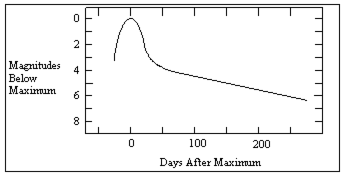
(Multiple Choice)
4.8/5 (81)
(81) What properties of degenerate matter are important to the structure of stars? Why?
(Essay)
4.9/5 (72)
(72) A white dwarf whose red giant companion dumps hydrogen onto it may
(Multiple Choice)
4.8/5 (89)
(89) A(n) _________ is a collection of 105 to 106 stars in a region 10 to 30 pc in diameter. The stars in the collection tend to be more than 109 years old and mostly yellow and red stars.
(Multiple Choice)
4.9/5 (80)
(80) A white dwarf converts __________________ energy into _________________ energy.
(Multiple Choice)
4.7/5 (81)
(81) 
Filters
- Essay(0)
- Multiple Choice(0)
- Short Answer(0)
- True False(0)
- Matching(0)