



 Chat with AI
Exam 10: The Deaths of Stars

Exam 1: Here and Now97 Questions
Exam 2: A Users Guide to the Sky116 Questions
Exam 3: Cycles of the Sun and Moon154 Questions
Exam 4: The Origin of Modern Astronomy144 Questions
Exam 5: Light and Telescopes156 Questions
Exam 6: Atoms and Spectra125 Questions
Exam 7: The Sun146 Questions
Exam 8: The Family of Stars190 Questions
Exam 9: The Formation and Structure of Stars136 Questions
Exam 10: The Deaths of Stars128 Questions
Exam 11: Neutron Stars and Black Holes99 Questions
Exam 12: The Milky Way Galaxy117 Questions
Exam 13: Galaxies: Normal and Active151 Questions
Exam 14: Modern Cosmology112 Questions
Exam 15: Origin of the Solar System and Extrasolar Planets104 Questions
Exam 16: Earth and Moon: Bases for Comparative Planetology98 Questions
Exam 17: Mercury, Venus, and Mars83 Questions
Exam 18: The Outer Solar System137 Questions
Exam 19: Meteorites, Asteroids, and Comets91 Questions
Exam 20: Astrobiology: Life on Other Worlds97 Questions
Select questions type


A(n) _________ is a collection of 10 to 1000 stars in a region about 25 pc in diameter. The stars in the collection are typically quite young.
(Multiple Choice)
4.7/5  (81)
(81) When material expanding away from a star in a binary system leaves a star's Roche lobe,
(Multiple Choice)
4.9/5 (71)
(71) ___________ clusters are compact, round, and red, containing mostly old stars.
(Short Answer)
4.8/5 (79)
(79) In the orbital plane of a binary star system matter can be transferred from one star to the other through the ___________, located directly between the two stars is the point where the Roche lobes meet.
(Multiple Choice)
4.8/5 (73)
(73) Giant and supergiant stars are rare because that stage of stellar evolution is short.
(True/False)
4.8/5 (77)
(77) Electrons moving in a strong magnetic field emit ____________________ radiation.
(Short Answer)
4.8/5 (90)
(90) _________ is a form of electromagnetic radiation produced by rapidly moving electrons spiraling through magnetic fields.
(Multiple Choice)
4.8/5 (90)
(90) Why do many planetary nebulae show ring-like features on the sky instead of spheres?
(Essay)
4.8/5 (88)
(88) A gas in which the pressure no longer depends on the temperature of the gas is said to be ____________________.
(Short Answer)
4.9/5 (87)
(87) Type II supernovae are believed to occur when the cores of massive stars collapse.
(True/False)
5.0/5 (87)
(87) Stars with ˜0.4-4 solar masses swell into giants when hydrogen is exhausted in their centers.
(True/False)
4.9/5 (72)
(72) A star begins fusing hydrogen to helium the moment it leaves the main sequence.
(True/False)
4.8/5 (84)
(84) Mass is transferred from a normal star in a close binary system toward a white dwarf. The material that is transferred to the white dwarf forms a rapidly growing whirlpool of material known around the white dwarf known as a(n)
(Multiple Choice)
4.8/5 (74)
(74) Hydrogen fusion does not occur in stars in the giant region of the H-R diagram.
(True/False)
4.8/5 (81)
(81) 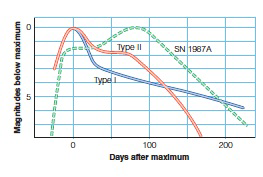 The SN 1987A event shown above is which type of supernova?
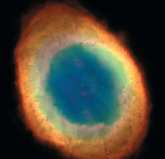 The nebula shown above is an example of a _____________ nebula.
 (Multiple Choice)
4.9/5 (76)
(76) 
Filters
- Essay(0)
- Multiple Choice(0)
- Short Answer(0)
- True False(0)
- Matching(0)