



 Chat with AI
Exam 7: Perfect Competition

Exam 1: Introducing the Economic Way of Thinking254 Questions
Exam 2: Production Possibilities, Opportunity Cost, and Economic Growth209 Questions
Exam 3: Market Demand and Supply361 Questions
Exam 4: Markets in Action259 Questions
Exam 5: Price Elasticity of Demand181 Questions
Exam 6: Production Costs254 Questions
Exam 7: Perfect Competition226 Questions
Exam 8: Monopoly175 Questions
Exam 9: Monopolistic Competition and Oligopoly166 Questions
Exam 10: Labor Markets and Income Distribution185 Questions
Exam 11: Gross Domestic Product207 Questions
Exam 12: Business Cycles and Unemployment199 Questions
Exam 13: Inflation131 Questions
Exam 14: Aggregate Demand and Supply83 Questions
Exam 15: Fiscal Policy205 Questions
Exam 16: The Public Sector131 Questions
Exam 17: Federal Deficits, Surpluses, and the National Debt102 Questions
Exam 18: Money and the Federal Reserve System159 Questions
Exam 19: Money Creation250 Questions
Exam 20: Policy Disputes Using the Self-Correcting Aggregate Demand and Supply Model246 Questions
Exam 21: International Trade and Finance251 Questions
Exam 22: Economies in Transition108 Questions
Exam 23: Growth and the Less-Developed Countries121 Questions
Select questions type


Which of the following offers the fullest explanation of why "price equals marginal cost" is the rule from marginal analysis that indicates the profit-maximizing output level?
(Multiple Choice)
4.9/5  (81)
(81) The neighborhood ice cream shop finds that when it charges $3 per ice cream cone, its total revenues are $90,000. It has total variable costs of $30,000 and total fixed costs of $40,000. From this we can infer the:
(Multiple Choice)
4.8/5 (78)
(78) In a perfectly competitive industry, assume there is a permanent increase in demand for a product. The process of transition to a new long-run equilibrium will include:
(Multiple Choice)
4.8/5 (75)
(75) Exhibit 7-17 Marginal revenue and cost per unit curves 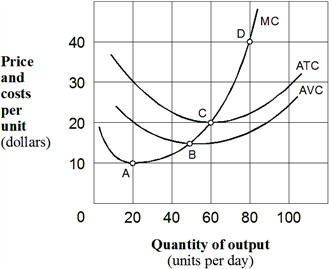 As shown in Exhibit 7-17, the price at which the firm earns zero economic profit in the short-run is:
 (Multiple Choice)
4.9/5 (74)
(74) Exhibit 7-5 A firm's MR and MC curves 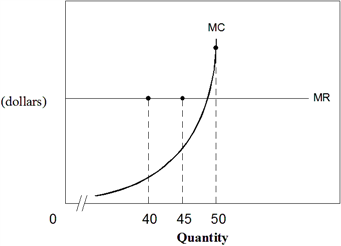 In Exhibit 7-5, a firm is currently producing 40 units of output. What would you advise this firm to do?
 (Multiple Choice)
4.9/5 (64)
(64) A perfectly competitive market is characterized by the free entry and exit of firms.
(True/False)
4.9/5 (78)
(78) The supply curve for a perfectly competitive firm is its marginal cost curve for all levels of output.
(True/False)
4.8/5 (93)
(93) Exhibit 7-6 A firm's cost and MC curves 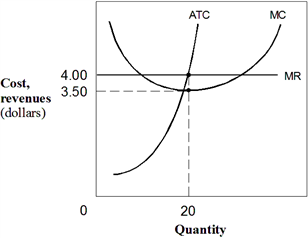 In Exhibit 7-6, if this firm is currently producing 20 units of output, this firm:
 (Multiple Choice)
4.8/5 (69)
(69) Suppose that price is below the minimum average total cost (ATC) but above the minimum average variable cost (AVC), and the market price is expected to rise at least to ATC in the near future. In the short run, a firm that is a price taker would:
(Multiple Choice)
4.9/5 (77)
(77) Jerome, the florist, sold 500 bridesmaid's bouquets in June. He estimates his costs that month were ATC = $10, AVC = $6, and MC = $9. If he sold each bouquet at the constant market price of $9, Jerome:
(Multiple Choice)
4.8/5 (72)
(72) Profit is maximized when which of the following conditions occurs?
(Multiple Choice)
4.8/5 (84)
(84) The most profitable output level can be found by looking at which two curves?
(Multiple Choice)
4.8/5 (68)
(68) If the market price is $5 and you are currently producing at a level where average total cost is $3 and falling, you should:
(Multiple Choice)
4.9/5 (72)
(72) In long-run equilibrium, the typical perfectly competitive firm will:
(Multiple Choice)
4.7/5 (71)
(71) If a firm in a competitive industry is making zero economic profit but still producing, it must be the case that:
(Multiple Choice)
4.8/5 (91)
(91) Exhibit 7-5 A firm's MR and MC curves 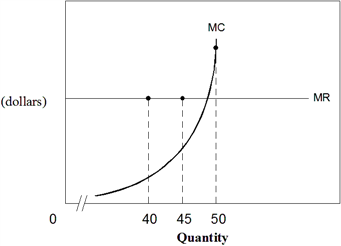 In Exhibit 7-5, suppose a firm is currently producing 50 units of output. What would you advise this firm to do?
 (Multiple Choice)
4.8/5 (85)
(85) Exhibit 7-2 Total revenue and total cost graph 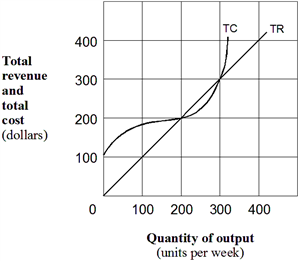 In Exhibit 7-2, if output is 200 units per week, economic profit for the firm is:
 (Multiple Choice)
4.8/5 (92)
(92) 
Filters
- Essay(0)
- Multiple Choice(0)
- Short Answer(0)
- True False(0)
- Matching(0)