



 Chat with AI
Exam 7: Perfect Competition

Exam 1: Introducing the Economic Way of Thinking254 Questions
Exam 2: Production Possibilities, Opportunity Cost, and Economic Growth209 Questions
Exam 3: Market Demand and Supply361 Questions
Exam 4: Markets in Action259 Questions
Exam 5: Price Elasticity of Demand181 Questions
Exam 6: Production Costs254 Questions
Exam 7: Perfect Competition226 Questions
Exam 8: Monopoly175 Questions
Exam 9: Monopolistic Competition and Oligopoly166 Questions
Exam 10: Labor Markets and Income Distribution185 Questions
Exam 11: Gross Domestic Product207 Questions
Exam 12: Business Cycles and Unemployment199 Questions
Exam 13: Inflation131 Questions
Exam 14: Aggregate Demand and Supply83 Questions
Exam 15: Fiscal Policy205 Questions
Exam 16: The Public Sector131 Questions
Exam 17: Federal Deficits, Surpluses, and the National Debt102 Questions
Exam 18: Money and the Federal Reserve System159 Questions
Exam 19: Money Creation250 Questions
Exam 20: Policy Disputes Using the Self-Correcting Aggregate Demand and Supply Model246 Questions
Exam 21: International Trade and Finance251 Questions
Exam 22: Economies in Transition108 Questions
Exam 23: Growth and the Less-Developed Countries121 Questions
Select questions type


In the short run, the supply curve for a perfectly competitive firm is its marginal cost curve for all levels of output.
(True/False)
4.8/5  (82)
(82) If a firm's marginal revenue from its 100th unit of output is $50 and the marginal cost from its 100th unit of output is $45, then in the short run this firm should:
(Multiple Choice)
4.8/5 (93)
(93) Exhibit 7-1 Quantity and total revenue data for a firm 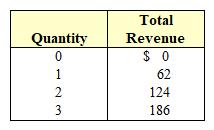 Exhibit 7-1 indicates that this firm is operating in which type of market structure?
 (Multiple Choice)
4.7/5 (94)
(94) Which of the following best explains why a firm in a perfectly competitive market must take the price determined in the market?
(Multiple Choice)
4.9/5 (74)
(74) If a perfectly competitive firm cannot cover all of its costs, then it should shut down in the short run.
(True/False)
4.9/5 (65)
(65) Exhibit 7-11 A firm's cost and marginal revenue curves 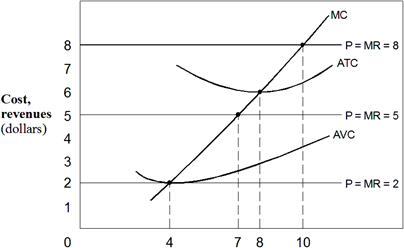 In Exhibit 7-11, when the price is $5, the firm:
 (Multiple Choice)
4.8/5 (81)
(81) Exhibit 7-11 A firm's cost and marginal revenue curves 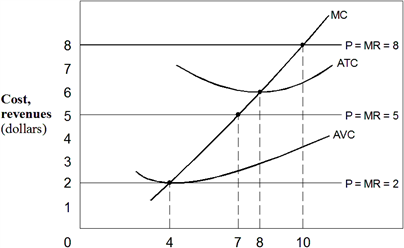 In Exhibit 7-11, when the price rises from $5 to $8, the profit-maximizing (or loss-minimizing) firm goes from making a:
 (Multiple Choice)
4.9/5 (78)
(78) If a business firm is not operating at the point where MR = MC, then:
(Multiple Choice)
4.9/5 (84)
(84) Which of the following is not a characteristic of a perfectly competitive market?
(Multiple Choice)
4.8/5 (68)
(68) If marginal revenue exceeds marginal cost in the short run, the perfectly competitive firm earns an economic profit in the short-run.
(True/False)
4.9/5 (74)
(74) Which of the following correctly explains why sellers in a perfectly competitive market are price takers?
(Multiple Choice)
4.7/5 (86)
(86) Exhibit 7-9 A firm's cost and marginal revenue curves 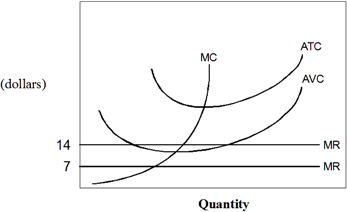 In Exhibit 7-9, product price in this market is fixed at $7. This firm is currently operating where MR = MC. What do you advise this firm to do?
 (Multiple Choice)
4.9/5 (87)
(87) Exhibit 7-5 A firm's MR and MC curves 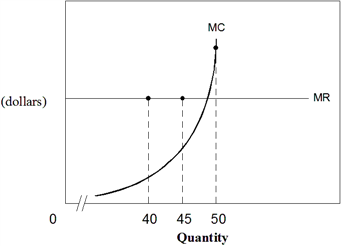 In Exhibit 7-5, suppose a firm is currently producing 45 units of output. What would you advise this firm to do?
 (Multiple Choice)
4.8/5 (83)
(83) In the long run, a competitive firm will earn zero economic profit.
(True/False)
4.9/5 (80)
(80) Which of the following is characteristic of a perfectly competitive market?
(Multiple Choice)
4.8/5 (85)
(85) The marginal approach to profit maximization means that a firm should produce until:
(Multiple Choice)
4.9/5 (88)
(88) If marginal revenue exceeds marginal cost, profit maximizers should:
(Multiple Choice)
4.8/5 (72)
(72) A perfectly competitive firm's short-run supply curve is the part of its marginal cost curve that is:
(Multiple Choice)
4.9/5 (78)
(78) 
Filters
- Essay(0)
- Multiple Choice(0)
- Short Answer(0)
- True False(0)
- Matching(0)