



 Chat with AI
Exam 4: Markets in Action

Exam 1: Introducing the Economic Way of Thinking254 Questions
Exam 2: Production Possibilities, Opportunity Cost, and Economic Growth209 Questions
Exam 3: Market Demand and Supply361 Questions
Exam 4: Markets in Action259 Questions
Exam 5: Price Elasticity of Demand181 Questions
Exam 6: Production Costs254 Questions
Exam 7: Perfect Competition226 Questions
Exam 8: Monopoly175 Questions
Exam 9: Monopolistic Competition and Oligopoly166 Questions
Exam 10: Labor Markets and Income Distribution185 Questions
Exam 11: Gross Domestic Product207 Questions
Exam 12: Business Cycles and Unemployment199 Questions
Exam 13: Inflation131 Questions
Exam 14: Aggregate Demand and Supply83 Questions
Exam 15: Fiscal Policy205 Questions
Exam 16: The Public Sector131 Questions
Exam 17: Federal Deficits, Surpluses, and the National Debt102 Questions
Exam 18: Money and the Federal Reserve System159 Questions
Exam 19: Money Creation250 Questions
Exam 20: Policy Disputes Using the Self-Correcting Aggregate Demand and Supply Model246 Questions
Exam 21: International Trade and Finance251 Questions
Exam 22: Economies in Transition108 Questions
Exam 23: Growth and the Less-Developed Countries121 Questions
Select questions type


If a good gives rise to substantial external benefits to society that are associated with its production and/or consumption then the good likely has too few resources devoted to its production.
(True/False)
4.8/5  (80)
(80) In order to avoid the free-rider problem, which of the following goods is best provided by the government and paid for with tax dollars?
(Multiple Choice)
4.9/5 (77)
(77) Denise is thinking about setting up a butterfly garden in her backyard. She estimates that it will cost her $2,000 to purchase and install special plants and an irrigation system to attract butterflies. The benefit she expects to receive is $1,800. In addition, neighbor Billy will receive a benefit of $150 and neighbor Sammy will receive a benefit of $100. From this, we can conclude that:
(Multiple Choice)
4.9/5 (88)
(88) If the equilibrium price of good X is $4 and a price ceiling is imposed at $5, the result will be a(n):
(Multiple Choice)
4.9/5 (78)
(78) If the equilibrium price of bread is $2 and the government imposes a $1.50 price ceiling on the price of bread, then:
(Multiple Choice)
4.8/5 (72)
(72) An externality is an unintended ____ imposed on ____ as a result of the ____.
(Multiple Choice)
4.9/5 (90)
(90) If you were a government official and wanted to raise the price of wheat, which of the following actions would you take?
(Multiple Choice)
4.8/5 (76)
(76) If there is a decrease in demand for lettuce, we would expect:
(Multiple Choice)
4.8/5 (81)
(81) The city of Logan Square needs $40 million for a network of streetlights. There are 20,000 residents in the Logan Square neighborhood, meaning the cost for each resident is $2,000. Psychiatrist Denise Miller refuses to donate $2,000 towards the project. This is an example of the problems encountered with:
(Multiple Choice)
4.8/5 (90)
(90) What are market failures? Discuss examples of market failures. What can government do to improve the results of market failures?
(Essay)
4.9/5 (79)
(79) Consider the market for chicken. Assuming that chicken and beef are substitutes, an increase in the price of beef will:
(Multiple Choice)
4.9/5 (86)
(86) Suppose that X and Y are substitutes. If the price of Y increases, equilibrium price and quantity for X both rise.
(True/False)
4.9/5 (88)
(88) If market supply decreases and, simultaneously, market demand increases, the new equilibrium will show:
(Multiple Choice)
4.8/5 (75)
(75) Bobby's neighbor is growing a tree that is blocking Bobby's ocean view. Bobby is considering taking his neighbor to court. This is most likely an example of a:
(Multiple Choice)
4.9/5 (77)
(77) Suppose a price ceiling is set by the government below the market equilibrium price. Which of the following will result?
(Multiple Choice)
4.8/5 (74)
(74) Exhibit 4-9 Data on supply and demand 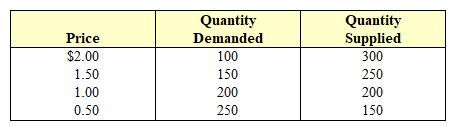 In Exhibit 4-9, if a price ceiling is set at $1.50 the market result after adjustment is:
 (Multiple Choice)
4.8/5 (70)
(70) If the supply curve decreases while the demand curve remains unchanged, the equilibrium price would decrease.
(True/False)
4.9/5 (74)
(74) 
Filters
- Essay(0)
- Multiple Choice(0)
- Short Answer(0)
- True False(0)
- Matching(0)