



 Chat with AI
Exam 4: Markets in Action

Exam 1: Introducing the Economic Way of Thinking254 Questions
Exam 2: Production Possibilities, Opportunity Cost, and Economic Growth209 Questions
Exam 3: Market Demand and Supply361 Questions
Exam 4: Markets in Action259 Questions
Exam 5: Price Elasticity of Demand181 Questions
Exam 6: Production Costs254 Questions
Exam 7: Perfect Competition226 Questions
Exam 8: Monopoly175 Questions
Exam 9: Monopolistic Competition and Oligopoly166 Questions
Exam 10: Labor Markets and Income Distribution185 Questions
Exam 11: Gross Domestic Product207 Questions
Exam 12: Business Cycles and Unemployment199 Questions
Exam 13: Inflation131 Questions
Exam 14: Aggregate Demand and Supply83 Questions
Exam 15: Fiscal Policy205 Questions
Exam 16: The Public Sector131 Questions
Exam 17: Federal Deficits, Surpluses, and the National Debt102 Questions
Exam 18: Money and the Federal Reserve System159 Questions
Exam 19: Money Creation250 Questions
Exam 20: Policy Disputes Using the Self-Correcting Aggregate Demand and Supply Model246 Questions
Exam 21: International Trade and Finance251 Questions
Exam 22: Economies in Transition108 Questions
Exam 23: Growth and the Less-Developed Countries121 Questions
Select questions type


Which of the following is not a characteristic of a public good?
(Multiple Choice)
4.9/5  (86)
(86) Which of the following is not an example of market failure?
(Multiple Choice)
4.9/5 (70)
(70) An increase in the price of plastic raises the cost of manufacturing DVDs. As a result, the market changes to a new equilibrium because of a(n):
(Multiple Choice)
4.8/5 (75)
(75) The former Soviet Union was known for black markets. An explanation for the existence of these illegal markets is that:
(Multiple Choice)
4.9/5 (77)
(77) Exhibit 4-3 Supply and demand curves 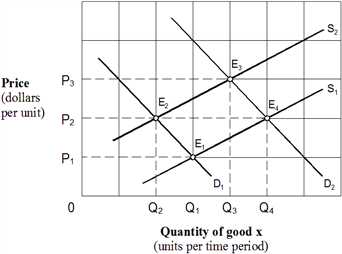 The market shown in Exhibit 4-3 is initially in equilibrium at E4. Changes in market conditions result in a new equilibrium at E3. This change is stated as a(n):
 (Multiple Choice)
5.0/5 (78)
(78) The Yankee Candle Company, in Hatfield, Massachusetts, makes thousands of scented candles each day. The factory emits the odor of the candles it produces, some of which smell quite nice. On days when they make strawberry candles the townspeople really enjoy the smell. On days when they make potpourri scented candles, people close their windows and don't go outside. What can we infer about the scented candle market?
(Multiple Choice)
4.7/5 (84)
(84) Exhibit 4-2 Supply and demand curves 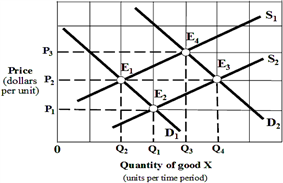 The market shown in Exhibit 4-2 is initially in equilibrium at E1. Changes in market conditions result in a new equilibrium at E2. This change is stated as a(n):
 (Multiple Choice)
4.8/5 (74)
(74) An increase in consumers' incomes will have what effect on the equilibrium in the restaurant meals market?
(Multiple Choice)
4.9/5 (77)
(77) If a chemical factory causes noxious fumes to be emitted in the neighborhood, a third party would be:
(Multiple Choice)
4.8/5 (84)
(84) Exhibit 4-11 Data on supply and demand 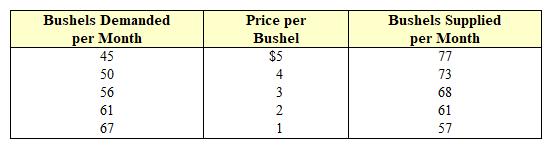 In Exhibit 4-11, the equilibrium price per bushel of wheat is:
 (Multiple Choice)
4.9/5 (82)
(82) Suppose the government imposes rent control (a price ceiling) below the equilibrium price for rental housing. Which of the following could result?
(Multiple Choice)
4.9/5 (81)
(81) Exhibit 4-10 Supply and demand data for apricots 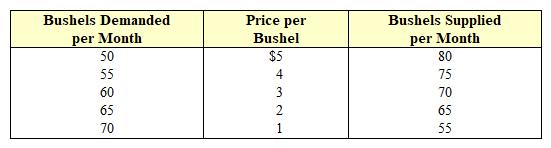 Which of the following would occur if the government set a price ceiling of $1 in the market shown in Exhibit 4-10?
 (Multiple Choice)
4.9/5 (82)
(82) An economic justification for government providing public goods and services is that many people can benefit regardless of whether they pay or not.
(True/False)
4.7/5 (70)
(70) 
Filters
- Essay(0)
- Multiple Choice(0)
- Short Answer(0)
- True False(0)
- Matching(0)