



 Chat with AI
Exam 3: Market Demand and Supply

Exam 1: Introducing the Economic Way of Thinking254 Questions
Exam 2: Production Possibilities, Opportunity Cost, and Economic Growth209 Questions
Exam 3: Market Demand and Supply361 Questions
Exam 4: Markets in Action259 Questions
Exam 5: Price Elasticity of Demand181 Questions
Exam 6: Production Costs254 Questions
Exam 7: Perfect Competition226 Questions
Exam 8: Monopoly175 Questions
Exam 9: Monopolistic Competition and Oligopoly166 Questions
Exam 10: Labor Markets and Income Distribution185 Questions
Exam 11: Gross Domestic Product207 Questions
Exam 12: Business Cycles and Unemployment199 Questions
Exam 13: Inflation131 Questions
Exam 14: Aggregate Demand and Supply83 Questions
Exam 15: Fiscal Policy205 Questions
Exam 16: The Public Sector131 Questions
Exam 17: Federal Deficits, Surpluses, and the National Debt102 Questions
Exam 18: Money and the Federal Reserve System159 Questions
Exam 19: Money Creation250 Questions
Exam 20: Policy Disputes Using the Self-Correcting Aggregate Demand and Supply Model246 Questions
Exam 21: International Trade and Finance251 Questions
Exam 22: Economies in Transition108 Questions
Exam 23: Growth and the Less-Developed Countries121 Questions
Select questions type


Suppose that X and Y are complementary goods. If the price of good X decreases, we can expect the:
(Multiple Choice)
4.7/5  (72)
(72) Which of the following is true about the market equilibrium?
(Multiple Choice)
5.0/5 (71)
(71) Exhibit 3-11 Demand and supply curves 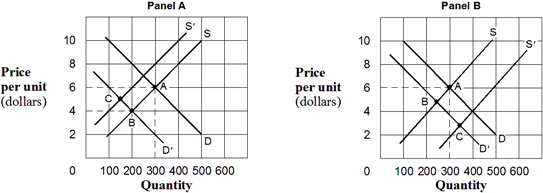 In Exhibit 3-11, in Panel B the movement from A to C describes a(n):
 (Multiple Choice)
4.8/5 (69)
(69) Three of the four events described below might reasonably be expected to shift the demand curve for beef to a new position. One would not shift that demand curve. The single exception is a(n):
(Multiple Choice)
4.9/5 (89)
(89) The "ceteris paribus" clause in the law of demand does not allow which of the following factors to change?
(Multiple Choice)
4.9/5 (72)
(72) Assuming that chicken and beef are substitutes, a decrease in the price of beef, other things being equal, will:
(Multiple Choice)
4.8/5 (77)
(77) Which of the following is least likely to increase the demand for new tires?
(Multiple Choice)
4.9/5 (81)
(81) Discuss how a market reaches equilibrium. How is it expressed graphically?
(Essay)
4.9/5 (73)
(73) Exhibit 3-15 Supply and demand curves for good X 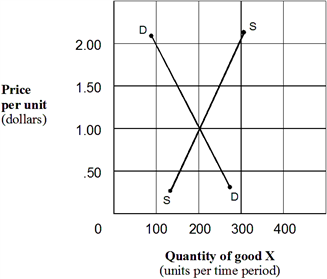 In Exhibit 3-15, if the price moves from $2.00 to $1.00, unsold inventories will:
 (Multiple Choice)
4.8/5 (70)
(70) The law of demand is the principle that there is ____ relationship between the price of a good and the quantity buyers are willing to purchase in a defined time period, ceteris paribus.
(Multiple Choice)
4.9/5 (80)
(80) In economics, the term "shortage" means that the quantity demanded is greater than the quantity supplied at the existing price.
(True/False)
4.8/5 (86)
(86) If the price of hot dogs increases, what will happen in the market for potato chips, a complementary good?
(Multiple Choice)
4.8/5 (79)
(79) If people expect the price of packaged coffee to rise next week, coffee demand will:
(Multiple Choice)
4.7/5 (72)
(72) 
Filters
- Essay(0)
- Multiple Choice(0)
- Short Answer(0)
- True False(0)
- Matching(0)