



 Chat with AI
Exam 3: Market Demand and Supply

Exam 1: Introducing the Economic Way of Thinking254 Questions
Exam 2: Production Possibilities, Opportunity Cost, and Economic Growth209 Questions
Exam 3: Market Demand and Supply361 Questions
Exam 4: Markets in Action259 Questions
Exam 5: Price Elasticity of Demand181 Questions
Exam 6: Production Costs254 Questions
Exam 7: Perfect Competition226 Questions
Exam 8: Monopoly175 Questions
Exam 9: Monopolistic Competition and Oligopoly166 Questions
Exam 10: Labor Markets and Income Distribution185 Questions
Exam 11: Gross Domestic Product207 Questions
Exam 12: Business Cycles and Unemployment199 Questions
Exam 13: Inflation131 Questions
Exam 14: Aggregate Demand and Supply83 Questions
Exam 15: Fiscal Policy205 Questions
Exam 16: The Public Sector131 Questions
Exam 17: Federal Deficits, Surpluses, and the National Debt102 Questions
Exam 18: Money and the Federal Reserve System159 Questions
Exam 19: Money Creation250 Questions
Exam 20: Policy Disputes Using the Self-Correcting Aggregate Demand and Supply Model246 Questions
Exam 21: International Trade and Finance251 Questions
Exam 22: Economies in Transition108 Questions
Exam 23: Growth and the Less-Developed Countries121 Questions
Select questions type


Interpret what an increase in demand and an increase in supply mean. Discuss the causes of an increase in demand and an increase in supply. How are increases in demand and supply expressed graphically?
(Essay)
4.7/5  (73)
(73) Ceteris paribus, a change in the price of a good always results in a change in:
(Multiple Choice)
4.9/5 (76)
(76) Farmers can produce wheat and/or rice. What will happen in the wheat market if there is an increase in the price of rice?
(Multiple Choice)
4.8/5 (54)
(54) Assuming that beef and chicken are substitutes, an increase in the price of beef, other things being equal, will:
(Multiple Choice)
4.8/5 (77)
(77) The law of demand states that, ceteris paribus, price and quantity demanded are:
(Multiple Choice)
5.0/5 (75)
(75) Exhibit 3-10 Demand and supply curves 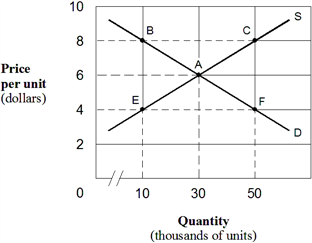 In Exhibit 3-10, what do you expect to happen in this market at point C?
 (Multiple Choice)
4.8/5 (82)
(82) Assume Qs represents the quantity supplied at a given price and Qd represents quantity demanded at the same given price. Which of the following market conditions produces an upward movement of the price?
(Multiple Choice)
4.8/5 (82)
(82) How will an increase in lumber prices influence the home construction market?
(Multiple Choice)
4.8/5 (77)
(77) Other things being equal, an increase in the price of aspirin will decrease the demand for aspirin.
(True/False)
4.8/5 (85)
(85) Exhibit 3-15 Supply and demand curves for good X 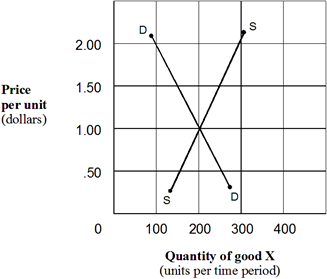 In Exhibit 3-15, at a price of $.50 the market for good X will experience a:
 (Multiple Choice)
4.7/5 (68)
(68) Surpluses cause prices to fall while shortages cause prices to rise.
(True/False)
4.9/5 (77)
(77) If movies are an inferior good, movie attendance will rise when consumer incomes fall.
(True/False)
4.8/5 (69)
(69) Assume Qs represents the quantity supplied at a given price and Qd represents the quantity demanded at the same given price. Which of the following market conditions produce a downward movement of the price?
(Multiple Choice)
4.8/5 (74)
(74) Exhibit 3-7 Demand and supply curves 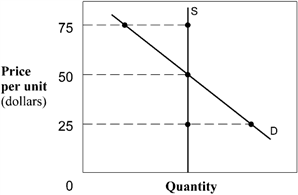 In Exhibit 3-7, if price happened to currently be $75 in this market, a ____ would result, causing a(n) ____ in price.
 (Multiple Choice)
4.9/5 (82)
(82) If the price of coffee decreases, the demand curve for tea (a substitute good) will:
(Multiple Choice)
4.8/5 (92)
(92) Exhibit 3-13 Supply and demand curves 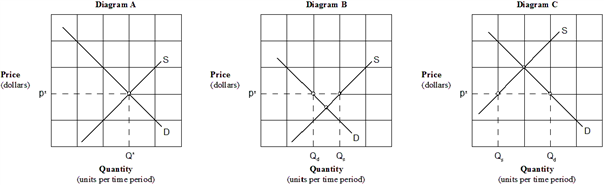 Which of the graphs in Exhibit 3-13 illustrates a shortage exists at the indicated market price?
 (Multiple Choice)
4.8/5 (84)
(84) 
Filters
- Essay(0)
- Multiple Choice(0)
- Short Answer(0)
- True False(0)
- Matching(0)