



 Chat with AI
Exam 11: Hemodynamic Monitoring

Exam 1: Basic Terms and Concepts of Mechanical Ventilation36 Questions
Exam 2: How Ventilators Work13 Questions
Exam 3: How a Breath Is Delivered30 Questions
Exam 4: Establishing the Need for Mechanical Ventilation27 Questions
Exam 5: Selecting the Ventilator and the Mode32 Questions
Exam 6: Initial Ventilator Settings32 Questions
Exam 7: Final Considerations in Ventilator Setup36 Questions
Exam 8: Initial Patient Assessment37 Questions
Exam 9: Ventilator Graphics32 Questions
Exam 10: Assessment of Respiratory Function55 Questions
Exam 11: Hemodynamic Monitoring56 Questions
Exam 12: Methods to Improve Ventilation in Patient-Ventilator Management32 Questions
Exam 13: Improving Oxygenation and Management of ARDS32 Questions
Exam 14: Ventilator-Associated Pneumonia26 Questions
Exam 15: Sedatives, Analgesics, and Paralytics17 Questions
Exam 16: Extrapulmonary Effects of Mechanical Ventilation17 Questions
Exam 17: Effects of Positive Pressure Ventilation on the Pulmonary System27 Questions
Exam 18: Troubleshooting and Problem Solving26 Questions
Exam 19: Basic Concepts of Noninvasive Positive-Pressure Ventilation27 Questions
Exam 20: Weaning and Discontinuation from Mechanical Ventilation27 Questions
Exam 21: Long-Term Ventilation29 Questions
Exam 22: Neonatal and Pediatric Ventilation40 Questions
Exam 23: Special Techniques in Ventilatory Support21 Questions
Select questions type


The respiratory therapist preparing to insert an arterial line in the right radial artery performs an Allen test.The result of the Allen test is 20 seconds.The respiratory therapist should do which of the following?
(Multiple Choice)
4.8/5  (68)
(68) Which of the following is the hemodynamic measurement that is indicative of a patient with right heart failure?
(Multiple Choice)
4.7/5 (80)
(80) Absolute confirmation of placement of a central venous pressure catheter is done with which of the following?
(Multiple Choice)
4.8/5 (78)
(78) While checking an indwelling central venous pressure (CVP)catheter the respiratory therapist observes that the transducer is at the epistatic line.The respiratory therapist should do which of the following at this time?
(Multiple Choice)
4.8/5 (74)
(74) Ventricular contractility can be estimated by which of the following?
(Multiple Choice)
4.9/5 (80)
(80) Calculate the arterial oxygen content for a patient with the following arterial blood gas measurements: Hgb = 17 g%,arterial oxygen saturation (SₐO₂)= 93%,arterial partial pressure of oxygen (PₐO₂)= 64 mm Hg.
(Multiple Choice)
4.9/5 (87)
(87) Which of the following disorders can cause an increase in systemic vascular resistance?
(Multiple Choice)
5.0/5 (83)
(83) Which of the following hemodynamic parameter that is not within normal limits?
(Multiple Choice)
4.8/5 (90)
(90) A patient in the ICU has a chest X-ray that shows bilateral infiltrates and has the following hemodynamic measurements: central venous pressure (CVP)5 mm Hg,pulmonary artery pressure (PAP)24/13 mm Hg,and pulmonary artery occlusion pressure (PAOP)21 mm Hg.These findings are consistent with which of the following?
(Multiple Choice)
4.8/5 (78)
(78) Calculate the pulmonary vascular resistance (PVR)given the following measurements obtained during a hemodynamic study: pulmonary artery pressure (PAP)= 40/22 mm Hg,pulmonary artery occlusion pressure (PAOP)= 12 mm Hg,blood pressure (BP)= 156/80 mm Hg,central venous pressure (CVP)= 19 mm Hg,cardiac output (C.O.)= 4.8 L/min,and heart rate (HR)= 68 beats/min.
(Multiple Choice)
4.7/5 (81)
(81) Calculate the right ventricular stroke work (RVSW)for a patient with the following measurements: pulmonary artery pressure (PAP)50/32 mm Hg,cardiac output (C.O.)4.0 L/min,heart rate (HR)127/min,and body surface area (BSA)1.72 m².
(Multiple Choice)
5.0/5 (81)
(81) Which of the following statements is true concerning the insertion of a radial arterial line?
1)The catheter tip must face upstream.
2)The catheter tip must face downstream.
3)The transducer must be higher than the catheter tip.
4)The transducer must be level with the catheter tip.
(Multiple Choice)
4.8/5 (82)
(82) Which of the following can occur with excessive pulmonary artery catheter movement?
(Multiple Choice)
4.9/5 (83)
(83) If the heart rate is 80 beats per minute,how long is one beat?
(Multiple Choice)
4.8/5 (89)
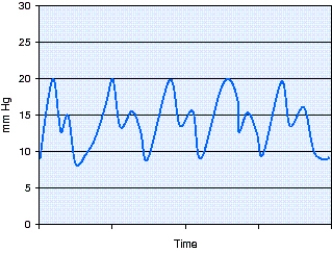
(89) The waveform of a pulmonary catheter,shown in the figure,is located in which of the following?
(Multiple Choice)
4.8/5 (76)
(76) 
Filters
- Essay(0)
- Multiple Choice(0)
- Short Answer(0)
- True False(0)
- Matching(0)