



 Chat with AI
Exam 10: Assessment of Respiratory Function

Exam 1: Basic Terms and Concepts of Mechanical Ventilation36 Questions
Exam 2: How Ventilators Work13 Questions
Exam 3: How a Breath Is Delivered30 Questions
Exam 4: Establishing the Need for Mechanical Ventilation27 Questions
Exam 5: Selecting the Ventilator and the Mode32 Questions
Exam 6: Initial Ventilator Settings32 Questions
Exam 7: Final Considerations in Ventilator Setup36 Questions
Exam 8: Initial Patient Assessment37 Questions
Exam 9: Ventilator Graphics32 Questions
Exam 10: Assessment of Respiratory Function55 Questions
Exam 11: Hemodynamic Monitoring56 Questions
Exam 12: Methods to Improve Ventilation in Patient-Ventilator Management32 Questions
Exam 13: Improving Oxygenation and Management of ARDS32 Questions
Exam 14: Ventilator-Associated Pneumonia26 Questions
Exam 15: Sedatives, Analgesics, and Paralytics17 Questions
Exam 16: Extrapulmonary Effects of Mechanical Ventilation17 Questions
Exam 17: Effects of Positive Pressure Ventilation on the Pulmonary System27 Questions
Exam 18: Troubleshooting and Problem Solving26 Questions
Exam 19: Basic Concepts of Noninvasive Positive-Pressure Ventilation27 Questions
Exam 20: Weaning and Discontinuation from Mechanical Ventilation27 Questions
Exam 21: Long-Term Ventilation29 Questions
Exam 22: Neonatal and Pediatric Ventilation40 Questions
Exam 23: Special Techniques in Ventilatory Support21 Questions
Select questions type


What type of electrode is used by a transcutaneous partial pressure of oxygen (PₜᴄO₂)device?

Free
(Multiple Choice)
4.9/5  (91)
(91) Correct Answer: Verified
B
A patient in the intensive care unit is receiving mechanical ventilation,has a pulmonary artery catheter in place,and is being monitored continuously with a capnometer.The patient's arterial partial pressure of carbon dioxide (PₐCO₂)is 41 mm Hg and the partial pressure of end-tidal carbon dioxide (PₑₜCO₂)is 36 mm Hg.There is a sudden decrease in the PₑₜCO₂ to 18 mm Hg causing an alarm to sound.The most likely cause of this development is which of the following?
Free
(Multiple Choice)
4.8/5 (72)
(72) Correct Answer:Verified
VerifiedC
A patient-ventilator system check reveals the following information: peak inspiratory pressure (PIP)32 cm H₂O,positive end-expiratory pressure (PEEP)12 cm H₂O,plateau pressure (Pₚₗₐₜₑₐᵤ)20 cm H₂O,inspiratory time (Tɪ)1 second,and set frequency 12/min.Calculate the mean airway pressure.
Free
(Multiple Choice)
4.8/5 (86)
(86) Correct Answer:Verified
VerifiedD
To properly operate,the transcutaneous partial pressure of oxygen electrode needs to be at what temperature range?
(Multiple Choice)
4.8/5 (93)
(93) Calculate the airway resistance given the following clinical data: flow rate 60 L/min,PIP 28 cm H₂O,Pₚₗₐₜₑₐᵤ 21 cm H₂O,and PEEP 8 cm H₂O.
(Multiple Choice)
4.8/5 (72)
(72) An energy expenditure (EE)of 20 kcal/hr/m² for an adult is indicative of which of the following conditions?
(Multiple Choice)
4.8/5 (76)
(76) Calculate dynamic compliance given the following clinical data: tidal volume 600 mL,peak inspiratory pressure (PIP)28 cm H₂O,plateau pressure (Pₚₗₐₜₑₐᵤ)15 cm H₂O,positive end-expiratory pressure (PEEP)10 cm H₂O,and CT 2 mL/cm H₂O.
(Multiple Choice)
4.9/5 (76)
(76) The respiratory quotient (RQ)value associated with substrate utilization patterns in normal,healthy individuals is which of the following?
(Multiple Choice)
4.9/5 (80)
(80) Bidirectional flow can be measured by which of the following devices?
(Multiple Choice)
4.9/5 (84)
(84) The respiratory therapist has just stopped postural drainage for a 24-year-old patient with cystic fibrosis because of shortness of breath and slight cyanosis in the "head-down" position.The respiratory therapist should recommend which of the following adjustments to therapy?
(Multiple Choice)
4.8/5 (78)
(78) Which of the following actions is indicated when a disparity exists between SₚO₂,SₐO₂,and the clinical presentation of a patient?
(Multiple Choice)
4.7/5 (76)
(76) Components of an indirect calorimeter may include which of the following?1.Pressure manometer
2)Pneumotachometer
3)Pressure-sensitive transducer
4)Oxygen and carbon dioxide analyzers
(Multiple Choice)
4.7/5 (79)
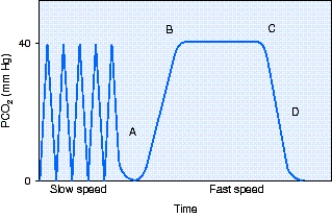
(79) The partial pressure of end-tidal carbon dioxide (PₑₜCO₂)reading is taken at what point in the figure?
(Multiple Choice)
4.8/5 (85)
(85) An increase in intrinsic work of breathing due to a decrease in static compliance is caused by which of the following?
(Multiple Choice)
4.7/5 (76)
(76) Calculate the dynamic compliance given the following clinical data: tidal volume 500 mL,peak inspiratory time (PIP)35 cm H₂O,plateau pressure (Pₚₗₐₜₑₐᵤ)20 cm H₂O,positive end-expiratory pressure (PEEP)5 cm H₂O,and tubing compliance (Cᴛ)2.5 mL/cm H₂O.
(Multiple Choice)
4.9/5 (74)
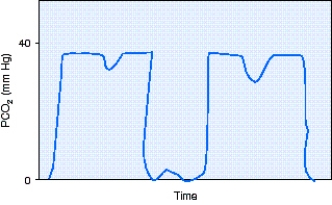
(74) During shift report,the day shift respiratory therapist informs the night shift respiratory therapist about a freshly postoperative patient who is receiving full support via mechanical ventilation.At the time of the last patient-ventilator system check the patient had not awaken from anesthesia.During first round on the day shift the respiratory therapist notes the capnography shown in the figure.The most appropriate action to take would be to do which of the following?
(Multiple Choice)
4.8/5 (88)
(88) What type of electrode is used by a transcutaneous partial pressure of carbon dioxide (PₜᴄO₂)device?
(Multiple Choice)
4.7/5 (75)
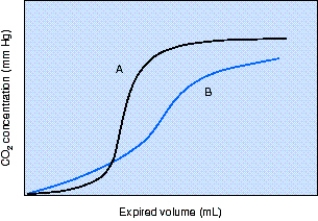
(75) The change in the single-breath carbon dioxide (CO₂)curve from "A" to "B" shown in the figure may be a result of which of the following?
(Multiple Choice)
4.8/5 (77)
(77) To measure plateau pressure,inspiration should be held for how many seconds?
(Multiple Choice)
4.8/5 (82)
(82) A patient arrives in the emergency department via ambulance following rescue from a house fire.The instrument that would be most appropriate to assist the respiratory therapist in assessing this patient's oxygenation status is which of the following?
(Multiple Choice)
4.8/5 (66)
(66) 
Filters
- Essay(0)
- Multiple Choice(0)
- Short Answer(0)
- True False(0)
- Matching(0)