



 Chat with AI
Exam 9: Ventilator Graphics

Exam 1: Basic Terms and Concepts of Mechanical Ventilation36 Questions
Exam 2: How Ventilators Work13 Questions
Exam 3: How a Breath Is Delivered30 Questions
Exam 4: Establishing the Need for Mechanical Ventilation27 Questions
Exam 5: Selecting the Ventilator and the Mode32 Questions
Exam 6: Initial Ventilator Settings32 Questions
Exam 7: Final Considerations in Ventilator Setup36 Questions
Exam 8: Initial Patient Assessment37 Questions
Exam 9: Ventilator Graphics32 Questions
Exam 10: Assessment of Respiratory Function55 Questions
Exam 11: Hemodynamic Monitoring56 Questions
Exam 12: Methods to Improve Ventilation in Patient-Ventilator Management32 Questions
Exam 13: Improving Oxygenation and Management of ARDS32 Questions
Exam 14: Ventilator-Associated Pneumonia26 Questions
Exam 15: Sedatives, Analgesics, and Paralytics17 Questions
Exam 16: Extrapulmonary Effects of Mechanical Ventilation17 Questions
Exam 17: Effects of Positive Pressure Ventilation on the Pulmonary System27 Questions
Exam 18: Troubleshooting and Problem Solving26 Questions
Exam 19: Basic Concepts of Noninvasive Positive-Pressure Ventilation27 Questions
Exam 20: Weaning and Discontinuation from Mechanical Ventilation27 Questions
Exam 21: Long-Term Ventilation29 Questions
Exam 22: Neonatal and Pediatric Ventilation40 Questions
Exam 23: Special Techniques in Ventilatory Support21 Questions
Select questions type


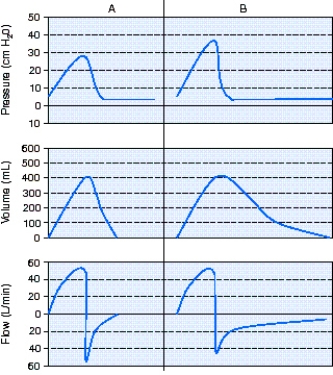
A patient is receiving full ventilatory support with volume ventilation.At 0700 the respiratory therapist observes the pressure-,volume-,and flow-time scalars shown in "A" below.Six hours later the respiratory therapist observes the scalars shown in "B." The most appropriate action to take is which of the following?

Free
(Multiple Choice)
4.9/5  (86)
(86) Correct Answer: Verified
C
The most important factor to affect the degree of resistance in the airways is which of the following?
Free
(Multiple Choice)
4.8/5 (79)
(79) Correct Answer:Verified
VerifiedD
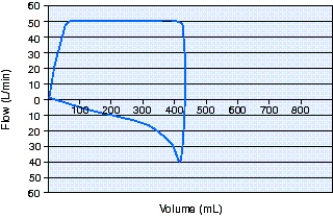
A patient is receiving ventilation with volume-controlled continuous mandatory ventilation (VC-CMV).During a patient-ventilator system check the respiratory therapist sees the flow-volume loop below.The most appropriate action is to do which of the following?
Free
(Multiple Choice)
4.8/5 (66)
(66) Correct Answer:Verified
VerifiedC
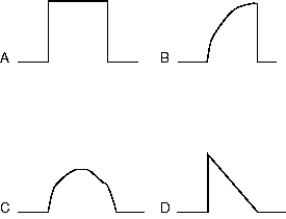
Identify the sinusoidal (or sine)waveform in the figure below.
(Multiple Choice)
4.9/5 (79)
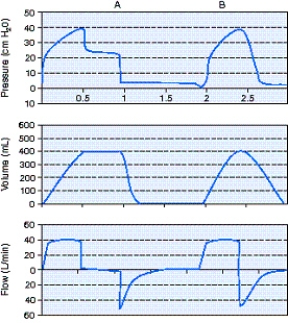
(79) Calculate the airway resistance (Rₐᴡ)using the information from the scalar below.
(Multiple Choice)
4.9/5 (76)
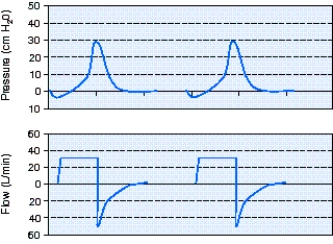
(76) The respiratory therapist observes the following pressure-time and flow-time scalars following a patient being intubated and placed on a mechanical ventilator using volume ventilation.The most appropriate action is which of the following?
(Multiple Choice)
4.7/5 (76)
(76) During a patient-ventilator system check the respiratory therapist notices that the pressure-volume loop begins at zero on the x-axis but does not return to zero during expiration.The cause of this is which of the following?
(Multiple Choice)
4.8/5 (65)
(65) The two waveforms that are common for pressure scalars are which of the following?
(Multiple Choice)
4.9/5 (74)
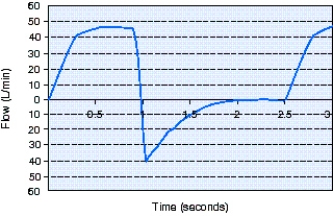
(74) What is the inspiratory time shown in the flow-time scalar below?
(Multiple Choice)
4.7/5 (67)
(67) The term used to specify the flow,pressure,and volume waveforms that are graphed relative to time is called:
(Multiple Choice)
4.8/5 (79)
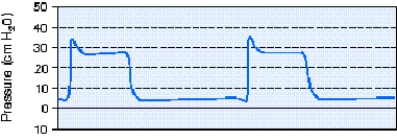
(79) During pressure-controlled continuous mandatory ventilation (PC-CMV)the respiratory therapist observes the pressure-time scalar shown below.The most appropriate action to take is which of the following?
(Multiple Choice)
4.9/5 (70)
(70) An increase in airway resistance during pressure ventilation will result in which of the following?
(Multiple Choice)
4.9/5 (70)
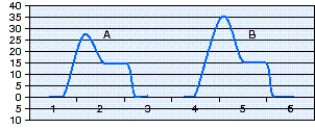
(70) The respiratory therapist observes the pressure-time scalar seen below.Wave A was generated at 1300 hour and wave B at 1600 hour.The action that is most appropriate for this situation is which of the following?
(Multiple Choice)
4.8/5 (73)
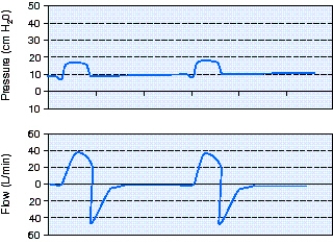
(73) What is the flow-cycle setting for the pressure support ventilation (PSV)breaths shown in the scalars below?
(Multiple Choice)
4.7/5 (54)
(54) The type of flow curve produced by volume ventilation with constant flow is which of the following?
(Multiple Choice)
5.0/5 (85)
(85) An inadequate flow setting during volume ventilation will cause which of the following to occur?
(Multiple Choice)
4.7/5 (78)
(78) Delayed termination during pressure support ventilation (PSV)can be avoided with patients who have chronic obstructive pulmonary disease (COPD)by doing which of the following?
(Multiple Choice)
4.8/5 (67)
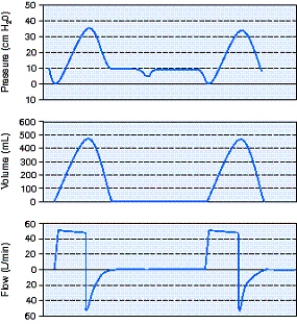
(67) The respiratory therapist sees the following scalars on the screen of a ventilator providing support to a patient in the ICU.What action should the respiratory therapist take?
(Multiple Choice)
4.9/5 (72)
(72) A reduction in compliance during pressure ventilation will cause which of the following?
(Multiple Choice)
4.9/5 (71)
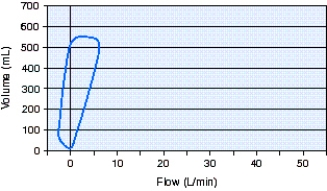
(71) The type of breath shown in the flow-volume loop below is which of the following?
(Multiple Choice)
4.8/5 (82)
(82) 
Filters
- Essay(0)
- Multiple Choice(0)
- Short Answer(0)
- True False(0)
- Matching(0)