



 Chat with AI
Exam 3: How a Breath Is Delivered

Exam 1: Basic Terms and Concepts of Mechanical Ventilation36 Questions
Exam 2: How Ventilators Work13 Questions
Exam 3: How a Breath Is Delivered30 Questions
Exam 4: Establishing the Need for Mechanical Ventilation27 Questions
Exam 5: Selecting the Ventilator and the Mode32 Questions
Exam 6: Initial Ventilator Settings32 Questions
Exam 7: Final Considerations in Ventilator Setup36 Questions
Exam 8: Initial Patient Assessment37 Questions
Exam 9: Ventilator Graphics32 Questions
Exam 10: Assessment of Respiratory Function55 Questions
Exam 11: Hemodynamic Monitoring56 Questions
Exam 12: Methods to Improve Ventilation in Patient-Ventilator Management32 Questions
Exam 13: Improving Oxygenation and Management of ARDS32 Questions
Exam 14: Ventilator-Associated Pneumonia26 Questions
Exam 15: Sedatives, Analgesics, and Paralytics17 Questions
Exam 16: Extrapulmonary Effects of Mechanical Ventilation17 Questions
Exam 17: Effects of Positive Pressure Ventilation on the Pulmonary System27 Questions
Exam 18: Troubleshooting and Problem Solving26 Questions
Exam 19: Basic Concepts of Noninvasive Positive-Pressure Ventilation27 Questions
Exam 20: Weaning and Discontinuation from Mechanical Ventilation27 Questions
Exam 21: Long-Term Ventilation29 Questions
Exam 22: Neonatal and Pediatric Ventilation40 Questions
Exam 23: Special Techniques in Ventilatory Support21 Questions
Select questions type


The most common method of terminating inspiration during pressure support ventilation is which of the following?

Free
(Multiple Choice)
4.9/5  (83)
(83) Correct Answer: Verified
A
The control variables most often used to ventilate infants are which of the following?
Free
(Multiple Choice)
4.7/5 (88)
(88) Correct Answer:Verified
VerifiedB
When the maximum pressure limit is reached during volume ventilation,which of the following occurs?
1)Inspiratory time is decreased.
2)Volume delivered is decreased.
3)Inspiration continues until volume is delivered.
4)Pressure is held and the breath is volume cycled.
Free
(Multiple Choice)
4.8/5 (68)
(68) Correct Answer:Verified
VerifiedC
The inspiratory and expiratory flow sensors are reading a base flow of 5 L/min.The flow trigger is set to 2 L/min.The expiratory flow sensor must read what flow to trigger inspiration?
(Multiple Choice)
4.8/5 (75)
(75) High-frequency oscillators control which of the following variables?
(Multiple Choice)
4.7/5 (88)
(88) The ventilator variable that begins inspiration is which of the following?
(Multiple Choice)
4.8/5 (89)
(89) An increase in airway resistance during pressure-targeted ventilation will have which of the following effects?
(Multiple Choice)
4.9/5 (78)
(78) The limit variable set on a mechanical ventilator will do which of the following?
(Multiple Choice)
4.8/5 (79)
(79) The patient trigger that requires the least amount of work of breathing for the patient is which of the following?
(Multiple Choice)
4.8/5 (91)
(91) The respiratory therapist enters the room of a patient being mechanically ventilated with volume ventilation.The high pressure alarm is sounding and the measured exhaled tidal volume is significantly lower than what is set.The variable that is ending inspiration is which of the following?
(Multiple Choice)
4.8/5 (91)
(91) The variable that a ventilator uses to end inspiration is known as which of the following?
(Multiple Choice)
4.9/5 (77)
(77) The most commonly used patient-trigger variables include which of the following?
1)Flow
2)Time
3)Pressure
4)Volume
(Multiple Choice)
4.9/5 (75)
(75) An increase in airway resistance during volume-controlled ventilation will have which of the following effects?
(Multiple Choice)
4.8/5 (79)
(79) The trigger variable in the controlled mode is which of the following?
(Multiple Choice)
4.8/5 (78)
(78) The ventilator that can provide a negative pressure during the very beginning of the exhalation phase is which of the following?
(Multiple Choice)
4.7/5 (73)
(73) The variable that controls exhalation is known as which of the following?
(Multiple Choice)
4.9/5 (91)
(91) Which maneuver will maintain air in the lungs at the end of inspiration,before the exhalation valve opens?
(Multiple Choice)
4.8/5 (79)
(79) A patient who has been sedated and paralyzed by medications is being controlled by the ventilator.The set rate is 15 breaths/min.How many seconds does it take for inspiration and expiration to occur?
(Multiple Choice)
4.9/5 (82)
(82) What is the flow-cycle setting for the following pressure supported breath?
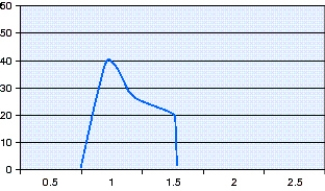
(Multiple Choice)
4.8/5 (88)
(88) Calculate the transrespiratory pressure given the following information: volume 0.6 L; compliance 1 L/cm H₂O; airway resistance 3 cm H₂O/L/sec; flow 1 L/sec.
(Multiple Choice)
4.8/5 (91)
(91) 
Filters
- Essay(0)
- Multiple Choice(0)
- Short Answer(0)
- True False(0)
- Matching(0)