



 Chat with AI
Exam 10: Assessment of Respiratory Function

Exam 1: Basic Terms and Concepts of Mechanical Ventilation36 Questions
Exam 2: How Ventilators Work13 Questions
Exam 3: How a Breath Is Delivered30 Questions
Exam 4: Establishing the Need for Mechanical Ventilation27 Questions
Exam 5: Selecting the Ventilator and the Mode32 Questions
Exam 6: Initial Ventilator Settings32 Questions
Exam 7: Final Considerations in Ventilator Setup36 Questions
Exam 8: Initial Patient Assessment37 Questions
Exam 9: Ventilator Graphics32 Questions
Exam 10: Assessment of Respiratory Function55 Questions
Exam 11: Hemodynamic Monitoring56 Questions
Exam 12: Methods to Improve Ventilation in Patient-Ventilator Management32 Questions
Exam 13: Improving Oxygenation and Management of ARDS32 Questions
Exam 14: Ventilator-Associated Pneumonia26 Questions
Exam 15: Sedatives, Analgesics, and Paralytics17 Questions
Exam 16: Extrapulmonary Effects of Mechanical Ventilation17 Questions
Exam 17: Effects of Positive Pressure Ventilation on the Pulmonary System27 Questions
Exam 18: Troubleshooting and Problem Solving26 Questions
Exam 19: Basic Concepts of Noninvasive Positive-Pressure Ventilation27 Questions
Exam 20: Weaning and Discontinuation from Mechanical Ventilation27 Questions
Exam 21: Long-Term Ventilation29 Questions
Exam 22: Neonatal and Pediatric Ventilation40 Questions
Exam 23: Special Techniques in Ventilatory Support21 Questions
Select questions type


For a given minute ventilation,partial pressure of end-tidal carbon dioxide (PₑₜCO₂)is a function of which of the following?
1.Metabolic rate
2)Cardiac output
3)Alveolar dead space
4)Physiologic shunt
(Multiple Choice)
4.9/5  (75)
(75) While trying to use a finger probe to assess a patient's oxygenation status,the respiratory therapist finds that the pulse rate and the ECG monitor heart rate are not consistent and the oxygen saturation measured by pulse oximeter (SₚO₂)reading is blank.The patient is awake,alert,and in no obvious respiratory distress.The respiratory therapist should first take which of the following actions?
1)Change the probe site.
2)Draw an arterial blood gas.
3)Adjust the probe position on the finger.
4)Remove the probe,and perform a capillary refill test.
(Multiple Choice)
4.8/5 (89)
(89) Which of the following situations will cause an increase in the single-breath carbon dioxide (SBCO₂)curve?
(Multiple Choice)
4.9/5 (74)
(74) A pulse oximeter differentiates oxyhemoglobin from deoxygenated hemoglobin by which of the following methods?
(Multiple Choice)
4.9/5 (82)
(82) A patient is receiving mechanical ventilation with a fractional inspired oxygen (FɪO₂)of 0.85 and a positive end-expiratory pressure (PEEP)of 5 cm H₂O.His arterial partial pressure of oxygen (PₐO₂)is 68 mm Hg,arterial oxygen saturation (SₐO₂)is 88%,and partial pressure of end-tidal carbon dioxide (PₑₜCO₂)is 32 mm Hg.Over the next few minutes his PEEP is titrated resulting in the following data:
Time ( (\%) () 0600 0.85 5 88 30 0630 0.85 8 88 30 0650 0.85 10 90 32 0720 0.80 12 93 34 0740 0.80 15 90 25
At 0740 the single-breath carbon dioxide (SBCO₂)curve shifted to the right.What action should the respiratory therapist take at this time?
(Multiple Choice)
4.9/5 (74)
(74) At which point in the pressure-time curve of a spontaneous breath should the transdiaphragmatic pressure be greatest?
(Multiple Choice)
4.9/5 (73)
(73) The energy required to move gas through the airways and expand the thorax is known as which of the following?
(Multiple Choice)
4.8/5 (92)
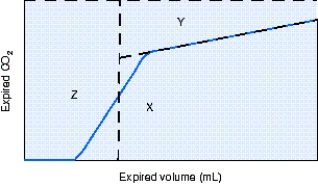
(92) The area under the curve of a single-breath carbon dioxide (SBCO₂)curve represents which of the following?
(Multiple Choice)
4.9/5 (90)
(90) The area represented by the letter "Y" in the figure is which of the following?
(Multiple Choice)
4.8/5 (77)
(77) A transcutaneous partial pressure of oxygen (PₜᴄO₂)reading is reliable in which of the following situations?
(Multiple Choice)
4.7/5 (71)
(71) How often should the respiratory therapist reposition the sensor of a transcutaneous monitor?
(Multiple Choice)
5.0/5 (95)
(95) An arterial blood gas should be done to confirm pulse oximetry findings less than a minimum of _____________.
(Multiple Choice)
4.9/5 (78)
(78) A patient whose carbon dioxide (CO₂)production is 390 mL/min and oxygen (O₂)consumption is 375 mL/min is most likely experiencing which of the following?
(Multiple Choice)
4.9/5 (81)
(81) Calculate the static compliance given the following clinical data: tidal volume 600 mL,peak inspiratory pressure (PIP)40 cm H₂O,plateau pressure (Pₚₗₐₜₑₐᵤ)30 cm H₂O,positive end-expiratory pressure (PEEP)15 cm H₂O,and tubing compliance Cᴛ2 mL/cm H₂O.
(Multiple Choice)
4.7/5 (91)
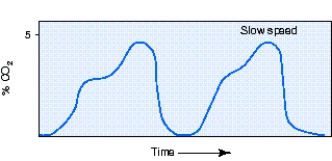
(91) The capnogram in the figure is indicative of which of the following conditions?
(Multiple Choice)
5.0/5 (70)
(70) Pulse oximetry is most useful in which of the following situations?
(Multiple Choice)
4.7/5 (84)
(84) The normal range for arterial-to-end-tidal partial pressure of carbon dioxide [P₍ₐ₋ₑₜ₎CO₂] is which of the following?
(Multiple Choice)
4.9/5 (69)
(69) Calculate the airway resistance given the following clinical data: flow rate 60 L/min,peak inspiratory pressure (PIP)42 cm H₂O,plateau pressure (Pₚₗₐₜₑₐᵤ)15 cm H₂O,and positive end-expiratory pressure (PEEP)5 cm H₂O.
(Multiple Choice)
4.9/5 (70)
(70) The clinical data that should be recorded when making transcutaneous measurements include which of the following?1.Electrode temperature
2)Skin temperature
3)Probe placement
4)Fractional inspired oxygen (FɪO₂)
(Multiple Choice)
4.8/5 (74)
(74) 
Filters
- Essay(0)
- Multiple Choice(0)
- Short Answer(0)
- True False(0)
- Matching(0)