



 Chat with AI
Exam 10: The Firm and the Industry Under Perfect Competition

Exam 1: What Is Economics261 Questions
Exam 2: The Economy: Myth and Reality185 Questions
Exam 3: The Fundamental Economic Problem: Scarcity and Choice290 Questions
Exam 4: Supply and Demand: an Initial Look337 Questions
Exam 5: Consumer Choice: Individual and Market Demand243 Questions
Exam 6: Demand and Elasticity254 Questions
Exam 7: Production, Inputs, and Cost: Building Blocks for Supply Analysis260 Questions
Exam 8: Output, Price, and Profit: the Importance of Marginal Analysis234 Questions
Exam 9: The Financial Markets and the Economy: the Tail That Wags the Dog227 Questions
Exam 10: The Firm and the Industry Under Perfect Competition253 Questions
Exam 11: The Case for Free Markets: the Price System259 Questions
Exam 12: Monopoly244 Questions
Exam 13: Between Competition and Monopoly254 Questions
Exam 14: Limiting Market Power: Antitrust and Regulation155 Questions
Exam 15: The Shortcomings of Free Markets219 Questions
Exam 16: Externalities, Externaliteis, the Environment, and Natural Resources222 Questions
Exam 17: Taxation and Resource Allocation221 Questions
Exam 18: Pricing the Factors of Production233 Questions
Exam 19: Labor and Entrepreneurship: the Human Inputs271 Questions
Exam 20: Poverty, Inequality, and Discrimination171 Questions
Exam 21: International Trade and Comparative Advantage226 Questions
Exam 22: Contemporary Issues in the Us Economy23 Questions
Select questions type


Figure 10-5
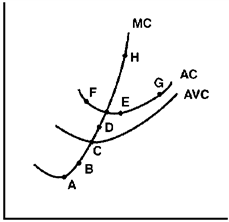 In Figure 10-5, points which lie on the firm's short-run supply curve are
 (Multiple Choice)
4.8/5  (76)
(76) In perfect competition, an increase in the firm's fixed costs lead to
(Multiple Choice)
4.8/5 (72)
(72) At a firm's profit-maximizing level of output, its price is $200 and its short-run average total cost is $225. The firm
(Multiple Choice)
4.7/5 (75)
(75) Table 10-1 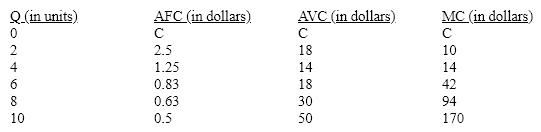 In Table 10-1 are the short-run cost schedules of a perfectly competitive firm. If the market price of output is $50, the firm will produce ____ units and earn a profit of ____.
 (Multiple Choice)
4.8/5 (87)
(87) A firm will not choose to produce if total variable costs exceed total revenue.
(True/False)
4.9/5 (73)
(73) In the short run, perfectly competitive firms will determine whether to continue producing the current output, reduce output, or increase output based on the relationship between
(Multiple Choice)
4.7/5 (63)
(63) A firm's minimum AC is $10, its minimum AVC $7. Show this firm's short-run supply curve, explaining how you obtained it.
(Essay)
4.9/5 (89)
(89) A perfectly competitive firm should continue to expand output until
(Multiple Choice)
4.8/5 (72)
(72) There are currently 1,000 firms in a competitive industry. Minimum long-run average cost is $80 and price $100. Explain what will happen to price, profit, and the number of firms in this industry over time.
(Essay)
4.9/5 (81)
(81) Table 10-2  Refer to Table 10-2. Which firm is better off staying in business in the short run?
 (Multiple Choice)
4.9/5 (83)
(83) What makes the demand curve of the perfectly competitive firm uniquely different from that of firms in other kinds of market structures?
(Essay)
4.9/5 (90)
(90) Using only marginal revenue and marginal cost, we can determine whether a firm is incurring a profit or a loss.
(True/False)
4.8/5 (76)
(76) In perfect competition, a firm's marginal revenue is the same as the demand curve at high levels of output.
(True/False)
4.9/5 (69)
(69) Once a firm's marginal revenue curve is known, the output level can be determined.
(True/False)
4.8/5 (81)
(81) Figure 10-3
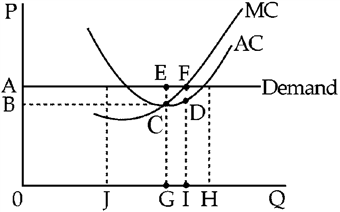 In Figure 10-3, the profit maximizing firm will operate at a level of
 (Multiple Choice)
4.9/5 (79)
(79) In the long run, a perfectly competitive industry tends to develop differentiated products.
(True/False)
4.9/5 (72)
(72) Figure 10-7
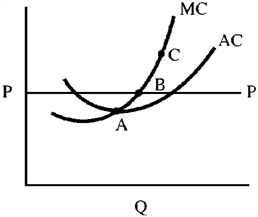 In Figure 10-7, through which point must a horizontal demand curve pass to yield a long-run equilibrium?
 (Multiple Choice)
4.9/5 (78)
(78) The opportunity cost of a given investment is the potential earnings forfeited by tying up money in the investment.
(True/False)
4.8/5 (73)
(73) 
Filters
- Essay(0)
- Multiple Choice(0)
- Short Answer(0)
- True False(0)
- Matching(0)