



 Chat with AI
Exam 10: The Firm and the Industry Under Perfect Competition

Exam 1: What Is Economics261 Questions
Exam 2: The Economy: Myth and Reality185 Questions
Exam 3: The Fundamental Economic Problem: Scarcity and Choice290 Questions
Exam 4: Supply and Demand: an Initial Look337 Questions
Exam 5: Consumer Choice: Individual and Market Demand243 Questions
Exam 6: Demand and Elasticity254 Questions
Exam 7: Production, Inputs, and Cost: Building Blocks for Supply Analysis260 Questions
Exam 8: Output, Price, and Profit: the Importance of Marginal Analysis234 Questions
Exam 9: The Financial Markets and the Economy: the Tail That Wags the Dog227 Questions
Exam 10: The Firm and the Industry Under Perfect Competition253 Questions
Exam 11: The Case for Free Markets: the Price System259 Questions
Exam 12: Monopoly244 Questions
Exam 13: Between Competition and Monopoly254 Questions
Exam 14: Limiting Market Power: Antitrust and Regulation155 Questions
Exam 15: The Shortcomings of Free Markets219 Questions
Exam 16: Externalities, Externaliteis, the Environment, and Natural Resources222 Questions
Exam 17: Taxation and Resource Allocation221 Questions
Exam 18: Pricing the Factors of Production233 Questions
Exam 19: Labor and Entrepreneurship: the Human Inputs271 Questions
Exam 20: Poverty, Inequality, and Discrimination171 Questions
Exam 21: International Trade and Comparative Advantage226 Questions
Exam 22: Contemporary Issues in the Us Economy23 Questions
Select questions type


How does a firm that is losing money in the short run decide whether to shut down or continue to produce to minimize its losses?
(Essay)
4.7/5  (80)
(80) Total profit of a competitive firm can be found by multiplying profit per unit and units sold.
(True/False)
4.9/5 (84)
(84) Figure 10-9
 Figure 10-9 shows supply and demand conditions in a perfectly competitive industry and for a firm in that industry. Assume the industry initially has supply curve S1 and demand curve D1. If demand shifts to D2, then in the short run price will
 (Multiple Choice)
4.9/5 (93)
(93) Zero economic profits for a perfectly competitive firm in the long run means
(Multiple Choice)
5.0/5 (81)
(81) What is the difference between the accountant's concept of profit and the economist's view of profit?
(Essay)
5.0/5 (90)
(90) Figure 10-7
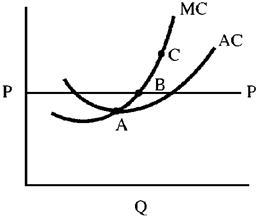 In Figure 10-7, output at which point represents short-run but not long-run equilibrium?
 (Multiple Choice)
4.9/5 (85)
(85) In a long-run equilibrium in a perfectly competitive market, firms are selling at a price equal to marginal cost.
(True/False)
4.8/5 (78)
(78) If a firm sells its output at a price greater than AVC, it will earn economic profit.
(True/False)
4.9/5 (82)
(82) Figure 10-5
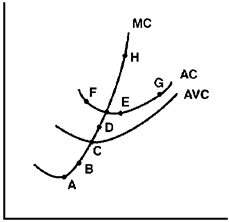 Figure 10-5 shows the short-run cost relationships for a perfectly competitive firm. Based on this diagram, which point would not be on the firm's short-run supply curve?
 (Multiple Choice)
4.7/5 (92)
(92) For a competitive firm, if at least some portion of its short-run average cost curve lies below the price of the product, we can conclude that the firm
(Multiple Choice)
4.9/5 (81)
(81) The perfectly competitive widget industry is in long-run equilibrium. A profit-maximizing manufacturer receives total revenue of $55,000. He uses his labor, $15,000 worth of wire, and $15,000 worth of steel to make the widgets. The manufacturer
(Multiple Choice)
4.8/5 (75)
(75) Figure 10-1
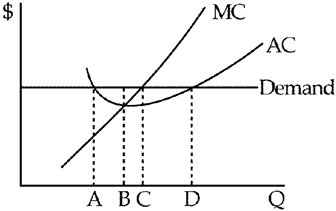 Suppose a perfectly competitive firm's situation is shown in Figure 10-1 and the firm is currently producing at D. What can be said about this situation?
 (Multiple Choice)
4.8/5 (76)
(76) A price taking firm is able to sell its product just slightly above the current market price.
(True/False)
4.8/5 (100)
(100) Figure 10-8
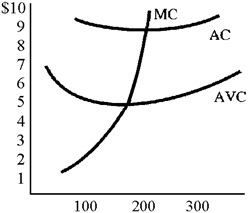 In the long run, the perfectly competitive firm in Figure 10-8 will leave the industry if the price falls below
 (Multiple Choice)
4.8/5 (64)
(64) If there are no profits in competitive equilibrium, why do firms produce? How can they stay in business?
(Essay)
4.9/5 (56)
(56) Which of the following statements is not true in a perfectly competitive industry in long-run equilibrium?
(Multiple Choice)
4.8/5 (83)
(83) We expect the demand curve in the perfectly competitive industry to be
(Multiple Choice)
4.9/5 (69)
(69) 
Filters
- Essay(0)
- Multiple Choice(0)
- Short Answer(0)
- True False(0)
- Matching(0)