



 Chat with AI
Exam 34: International Trade and Comparative Advantage

Exam 1: What Is Economics261 Questions
Exam 2: The Economy: Myth and Reality185 Questions
Exam 3: The Fundamental Economic Problem: Scarcity and Choice290 Questions
Exam 4: Supply and Demand: an Initial Look337 Questions
Exam 21: An Introduction to Macroeconomics216 Questions
Exam 22: The Goals of Macroeconomic Policy212 Questions
Exam 23: Economic Growth: Theory and Policy228 Questions
Exam 24: Aggregate Demand and the Powerful Consumer219 Questions
Exam 25: Demand-Side Equilibrium: Unemployment or Inflation216 Questions
Exam 26: Bringing in the Supply Side: Unemployment and Inflation228 Questions
Exam 27: Managing Aggregate Demand: Fiscal Policy210 Questions
Exam 28: Money and the Banking System224 Questions
Exam 29: Monetary Policy: Conventional and Unconventional210 Questions
Exam 30: The Financial Crisis and the Great Recession66 Questions
Exam 31: The Debate Over Monetary and Fiscal Policy219 Questions
Exam 32: Budget Deficits in the Short and Long Run215 Questions
Exam 33: The Trade-Off Between Inflation and Unemployment219 Questions
Exam 34: International Trade and Comparative Advantage226 Questions
Exam 35: The International Monetary System: Order or Disorder218 Questions
Exam 36: Exchange Rates and the Macroeconomy219 Questions
Exam 37: Contemporary Issues in the Us Economy23 Questions
Select questions type


If gains from trade are based solely on comparative advantage, and if all countries have the same opportunity costs of production, then there are no gains from trade.
(True/False)
4.9/5  (75)
(75) If England uses one week's time to produce 10 yards of cloth or 2 barrels of wine and Portugal uses one week's time to produce 12 yards of cloth or 6 barrels of wine, England has the comparative advantage in both goods.
(True/False)
4.9/5 (76)
(76) In William Safire's 1983 essay, "Smoot-Hawley Lives," he argues that the United States should
(Multiple Choice)
4.8/5 (77)
(77) If a country's productivity doubles for everything it produces, this will not alter its prior pattern of specialization because it has not altered its comparative advantage.
(True/False)
4.7/5 (95)
(95) Are there impediments to international movement of labor and capital?
(Multiple Choice)
4.9/5 (97)
(97) A tariff is a tax on imports imposed by the country that is importing the goods.
(True/False)
4.7/5 (68)
(68) An example of a quota that protects an American industry is the quota on
(Multiple Choice)
4.8/5 (98)
(98) 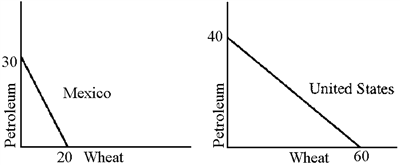 In Figure 34-2,
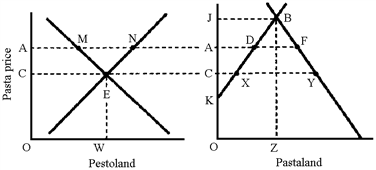 In Figure 34-9, at price OC
If producers have different opportunity costs of production, trade will allow them to consume outside their production possibility frontiers.
(True/False)
4.7/5 (83)
(83) The world price of a commodity will settle at the level where
(Multiple Choice)
4.9/5 (79)
(79) Carefully define the following terms and explain their importance to the study of economics.
a. Specialization
b. Absolute advantage
c. Comparative advantage
d. Quota
e. Trade adjustment assistance
(Essay)
4.9/5 (72)
(72) Figure 34-3
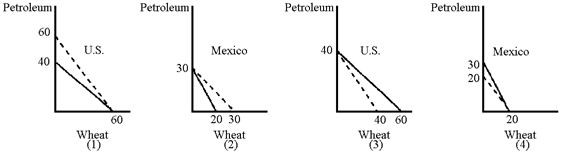 In Figure 34-3, the solid lines represent the respective production possibilities curves for the United States and Mexico. Which graphs show the correct consumption possibilities curves (dashed lines) after an agreement is reached to trade 1 unit of wheat for 1 unit of petroleum?
 (Multiple Choice)
4.9/5 (68)
(68) What is an export subsidy? Discuss some of the recent examples where such subsidies were controversial.
(Essay)
4.9/5 (74)
(74) Table 34-1 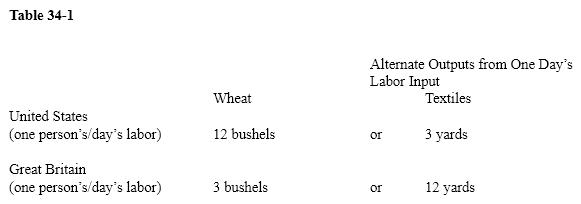 From Table 34-1, the opportunity cost of one bushel of wheat in Great Britain is
 (Multiple Choice)
4.9/5 (76)
(76) The United States is known worldwide as being a low-tariff nation.
(True/False)
4.8/5 (85)
(85) Suppose a country's workers can produce 4 watches per hour or 16 rings per hour. If there is no trade
(Multiple Choice)
4.8/5 (94)
(94) When can a country gain a price advantage on imports by imposing a tariff?
(Multiple Choice)
4.8/5 (75)
(75) 
Filters
- Essay(0)
- Multiple Choice(0)
- Short Answer(0)
- True False(0)
- Matching(0)