



 Chat with AI
Exam 34: International Trade and Comparative Advantage

Exam 1: What Is Economics261 Questions
Exam 2: The Economy: Myth and Reality185 Questions
Exam 3: The Fundamental Economic Problem: Scarcity and Choice290 Questions
Exam 4: Supply and Demand: an Initial Look337 Questions
Exam 21: An Introduction to Macroeconomics216 Questions
Exam 22: The Goals of Macroeconomic Policy212 Questions
Exam 23: Economic Growth: Theory and Policy228 Questions
Exam 24: Aggregate Demand and the Powerful Consumer219 Questions
Exam 25: Demand-Side Equilibrium: Unemployment or Inflation216 Questions
Exam 26: Bringing in the Supply Side: Unemployment and Inflation228 Questions
Exam 27: Managing Aggregate Demand: Fiscal Policy210 Questions
Exam 28: Money and the Banking System224 Questions
Exam 29: Monetary Policy: Conventional and Unconventional210 Questions
Exam 30: The Financial Crisis and the Great Recession66 Questions
Exam 31: The Debate Over Monetary and Fiscal Policy219 Questions
Exam 32: Budget Deficits in the Short and Long Run215 Questions
Exam 33: The Trade-Off Between Inflation and Unemployment219 Questions
Exam 34: International Trade and Comparative Advantage226 Questions
Exam 35: The International Monetary System: Order or Disorder218 Questions
Exam 36: Exchange Rates and the Macroeconomy219 Questions
Exam 37: Contemporary Issues in the Us Economy23 Questions
Select questions type


Absolute advantage is the ability to produce a good using fewer inputs than another producer.
(True/False)
4.9/5  (65)
(65) After the American Civil War, many prominent Southerners lamented the fact that the South "overproduced" cotton and "underproduced" food. In fact, the South did import a very large percentage of its food. Nevertheless, rather than reduce cotton production and grow more food, Southern farmers did the opposite because
(Multiple Choice)
4.8/5 (84)
(84) The following table shows the units of output a worker can produce per month in country A and country B. Country  The opportunity cost of a unit of electronics in Country B is
 (Multiple Choice)
4.7/5 (74)
(74) Figure 34-5
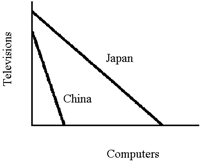 From the graph in Figure 34-5 (curves show output per unit of labor input), one can infer that
 (Multiple Choice)
4.8/5 (70)
(70) Opening trade between a nation that has "cheap labor" and one that has "expensive labor" will
(Multiple Choice)
4.7/5 (76)
(76) Even though international trade is more complicated, supply and demand are still at the center of the price determination mechanism.
(True/False)
4.9/5 (95)
(95) American producers often complain about dumping. What is dumping, and should it be prohibited?
(Essay)
4.8/5 (84)
(84) A quota sets the maximum amount of a good that is permitted into a country.
(True/False)
4.9/5 (82)
(82) Using graphs to illustrate the concepts, absolute advantage
(Multiple Choice)
4.9/5 (83)
(83) Suppose that the United States can make 15 cars or 20 bottles of wine with one year's worth of labor. France can make 10 cars or 18 bottles of wine with one year's worth of labor. From these numbers, we can conclude that
(Multiple Choice)
4.8/5 (86)
(86) The two primary reasons to adopt measures to restrict trade are that
(Multiple Choice)
4.7/5 (74)
(74) Suppose that a quota is imposed on imports of minivans. Show graphically what the effect is in terms of price and quantity of imports. Be sure that your graph is completely and correctly labeled. What determines how much of the quota is paid by the buyers of the minivans?
(Essay)
4.8/5 (82)
(82) If the United States imposes a tariff on the import of Japanese cars instead of a quota, the price
(Multiple Choice)
4.8/5 (74)
(74) An export subsidy helps reduce the selling price of a product by allowing individual producers to charge less and still cover all of their production costs.
(True/False)
4.9/5 (77)
(77) In discussing trade, it is ____ that matters rather than ____.
(Multiple Choice)
4.7/5 (76)
(76) 
Filters
- Essay(0)
- Multiple Choice(0)
- Short Answer(0)
- True False(0)
- Matching(0)