



 Chat with AI
Exam 34: International Trade and Comparative Advantage

Exam 1: What Is Economics261 Questions
Exam 2: The Economy: Myth and Reality185 Questions
Exam 3: The Fundamental Economic Problem: Scarcity and Choice290 Questions
Exam 4: Supply and Demand: an Initial Look337 Questions
Exam 21: An Introduction to Macroeconomics216 Questions
Exam 22: The Goals of Macroeconomic Policy212 Questions
Exam 23: Economic Growth: Theory and Policy228 Questions
Exam 24: Aggregate Demand and the Powerful Consumer219 Questions
Exam 25: Demand-Side Equilibrium: Unemployment or Inflation216 Questions
Exam 26: Bringing in the Supply Side: Unemployment and Inflation228 Questions
Exam 27: Managing Aggregate Demand: Fiscal Policy210 Questions
Exam 28: Money and the Banking System224 Questions
Exam 29: Monetary Policy: Conventional and Unconventional210 Questions
Exam 30: The Financial Crisis and the Great Recession66 Questions
Exam 31: The Debate Over Monetary and Fiscal Policy219 Questions
Exam 32: Budget Deficits in the Short and Long Run215 Questions
Exam 33: The Trade-Off Between Inflation and Unemployment219 Questions
Exam 34: International Trade and Comparative Advantage226 Questions
Exam 35: The International Monetary System: Order or Disorder218 Questions
Exam 36: Exchange Rates and the Macroeconomy219 Questions
Exam 37: Contemporary Issues in the Us Economy23 Questions
Select questions type


"The United States has more oil in Alaska than there is oil in Kuwait. Therefore, the United States should stop importing oil." Evaluate this statement using economic analysis.
(Essay)
4.8/5  (76)
(76) Japan and China produce guns and rice. The country with the lowest opportunity cost of guns (in terms of rice) will
(Multiple Choice)
4.8/5 (92)
(92) Figure 34-7
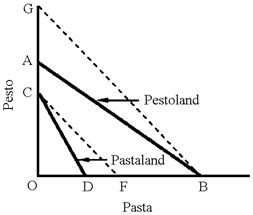 In Figure 34-7, CF has the same slope as BG. AB and CD are the production possibilities of Pestoland and Pastaland, respectively. If both countries are given the opportunity to trade at prices indicated by CF,
 (Multiple Choice)
5.0/5 (96)
(96) Suppose that a tariff is imposed on imports of minivans. Show graphically what the effect is in terms of price and quantity of imports. Be sure that your graph is completely and correctly labeled. What determines how much of the tariff is paid by the buyers of the minivans?
(Essay)
4.8/5 (60)
(60) Table 34-2 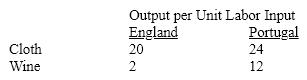 Using the data from Table 34-2, suppose England transfers 2 units of labor from wine to cloth and Portugal transfers 1 unit from cloth to wine. The combined production of wine and cloth will be increased by
 (Multiple Choice)
4.9/5 (77)
(77) If a nation has an absolute advantage in the production of some commodity, it
(Multiple Choice)
4.9/5 (83)
(83) Discuss national defense, infant industry, and strategic trade as arguments for protection.
(Essay)
4.8/5 (85)
(85) A program of protection that results in preserving jobs in certain industries
(Multiple Choice)
4.8/5 (89)
(89) The quantity supplied by domestic producers in an importing country must be less than the quantity demanded by its population.
(True/False)
4.8/5 (93)
(93) Compare and contrast the effects of a quota and a tariff on imports. Be sure to include both short-run and long-run effects in your answer.
(Essay)
4.7/5 (83)
(83) The United States can produce 1,000 shoes if it specializes in shoe production. Alternatively, it can produce 500 shirts. Taiwan can produce 500 shoes or 200 shirts. Explain which country will specialize in shoe production and which in shirt production. What are the possible terms of trade?
(Essay)
4.9/5 (85)
(85) Is the call for protection on the basis of national defense valid?
(Multiple Choice)
4.8/5 (71)
(71) An import quota on a product normally does all of the following except
(Multiple Choice)
4.8/5 (72)
(72) Figure 34-5
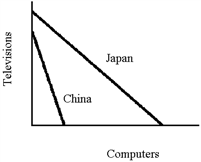 From the graph in Figure 34-5 (curves show output per unit of labor input), one can infer that
 (Multiple Choice)
4.9/5 (73)
(73) An essential point, among many, in the refutation of the "cheap foreign labor" argument is that
(Multiple Choice)
4.8/5 (70)
(70) 
Filters
- Essay(0)
- Multiple Choice(0)
- Short Answer(0)
- True False(0)
- Matching(0)