



 Chat with AI
Exam 34: International Trade and Comparative Advantage

Exam 1: What Is Economics261 Questions
Exam 2: The Economy: Myth and Reality185 Questions
Exam 3: The Fundamental Economic Problem: Scarcity and Choice290 Questions
Exam 4: Supply and Demand: an Initial Look337 Questions
Exam 21: An Introduction to Macroeconomics216 Questions
Exam 22: The Goals of Macroeconomic Policy212 Questions
Exam 23: Economic Growth: Theory and Policy228 Questions
Exam 24: Aggregate Demand and the Powerful Consumer219 Questions
Exam 25: Demand-Side Equilibrium: Unemployment or Inflation216 Questions
Exam 26: Bringing in the Supply Side: Unemployment and Inflation228 Questions
Exam 27: Managing Aggregate Demand: Fiscal Policy210 Questions
Exam 28: Money and the Banking System224 Questions
Exam 29: Monetary Policy: Conventional and Unconventional210 Questions
Exam 30: The Financial Crisis and the Great Recession66 Questions
Exam 31: The Debate Over Monetary and Fiscal Policy219 Questions
Exam 32: Budget Deficits in the Short and Long Run215 Questions
Exam 33: The Trade-Off Between Inflation and Unemployment219 Questions
Exam 34: International Trade and Comparative Advantage226 Questions
Exam 35: The International Monetary System: Order or Disorder218 Questions
Exam 36: Exchange Rates and the Macroeconomy219 Questions
Exam 37: Contemporary Issues in the Us Economy23 Questions
Select questions type


Figure 34-9
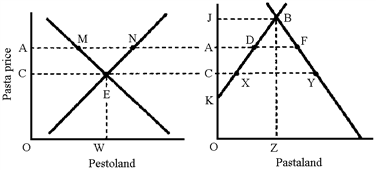 In Figure 34-9, hostilities break out between Pastaland and Pestoland after Pestoland violates the Treaty of Basil. Consequently, trade stops and the price of pasta
 (Multiple Choice)
4.9/5  (87)
(87) 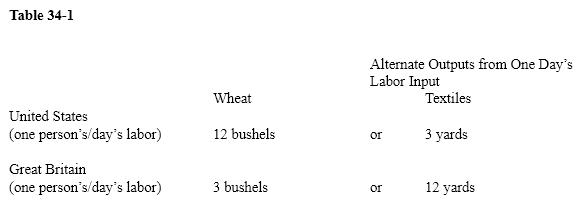 From Table 34-1, the United States
Which of the following observations is true of the principle of comparative advantage?
(Multiple Choice)
4.9/5 (69)
(69) What matters most in determining efficient distribution of production over the world is
(Multiple Choice)
4.8/5 (83)
(83) What would be the output combination for two products A and B on the production possibility frontier, if a country uses its entire resources for producing A?
(Multiple Choice)
4.7/5 (68)
(68) Quebec is capable of producing 10,000 pallets of wood shingles or 8,000 barrels of maple syrup. Vermont is capable of producing 12,000 pallets of wood shingles or 12,000 barrels of maple syrup. a. Graph these production possibilities curves. Indicate from the slope, which has the absolute advantage, which the comparative advantage, and whether there are gains from trade. b. Assume that Vermont and Quebec each specializes in the good in which they have a comparative advantage. Suppose that Vermont and Quebec decide to trade 5,000 pallets of shingles for 5,000 barrels of syrup. Indicate this on the graph. How does this affect the well-being of the two societies? Explain.
(Essay)
4.8/5 (90)
(90) Is it possible for a country to have an absolute disadvantage and a comparative advantage in the production of a good?
(Multiple Choice)
4.7/5 (88)
(88) Large gains from trade are most likely when countries are very different.
(True/False)
4.9/5 (88)
(88) Quotas and tariffs provide the same outcome: restriction of international trade and higher prices for consumers.
(True/False)
4.7/5 (71)
(71) 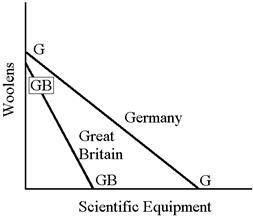 In Figure 34-1,
Table 34-4 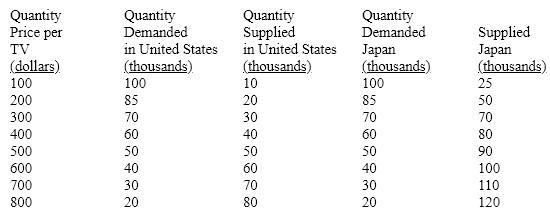 Table 34-4 presents the demand and supply schedules for television sets in Japan and the United States. If Japan and the United States trade with each other, what will be the equilibrium price in the world market for television sets?
 (Multiple Choice)
4.8/5 (83)
(83) Table 34-4
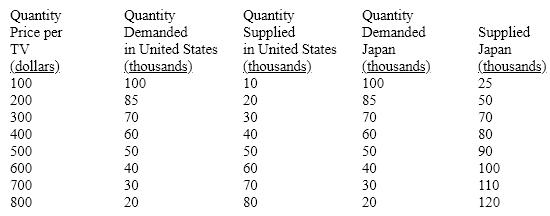 Table 34-4 presents the demand and supply schedules for television sets in Japan and the United States. If the United States and Japan decide to trade with each other, what will happen to the output of television sets in Japan?
 (Multiple Choice)
4.9/5 (69)
(69) Comparative advantage is illustrated by the slopes of production possibilities frontiers.
(True/False)
4.8/5 (72)
(72) Figure 34-9
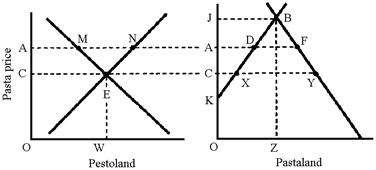 In Figure 34-9, Pestoland exports pasta to Pastaland. Equilibrium will occur when
 (Multiple Choice)
4.8/5 (84)
(84) Mercantilism is a doctrine that holds that exports are good for a country, whereas imports are harmful.
(True/False)
4.8/5 (88)
(88) If two countries voluntarily trade two goods with one another, the rate of exchange between the goods must fall in between the price ratios that would prevail in the two countries in the absence of trade.
(True/False)
4.8/5 (87)
(87) Figure 34-7
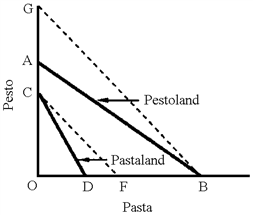 In Figure 34-7, AB represents the production possibilities of Pestoland and CD that of Pastaland. In this graph, Pestoland has a comparative advantage in
 (Multiple Choice)
4.9/5 (75)
(75) When other nations Orient "dump" products on the U.S. market, they
(Multiple Choice)
4.8/5 (81)
(81) Self-sufficiency is the best way to increase one's material welfare.
(True/False)
4.9/5 (70)
(70) Baumol and Blinder offer some reasons why countries trade with each other. List three of the reasons, and give an example of each to illustrate the reason.
(Essay)
4.7/5 (85)
(85) 
Filters
- Essay(0)
- Multiple Choice(0)
- Short Answer(0)
- True False(0)
- Matching(0)