



 Chat with AI
Exam 34: International Trade and Comparative Advantage

Exam 1: What Is Economics261 Questions
Exam 2: The Economy: Myth and Reality185 Questions
Exam 3: The Fundamental Economic Problem: Scarcity and Choice290 Questions
Exam 4: Supply and Demand: an Initial Look337 Questions
Exam 21: An Introduction to Macroeconomics216 Questions
Exam 22: The Goals of Macroeconomic Policy212 Questions
Exam 23: Economic Growth: Theory and Policy228 Questions
Exam 24: Aggregate Demand and the Powerful Consumer219 Questions
Exam 25: Demand-Side Equilibrium: Unemployment or Inflation216 Questions
Exam 26: Bringing in the Supply Side: Unemployment and Inflation228 Questions
Exam 27: Managing Aggregate Demand: Fiscal Policy210 Questions
Exam 28: Money and the Banking System224 Questions
Exam 29: Monetary Policy: Conventional and Unconventional210 Questions
Exam 30: The Financial Crisis and the Great Recession66 Questions
Exam 31: The Debate Over Monetary and Fiscal Policy219 Questions
Exam 32: Budget Deficits in the Short and Long Run215 Questions
Exam 33: The Trade-Off Between Inflation and Unemployment219 Questions
Exam 34: International Trade and Comparative Advantage226 Questions
Exam 35: The International Monetary System: Order or Disorder218 Questions
Exam 36: Exchange Rates and the Macroeconomy219 Questions
Exam 37: Contemporary Issues in the Us Economy23 Questions
Select questions type


An export subsidy is a payment by the government to exporters to permit them to charge lower prices.
(True/False)
4.9/5  (87)
(87) The Trade Adjustment Assistance program is intended to help
(Multiple Choice)
4.9/5 (79)
(79) Figure 34-9
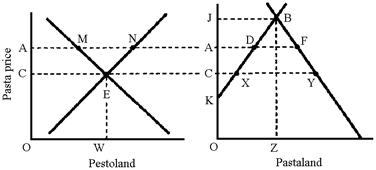 In Figure 34-9, Pestoland exports pasta to Pastaland. The equilibrium price of pasta will be
 (Multiple Choice)
4.9/5 (80)
(80) Talented people who are best at everything have a comparative advantage in the production of everything.
(True/False)
4.9/5 (87)
(87) The U.S. Constitution prevents tariffs on trade between the individual states.
(True/False)
5.0/5 (70)
(70) Figure 34-6
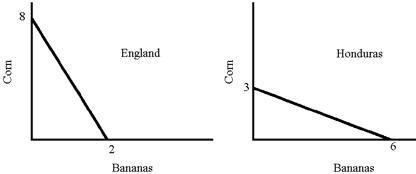 From the graph in Figure 34-6, the opportunity cost of a unit of bananas is
 (Multiple Choice)
4.8/5 (73)
(73) The infant-industry argument for trade protection holds that new industries need to be protected from foreign competition until they develop and flourish.
(True/False)
4.8/5 (75)
(75) Gain from trade is the increase in total production due to specialization allowed by trade.
(True/False)
4.7/5 (91)
(91) If a nation has an absolute advantage in the production of a good
(Multiple Choice)
4.9/5 (71)
(71) Table 34-3
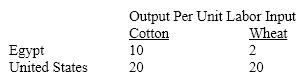 The data in Table 34-3 indicate that the United States has
 (Multiple Choice)
4.8/5 (79)
(79) The basic concept behind strategic trade policy is that free trade is the best policy to pursue, but some countries don't play by those rules. Therefore,
(Multiple Choice)
4.8/5 (84)
(84) According to the ____ view, a nation's wealth consists of the amount of gold or other monies at its command.
(Multiple Choice)
4.8/5 (88)
(88) Figure 34-4
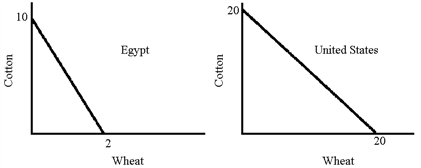 In Figure 34-4, the opportunity cost of a unit of wheat in terms of cotton is
 (Multiple Choice)
4.9/5 (83)
(83) What is strategic trade policy? What are the pros and cons of such a policy by a nation in its dealings with other nations?
(Essay)
4.9/5 (82)
(82) The estimated cost of automobile jobs saved due to limitations on foreign autos is $105,000 per job. Why is there a cost to saving jobs through protectionism?
(Essay)
5.0/5 (76)
(76) Dumping is a trade practice in which countries sell goods in a foreign market at cheaper prices than the goods can be produced domestically.
(True/False)
4.8/5 (80)
(80) If a nation does not have an absolute advantage in producing anything, it
(Multiple Choice)
4.8/5 (76)
(76) If the production possibilities curves of two countries have the same slope,
(Multiple Choice)
4.8/5 (88)
(88) 
Filters
- Essay(0)
- Multiple Choice(0)
- Short Answer(0)
- True False(0)
- Matching(0)