



 Chat with AI
Exam 34: International Trade and Comparative Advantage

Exam 1: What Is Economics261 Questions
Exam 2: The Economy: Myth and Reality185 Questions
Exam 3: The Fundamental Economic Problem: Scarcity and Choice290 Questions
Exam 4: Supply and Demand: an Initial Look337 Questions
Exam 21: An Introduction to Macroeconomics216 Questions
Exam 22: The Goals of Macroeconomic Policy212 Questions
Exam 23: Economic Growth: Theory and Policy228 Questions
Exam 24: Aggregate Demand and the Powerful Consumer219 Questions
Exam 25: Demand-Side Equilibrium: Unemployment or Inflation216 Questions
Exam 26: Bringing in the Supply Side: Unemployment and Inflation228 Questions
Exam 27: Managing Aggregate Demand: Fiscal Policy210 Questions
Exam 28: Money and the Banking System224 Questions
Exam 29: Monetary Policy: Conventional and Unconventional210 Questions
Exam 30: The Financial Crisis and the Great Recession66 Questions
Exam 31: The Debate Over Monetary and Fiscal Policy219 Questions
Exam 32: Budget Deficits in the Short and Long Run215 Questions
Exam 33: The Trade-Off Between Inflation and Unemployment219 Questions
Exam 34: International Trade and Comparative Advantage226 Questions
Exam 35: The International Monetary System: Order or Disorder218 Questions
Exam 36: Exchange Rates and the Macroeconomy219 Questions
Exam 37: Contemporary Issues in the Us Economy23 Questions
Select questions type


Which of the following statements regarding the cheap foreign labor argument is correct?
(Multiple Choice)
4.9/5  (66)
(66) William Safire argues that a unilateral free trade policy is a disaster if
(Multiple Choice)
4.7/5 (73)
(73) Table 34-4
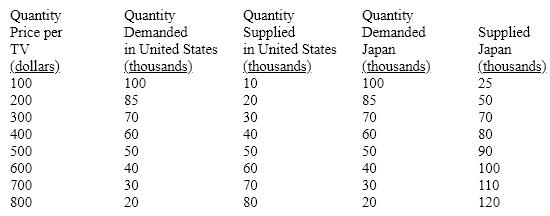 Table 34-4 presents the demand and supply schedules for television sets in Japan and the United States. If the United States and Japan trade with each other, what will happen to the output of television sets in the United States?
 (Multiple Choice)
4.8/5 (79)
(79) Is the call for protection on the basis of "infant industry" valid?
(Multiple Choice)
4.7/5 (83)
(83) For many years the U.S. government imposed quotas on cheap, Middle Eastern oil imports. The U.S. consumer consequently paid $3 billion more per year for oil products. A likely rationale for such a policy is
(Multiple Choice)
4.8/5 (73)
(73) Colombia produces coffee with less labor and land than any other country; it therefore surely has
(Multiple Choice)
4.9/5 (65)
(65) Table 34-4 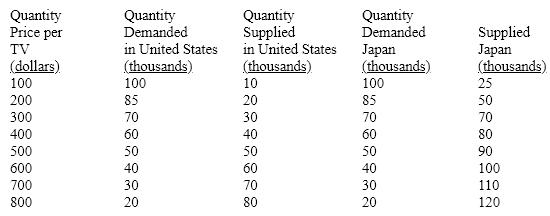 Table 34-4 presents the demand and supply schedules for television sets in Japan and the United States. If there is no trade between these countries, what are the equilibrium price and quantity in Japan?
 (Multiple Choice)
4.8/5 (79)
(79) Voluntary exchange is based on the principle that all parties must gain from trade.
(True/False)
4.8/5 (82)
(82) Both tariffs and quotas will restrict supplies coming into the country from abroad.
(True/False)
4.7/5 (83)
(83) Figure 34-9
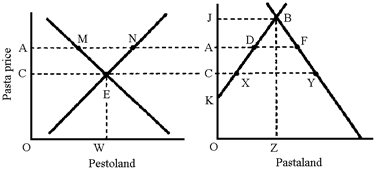 In Figure 34-9, at price OC total quantity demanded exceeds quantity supplied and price will rise to
 (Multiple Choice)
4.9/5 (83)
(83) __________ is a payment by the government to exporters to permit them to reduce the selling prices of their goods so they can compete more effectively in foreign markets.
(Multiple Choice)
4.8/5 (77)
(77) A restriction of imports that is accomplished by a quota normally
(Multiple Choice)
4.9/5 (85)
(85) If a nation has an absolute advantage in the production of a good,
(Multiple Choice)
5.0/5 (70)
(70) The following table shows the units of output a worker can produce per month in country A and country B. Country  The opportunity cost of 1 unit of electronics in country A is
 (Multiple Choice)
5.0/5 (74)
(74) Table 34-4
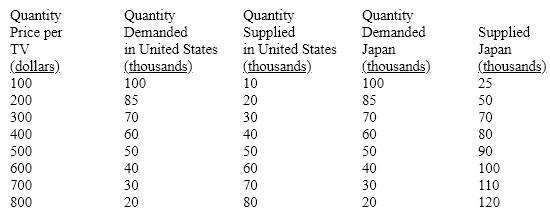 Table 34-4 presents the demand and supply schedules for television sets in Japan and the United States. If Japan and the United States trade with each other, which country will export television sets and how many?
 (Multiple Choice)
4.8/5 (78)
(78) ____ is a doctrine that holds that exports are good for a country, whereas imports are harmful.
(Multiple Choice)
4.9/5 (80)
(80) Which of the following positions would a mercantilist support?
(Multiple Choice)
4.9/5 (76)
(76) If the supply curve of a commodity is upward sloping, and the producing country begins to export more in a pure free trade system, the domestic price of the commodity will
(Multiple Choice)
4.8/5 (68)
(68) Trade adjustment assistance provides special unemployment benefits, loans, retraining programs, and other aid to workers and firms that are harmed by foreign competition.
(True/False)
4.8/5 (70)
(70) 
Filters
- Essay(0)
- Multiple Choice(0)
- Short Answer(0)
- True False(0)
- Matching(0)