



 Chat with AI
Exam 34: International Trade and Comparative Advantage

Exam 1: What Is Economics261 Questions
Exam 2: The Economy: Myth and Reality185 Questions
Exam 3: The Fundamental Economic Problem: Scarcity and Choice290 Questions
Exam 4: Supply and Demand: an Initial Look337 Questions
Exam 21: An Introduction to Macroeconomics216 Questions
Exam 22: The Goals of Macroeconomic Policy212 Questions
Exam 23: Economic Growth: Theory and Policy228 Questions
Exam 24: Aggregate Demand and the Powerful Consumer219 Questions
Exam 25: Demand-Side Equilibrium: Unemployment or Inflation216 Questions
Exam 26: Bringing in the Supply Side: Unemployment and Inflation228 Questions
Exam 27: Managing Aggregate Demand: Fiscal Policy210 Questions
Exam 28: Money and the Banking System224 Questions
Exam 29: Monetary Policy: Conventional and Unconventional210 Questions
Exam 30: The Financial Crisis and the Great Recession66 Questions
Exam 31: The Debate Over Monetary and Fiscal Policy219 Questions
Exam 32: Budget Deficits in the Short and Long Run215 Questions
Exam 33: The Trade-Off Between Inflation and Unemployment219 Questions
Exam 34: International Trade and Comparative Advantage226 Questions
Exam 35: The International Monetary System: Order or Disorder218 Questions
Exam 36: Exchange Rates and the Macroeconomy219 Questions
Exam 37: Contemporary Issues in the Us Economy23 Questions
Select questions type


If England uses one week's time to produce 10 yards of cloth or 2 barrels of wine and Portugal uses one week's time to produce 12 yards of cloth or 6 barrels of wine, then England has a comparative advantage in the production of cloth.
(True/False)
4.8/5  (68)
(68) 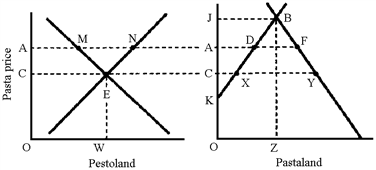 In Figure 34-9, Pestoland at price OA
Figure 34-8
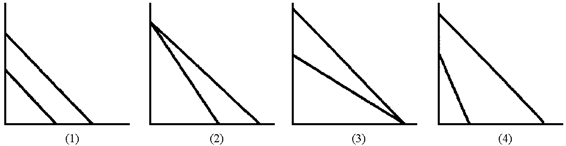 Figure 34-8 has four sets of production possibility curves for two hypothetical countries. In which case will there be no advantage to trade between the two countries?
 (Multiple Choice)
4.8/5 (82)
(82) Figure 34-7
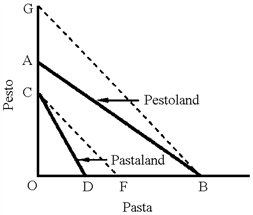 In Figure 34-7, it is probably true that wages are
 (Multiple Choice)
4.8/5 (88)
(88) The logic of why international trade increases well-being is
(Multiple Choice)
4.8/5 (84)
(84) Dumping means selling goods in a foreign market at lower prices than those charged in the home market.
(True/False)
4.9/5 (94)
(94) Comparative advantage, not absolute advantage, determines the decision to specialize in production.
(True/False)
4.9/5 (88)
(88) The trade philosophy of the Clinton administration is best characterized as
(Multiple Choice)
4.9/5 (81)
(81) Unequal distribution of resources is one of the main reasons for international trade.
(True/False)
4.9/5 (82)
(82) If South Korea has an absolute advantage in the production of an item, it must also have a comparative advantage in the production of that item.
(True/False)
4.9/5 (85)
(85) One of the main reasons that people want to limit imports is the
(Multiple Choice)
4.9/5 (90)
(90) Absolute advantage is a comparison among producers based on productivity.
(True/False)
4.8/5 (68)
(68) The way in which a country benefits from trade is that it can
(Multiple Choice)
4.9/5 (64)
(64) Strategic trade policy relies on threats of protectionism to protect free trade.
(True/False)
4.9/5 (68)
(68) The principle of comparative advantage states that countries should specialize in the production of goods for which they have a lower opportunity cost of production than their trading partners.
(True/False)
4.7/5 (93)
(93) What are the two approaches followed by the U.S. government to ease the burden on the victims of free trade?
(Essay)
4.9/5 (80)
(80) A common fallacy that is used to oppose trade is the idea that
(Multiple Choice)
5.0/5 (100)
(100) 
Filters
- Essay(0)
- Multiple Choice(0)
- Short Answer(0)
- True False(0)
- Matching(0)