



 Chat with AI
Exam 34: International Trade and Comparative Advantage

Exam 1: What Is Economics261 Questions
Exam 2: The Economy: Myth and Reality185 Questions
Exam 3: The Fundamental Economic Problem: Scarcity and Choice290 Questions
Exam 4: Supply and Demand: an Initial Look337 Questions
Exam 21: An Introduction to Macroeconomics216 Questions
Exam 22: The Goals of Macroeconomic Policy212 Questions
Exam 23: Economic Growth: Theory and Policy228 Questions
Exam 24: Aggregate Demand and the Powerful Consumer219 Questions
Exam 25: Demand-Side Equilibrium: Unemployment or Inflation216 Questions
Exam 26: Bringing in the Supply Side: Unemployment and Inflation228 Questions
Exam 27: Managing Aggregate Demand: Fiscal Policy210 Questions
Exam 28: Money and the Banking System224 Questions
Exam 29: Monetary Policy: Conventional and Unconventional210 Questions
Exam 30: The Financial Crisis and the Great Recession66 Questions
Exam 31: The Debate Over Monetary and Fiscal Policy219 Questions
Exam 32: Budget Deficits in the Short and Long Run215 Questions
Exam 33: The Trade-Off Between Inflation and Unemployment219 Questions
Exam 34: International Trade and Comparative Advantage226 Questions
Exam 35: The International Monetary System: Order or Disorder218 Questions
Exam 36: Exchange Rates and the Macroeconomy219 Questions
Exam 37: Contemporary Issues in the Us Economy23 Questions
Select questions type


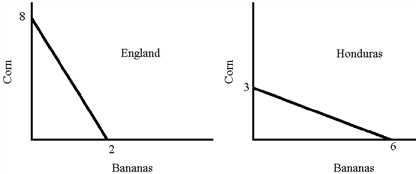 From Figure 34-6, one can infer that

The strategic argument for protectionism holds that a nation may sometimes have to threaten protectionism to induce other countries to drop their own protectionist measures.
(True/False)
5.0/5  (92)
(92) Figure 34-10
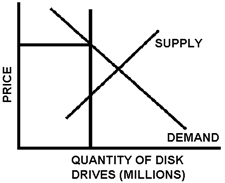 Figure 34-10 shows the effect on the market for disk drives of a(n)
 (Multiple Choice)
4.8/5 (82)
(82) Table 34-4 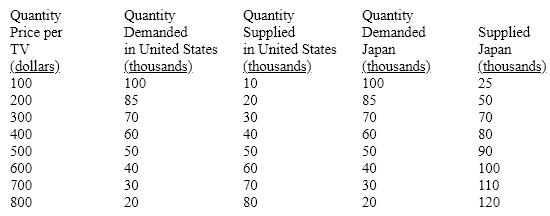 Table 34-4 presents the demand and supply schedules for television sets in Japan and the United States. If there is no trade between these countries, what are the equilibrium price and quantity in the United States?
 (Multiple Choice)
4.8/5 (96)
(96) A program of protection that results in preserving jobs in certain industries
(Multiple Choice)
4.9/5 (80)
(80) Many countries impose tariffs or quotas to protect the domestic industry from competition.
(True/False)
4.8/5 (81)
(81) The essential logic behind international trade is not different from that underlying trade among different states. Why, then, do we study international trade as a special subject?
(Essay)
4.9/5 (69)
(69) The following table shows the units of output a worker can produce per month in country A and country B. Country  Which of the following statements about absolute advantage is true?
 (Multiple Choice)
4.8/5 (85)
(85) A country that must inhibit imports should give preference to
(Multiple Choice)
4.9/5 (63)
(63) Quebec is capable of producing 10 pallets of wood shingles or 8 barrels of maple syrup with a unit of labor. Vermont is capable of producing 12 pallets of wood shingles or 12 barrels of maple syrup with a unit of labor. Assume that this is typical of the labor force as a whole. Which location has the absolute advantage and which has the comparative advantage, in the production of each good? Can these locations reap gains from trade?
(Essay)
4.9/5 (80)
(80) A country has a comparative advantage over another in the production of gadgets if it can produce
(Multiple Choice)
4.9/5 (87)
(87) Suppose that Captain Canada can produce 100 hockey sticks or 10 gallons of maple syrup in a typical work week, while Captain Germany can produce 90 hockey sticks or 10 gallons of maple syrup in a typical work week. From these numbers, we can conclude
(Multiple Choice)
4.9/5 (79)
(79) A nation can gain from imposing a tariff on imports if it forces exporting countries
(Multiple Choice)
4.9/5 (86)
(86) By tradition, Japanese employers cannot "lay off" workers. As a result they have goods that they cannot sell on the domestic market without driving down prices. To minimize losses, they sell goods such as steel and televisions in foreign markets at prices well below those in Japan. This is called
(Multiple Choice)
4.9/5 (85)
(85) Variability in exchange rates of currencies used in international trade
(Multiple Choice)
4.8/5 (73)
(73) 
Filters
- Essay(0)
- Multiple Choice(0)
- Short Answer(0)
- True False(0)
- Matching(0)