



 Chat with AI
Exam 33: The Trade-Off Between Inflation and Unemployment

Exam 1: What Is Economics261 Questions
Exam 2: The Economy: Myth and Reality185 Questions
Exam 3: The Fundamental Economic Problem: Scarcity and Choice290 Questions
Exam 4: Supply and Demand: an Initial Look337 Questions
Exam 21: An Introduction to Macroeconomics216 Questions
Exam 22: The Goals of Macroeconomic Policy212 Questions
Exam 23: Economic Growth: Theory and Policy228 Questions
Exam 24: Aggregate Demand and the Powerful Consumer219 Questions
Exam 25: Demand-Side Equilibrium: Unemployment or Inflation216 Questions
Exam 26: Bringing in the Supply Side: Unemployment and Inflation228 Questions
Exam 27: Managing Aggregate Demand: Fiscal Policy210 Questions
Exam 28: Money and the Banking System224 Questions
Exam 29: Monetary Policy: Conventional and Unconventional210 Questions
Exam 30: The Financial Crisis and the Great Recession66 Questions
Exam 31: The Debate Over Monetary and Fiscal Policy219 Questions
Exam 32: Budget Deficits in the Short and Long Run215 Questions
Exam 33: The Trade-Off Between Inflation and Unemployment219 Questions
Exam 34: International Trade and Comparative Advantage226 Questions
Exam 35: The International Monetary System: Order or Disorder218 Questions
Exam 36: Exchange Rates and the Macroeconomy219 Questions
Exam 37: Contemporary Issues in the Us Economy23 Questions
Select questions type


There is no long-run trade-off between inflation and unemployment.
(True/False)
4.8/5  (94)
(94) The unemployment rate was increasing from 6 percent to 7 percent could be interpreted as an increase in the natural rate of
(Multiple Choice)
4.9/5 (96)
(96) If workers expect inflation, and tend to overestimate actual inflation when they negotiate wage increases, the result will be a continuing
(Multiple Choice)
4.9/5 (87)
(87) Most economists agree that the self-correcting mechanism works
(Multiple Choice)
4.8/5 (81)
(81) Figure 33-7
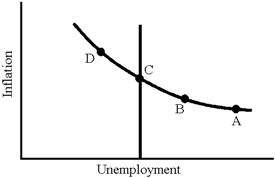 In Figure 33-7, the case for expansionary monetary policy and fiscal policy is strongest at point
 (Multiple Choice)
4.8/5 (77)
(77) To make rational forecasts, your predictions do not have to be correct all of the time.
(True/False)
5.0/5 (76)
(76) Most economists believe that the theory of rational expectations is
(Multiple Choice)
4.8/5 (71)
(71) A nonpolicy reason for the reduction in the natural rate of unemployment is the
(Multiple Choice)
4.9/5 (80)
(80) Figure 33-8
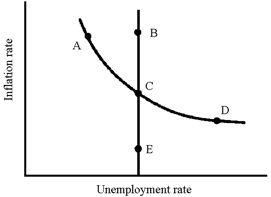 In Figure 33-8, which of the following movements reflects the closing of a recessionary gap with an expansionary monetary and fiscal policy?
 (Multiple Choice)
4.9/5 (82)
(82) A decrease in the price of foreign oil will affect the U.S. economy by
(Multiple Choice)
4.7/5 (87)
(87) One explanation for the increase in the natural rate of unemployment in 2010 was a mismatch between the skills of the American labor force and the skills that the modern job market demanded.
(True/False)
4.9/5 (68)
(68) The economy's self-correcting mechanism refers to the way money wages react to either a recessionary gap or an inflationary gap.
(True/False)
4.9/5 (88)
(88) Figure 33-7
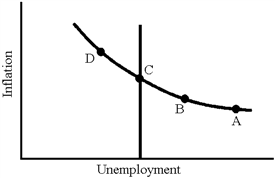 In Figure 33-7, the only sustainable long-run equilibrium position is at point
 (Multiple Choice)
4.9/5 (76)
(76) If workers always see inflation coming, and if they demand wage increases in advance so that inflation does not erode real wages, then the economy's aggregate supply curve on the AD-AS diagram will
(Multiple Choice)
4.8/5 (75)
(75) Figure 33-8
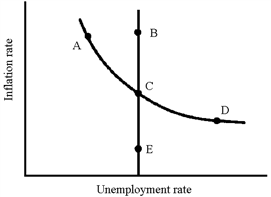 In Figure 33-8, policymakers can choose which of the following points as sustainable inflation-unemployment combinations?
 (Multiple Choice)
4.7/5 (77)
(77) The proposition that the Fed should concentrate on price stability rather than reducing unemployment is
(Multiple Choice)
4.8/5 (63)
(63) If policymakers do nothing in response to a recessionary gap, what will happen?
(Multiple Choice)
4.8/5 (82)
(82) 
Filters
- Essay(0)
- Multiple Choice(0)
- Short Answer(0)
- True False(0)
- Matching(0)