



 Chat with AI
Exam 33: The Trade-Off Between Inflation and Unemployment

Exam 1: What Is Economics261 Questions
Exam 2: The Economy: Myth and Reality185 Questions
Exam 3: The Fundamental Economic Problem: Scarcity and Choice290 Questions
Exam 4: Supply and Demand: an Initial Look337 Questions
Exam 21: An Introduction to Macroeconomics216 Questions
Exam 22: The Goals of Macroeconomic Policy212 Questions
Exam 23: Economic Growth: Theory and Policy228 Questions
Exam 24: Aggregate Demand and the Powerful Consumer219 Questions
Exam 25: Demand-Side Equilibrium: Unemployment or Inflation216 Questions
Exam 26: Bringing in the Supply Side: Unemployment and Inflation228 Questions
Exam 27: Managing Aggregate Demand: Fiscal Policy210 Questions
Exam 28: Money and the Banking System224 Questions
Exam 29: Monetary Policy: Conventional and Unconventional210 Questions
Exam 30: The Financial Crisis and the Great Recession66 Questions
Exam 31: The Debate Over Monetary and Fiscal Policy219 Questions
Exam 32: Budget Deficits in the Short and Long Run215 Questions
Exam 33: The Trade-Off Between Inflation and Unemployment219 Questions
Exam 34: International Trade and Comparative Advantage226 Questions
Exam 35: The International Monetary System: Order or Disorder218 Questions
Exam 36: Exchange Rates and the Macroeconomy219 Questions
Exam 37: Contemporary Issues in the Us Economy23 Questions
Select questions type


If inflationary expectations are quite sluggish (that is, they do not adapt quickly), then the short-run Phillips curve will
(Multiple Choice)
4.7/5  (73)
(73) If the short-run Phillips curve has a very steep slope, the
(Multiple Choice)
4.8/5 (82)
(82) In the short run, fiscal and monetary policy cause unemployment and inflation to move in opposite directions because
(Multiple Choice)
4.9/5 (83)
(83) Figure 33-5
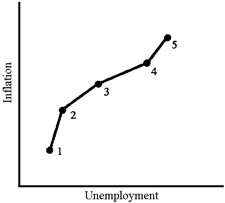 The data illustrated in Figure 33-5 would be most representative of which of the following decades?
 (Multiple Choice)
4.9/5 (77)
(77) Policies to lower the natural rate of unemployment include
(Multiple Choice)
5.0/5 (94)
(94) Inflation targeting requires monetary policymakers to rely heavily on the Phillips curve.
(True/False)
4.9/5 (76)
(76) Figure 33-7
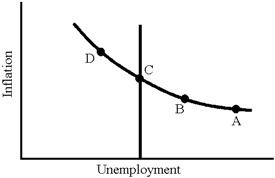 In Figure 33-7, the case for restrictive monetary and fiscal policy is strongest at point
 (Multiple Choice)
4.7/5 (72)
(72) If strong monetary policy stimulus is used to combat a recessionary gap, what will happen?
(Multiple Choice)
4.9/5 (84)
(84) If workers demand wage compensation in advance of inflation, the economy's aggregate supply curve will
(Multiple Choice)
4.9/5 (61)
(61) Figure 33-1
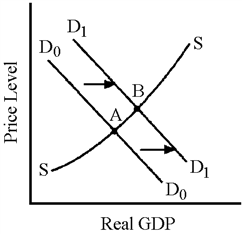 Which of the following is true about the economy depicted in Figure 33-1?
 (Multiple Choice)
4.9/5 (87)
(87) The unemployment rate for the U.S. economy in 2014 averaged about
(Multiple Choice)
4.8/5 (85)
(85) If aggregate demand grows faster than aggregate supply, the equilibrium price level will rise.
(True/False)
4.7/5 (80)
(80) When inflation comes from the supply side, inflation and unemployment are positively correlated. Does this mean that monetary and fiscal policymakers can escape the trade-off between inflation and unemployment?
(Essay)
4.9/5 (77)
(77) What are some of the possible ways in which we could reduce the natural rate of unemployment?
(Essay)
4.8/5 (92)
(92) If, in the long run, people adjust their price expectation so that all prices and incomes move proportionately to an increase in the price level, then the long-run Phillips curve is vertical.
(True/False)
4.8/5 (81)
(81) The rapid advance in computer technology is one of the reasons given for the shift of the
(Multiple Choice)
4.9/5 (81)
(81) If fluctuations in economic activity emanate from the supply side, higher rates of inflation will be associated with higher rates of unemployment, and lower rates of inflation will be associated with lower rates of unemployment.
(True/False)
4.9/5 (79)
(79) Stimulating aggregate demand to reduce unemployment will aggravate inflation.
(True/False)
4.9/5 (87)
(87) 
Filters
- Essay(0)
- Multiple Choice(0)
- Short Answer(0)
- True False(0)
- Matching(0)