



 Chat with AI
Exam 33: The Trade-Off Between Inflation and Unemployment

Exam 1: What Is Economics261 Questions
Exam 2: The Economy: Myth and Reality185 Questions
Exam 3: The Fundamental Economic Problem: Scarcity and Choice290 Questions
Exam 4: Supply and Demand: an Initial Look337 Questions
Exam 21: An Introduction to Macroeconomics216 Questions
Exam 22: The Goals of Macroeconomic Policy212 Questions
Exam 23: Economic Growth: Theory and Policy228 Questions
Exam 24: Aggregate Demand and the Powerful Consumer219 Questions
Exam 25: Demand-Side Equilibrium: Unemployment or Inflation216 Questions
Exam 26: Bringing in the Supply Side: Unemployment and Inflation228 Questions
Exam 27: Managing Aggregate Demand: Fiscal Policy210 Questions
Exam 28: Money and the Banking System224 Questions
Exam 29: Monetary Policy: Conventional and Unconventional210 Questions
Exam 30: The Financial Crisis and the Great Recession66 Questions
Exam 31: The Debate Over Monetary and Fiscal Policy219 Questions
Exam 32: Budget Deficits in the Short and Long Run215 Questions
Exam 33: The Trade-Off Between Inflation and Unemployment219 Questions
Exam 34: International Trade and Comparative Advantage226 Questions
Exam 35: The International Monetary System: Order or Disorder218 Questions
Exam 36: Exchange Rates and the Macroeconomy219 Questions
Exam 37: Contemporary Issues in the Us Economy23 Questions
Select questions type


Figure 33-8
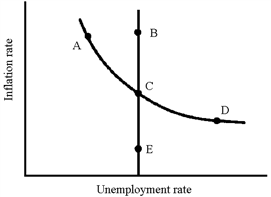 In Figure 33-8, which of the following points cannot be observed in the long run?
 (Multiple Choice)
4.8/5  (72)
(72) Figure 33-8
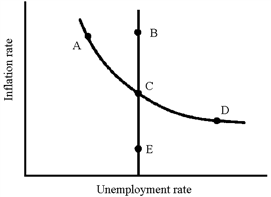 In Figure 33-8, which of the following movements reflects the closing of an inflationary gap through the economy's self-correcting mechanism?
 (Multiple Choice)
4.9/5 (82)
(82) An example of indexing is a "cost of living" adjustment clause in a wage contract.
(True/False)
4.8/5 (90)
(90) Figure 33-1
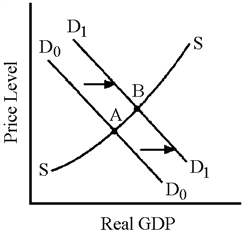 Which of the following is true about the economy depicted in Figure 33-1?
 (Multiple Choice)
5.0/5 (65)
(65) Figure 33-3
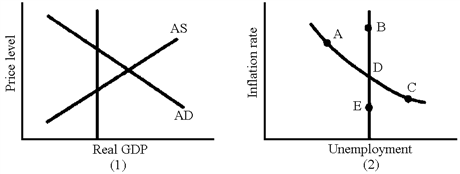 Given the situation in graph (1) in Figure 33-3, what movement would be expected in graph (2) from the economy's self-correcting mechanism?
 (Multiple Choice)
4.8/5 (84)
(84) Which of the following factors contributed to the collapse of the Phillips curve in the 1970s?
(Multiple Choice)
4.8/5 (89)
(89) At one time, policymakers interpreted the Phillips curve as offering a menu of inflation-unemployment choices. Today, the curve is no longer viewed this way. Why has the interpretation changed?
(Essay)
4.7/5 (84)
(84) One piece of evidence that business fluctuations are caused by demand-side changes would be that
(Multiple Choice)
4.9/5 (83)
(83) If unemployment and inflation always move in the same direction, then we can infer that business fluctuations are
(Multiple Choice)
4.9/5 (73)
(73) If policymakers do nothing in response to an inflationary gap, what will happen?
(Multiple Choice)
4.9/5 (84)
(84) Figure 33-4
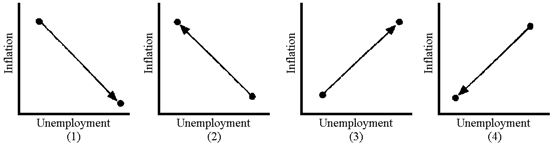 Which panel in Figure 33-4 shows the movement associated with the supply-side changes of the 1990s?
 (Multiple Choice)
4.7/5 (79)
(79) A supply shock is an event that directly alters firms' costs and prices, shifting the economy's aggregate supply and thus the Phillips curve.
(True/False)
4.9/5 (64)
(64) Figure 33-6
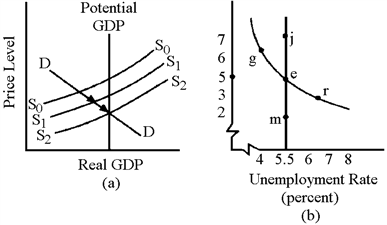 If Figure 33-6 (a) illustrates the elimination of a recessionary gap, then the economy should move to what point on the curves shown in Figure 33-6 (b)?
 (Multiple Choice)
4.8/5 (83)
(83) If policymakers do nothing in a recessionary gap, the most likely outcome is a
(Multiple Choice)
4.9/5 (88)
(88) The Phillips curve is a statistical relationship that was misrepresented as showing
(Multiple Choice)
4.7/5 (82)
(82) A decrease in AS will trigger less inflation under which of the following conditions?
(Multiple Choice)
4.8/5 (76)
(76) 
Filters
- Essay(0)
- Multiple Choice(0)
- Short Answer(0)
- True False(0)
- Matching(0)