



 Chat with AI
Exam 33: The Trade-Off Between Inflation and Unemployment

Exam 1: What Is Economics261 Questions
Exam 2: The Economy: Myth and Reality185 Questions
Exam 3: The Fundamental Economic Problem: Scarcity and Choice290 Questions
Exam 4: Supply and Demand: an Initial Look337 Questions
Exam 21: An Introduction to Macroeconomics216 Questions
Exam 22: The Goals of Macroeconomic Policy212 Questions
Exam 23: Economic Growth: Theory and Policy228 Questions
Exam 24: Aggregate Demand and the Powerful Consumer219 Questions
Exam 25: Demand-Side Equilibrium: Unemployment or Inflation216 Questions
Exam 26: Bringing in the Supply Side: Unemployment and Inflation228 Questions
Exam 27: Managing Aggregate Demand: Fiscal Policy210 Questions
Exam 28: Money and the Banking System224 Questions
Exam 29: Monetary Policy: Conventional and Unconventional210 Questions
Exam 30: The Financial Crisis and the Great Recession66 Questions
Exam 31: The Debate Over Monetary and Fiscal Policy219 Questions
Exam 32: Budget Deficits in the Short and Long Run215 Questions
Exam 33: The Trade-Off Between Inflation and Unemployment219 Questions
Exam 34: International Trade and Comparative Advantage226 Questions
Exam 35: The International Monetary System: Order or Disorder218 Questions
Exam 36: Exchange Rates and the Macroeconomy219 Questions
Exam 37: Contemporary Issues in the Us Economy23 Questions
Select questions type


Many economists think that, in the long run, the Phillips curve is
(Multiple Choice)
4.8/5  (92)
(92) The economy's self-correcting mechanism to eliminate a recessionary gap relies on
(Multiple Choice)
4.8/5 (92)
(92) According to the Phillips curve, in the short run, if policymakers choose an expansionary policy to lower the rate of unemployment, the economy will experience an increase in inflation.
(True/False)
4.7/5 (67)
(67) In the 1990s, the United States benefited from a series of favorable supply shocks. This caused a(n)
(Multiple Choice)
5.0/5 (85)
(85) The Phillips curve is an extension of the model of aggregate supply and aggregate demand because, in the short run, an increase in aggregate demand increases prices and decreases unemployment.
(True/False)
4.8/5 (73)
(73) Figure 33-3
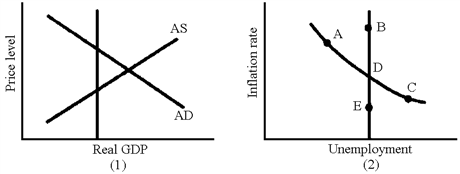 Given the situation in graph (1) in Figure 33-3, what can be expected to change in graph (1) when the economy's self-correcting mechanism operates?
 (Multiple Choice)
4.9/5 (85)
(85) A vocal minority of economists, believers in the theory of rational expectations, insist that
(Multiple Choice)
4.9/5 (81)
(81) Which of the following observations concerning the Phillips curve is not true?
(Multiple Choice)
4.8/5 (77)
(77) Which of the following is most likely to result in inflation?
(Multiple Choice)
4.8/5 (94)
(94) A study of the U.S. price level and real GDP from 1972 to 2007 reveals a clear upward march toward higher prices and greater output. What explains this?
(Multiple Choice)
4.8/5 (75)
(75) Define the following terms and explain their importance to the study of macroeconomics:
a. Phillips curve
b. rational expectations
c. indexing
d. stagflation
(Essay)
4.9/5 (93)
(93) Describe three arguments of why some economists object to the predictions of the rational expectations theory and do not subscribe to the conclusions of this approach.
(Essay)
4.9/5 (74)
(74) If fluctuations in economic activity come from the supply side, higher inflation is associated with
(Multiple Choice)
5.0/5 (93)
(93) If people have ________________, an announced monetary contraction by the Fed that is credible could reduce inflation with little or no increase in inflation.
(Multiple Choice)
4.9/5 (71)
(71) In the 1960s and early 1970s, many economists and policymakers thought the Phillips curve was
(Multiple Choice)
4.7/5 (85)
(85) Which of the following could trigger supply-side inflation?
(Multiple Choice)
4.9/5 (93)
(93) If the aggregate supply curve shifts outward, then unemployment
(Multiple Choice)
4.8/5 (92)
(92) 
Filters
- Essay(0)
- Multiple Choice(0)
- Short Answer(0)
- True False(0)
- Matching(0)