



 Chat with AI
Exam 33: The Trade-Off Between Inflation and Unemployment

Exam 1: What Is Economics261 Questions
Exam 2: The Economy: Myth and Reality185 Questions
Exam 3: The Fundamental Economic Problem: Scarcity and Choice290 Questions
Exam 4: Supply and Demand: an Initial Look337 Questions
Exam 21: An Introduction to Macroeconomics216 Questions
Exam 22: The Goals of Macroeconomic Policy212 Questions
Exam 23: Economic Growth: Theory and Policy228 Questions
Exam 24: Aggregate Demand and the Powerful Consumer219 Questions
Exam 25: Demand-Side Equilibrium: Unemployment or Inflation216 Questions
Exam 26: Bringing in the Supply Side: Unemployment and Inflation228 Questions
Exam 27: Managing Aggregate Demand: Fiscal Policy210 Questions
Exam 28: Money and the Banking System224 Questions
Exam 29: Monetary Policy: Conventional and Unconventional210 Questions
Exam 30: The Financial Crisis and the Great Recession66 Questions
Exam 31: The Debate Over Monetary and Fiscal Policy219 Questions
Exam 32: Budget Deficits in the Short and Long Run215 Questions
Exam 33: The Trade-Off Between Inflation and Unemployment219 Questions
Exam 34: International Trade and Comparative Advantage226 Questions
Exam 35: The International Monetary System: Order or Disorder218 Questions
Exam 36: Exchange Rates and the Macroeconomy219 Questions
Exam 37: Contemporary Issues in the Us Economy23 Questions
Select questions type


Rational expectations are forecasts that, although not necessarily correct, are the best that can be made given the available information.
(True/False)
4.9/5  (89)
(89) Supply-side inflation is the rise in price level caused by slow growth (or decline) of aggregate supply.
(True/False)
4.7/5 (67)
(67) Which of the following led to the collapse of the Phillips curve?
(Multiple Choice)
4.9/5 (76)
(76) The Phillips curve is built on the assumption that business fluctuations are
(Multiple Choice)
4.7/5 (89)
(89) If expectations are rational, inflation can be reduced without a period of high unemployment.
(True/False)
4.8/5 (87)
(87) The short-run aggregate supply curve is upward sloping when inflation is underestimated.
(True/False)
4.9/5 (82)
(82) If strong fiscal policy stimulus is used to combat a recessionary gap, what will happen?
(Multiple Choice)
4.9/5 (79)
(79) If you believe that expectations react slowly, you are likely
(Multiple Choice)
4.7/5 (72)
(72) Inflationary gaps lead to rising unemployment and rising inflation.
(True/False)
4.8/5 (83)
(83) If actual inflation differs from expected inflation, what is the slope of the Phillips curve?
(Multiple Choice)
4.8/5 (70)
(70) Some of the promising approaches to reducing the natural rate of unemployment have to do with education, training, and job placement. What implementation problems do you anticipate?
(Essay)
4.9/5 (84)
(84) A vertical long-run Phillips curve is a vertical straight line at the natural rate of unemployment.
(True/False)
5.0/5 (77)
(77) Figure 33-4
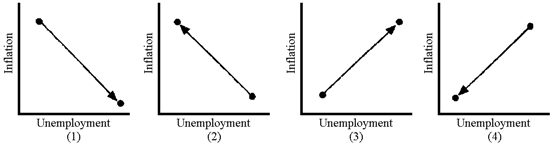 Which panel in Figure 33-4 shows what happened in 2007-2009?
 (Multiple Choice)
4.9/5 (81)
(81) Many economists think that, in the long run, the economy tends to move toward
(Multiple Choice)
4.9/5 (68)
(68) Inflation can be caused by rapid growth of aggregate demand or by sluggish growth of aggregate supply.
(True/False)
4.8/5 (85)
(85) An economy eliminates a recessionary gap by reducing wages and prices.
(True/False)
4.9/5 (71)
(71) If the fluctuations in the economy's real growth rate from year to year are caused primarily by variations in the rate at which aggregate supply increases, then data would show
(Multiple Choice)
4.8/5 (68)
(68) Some economists argue that there is no such thing as a short-run Phillips curve. Who are these economists and what is their argument?
(Essay)
4.9/5 (87)
(87) 
Filters
- Essay(0)
- Multiple Choice(0)
- Short Answer(0)
- True False(0)
- Matching(0)